Why Do Cats Bring You Dead Animals?
The two explanations you have heard — that it is a gift, or that she is teaching you to hunt because you are hopeless at it — are folklore. Neither has been demonstrated, and the teaching version is a leap from an observation about mother cats to a claim about you. The much simpler explanation is that cats carry prey somewhere safe before dealing with it, and your house is the safest place she knows. She is not thanking you and she is not training you. She is bringing dinner home, and then usually losing interest in it, because hunting and eating are driven by two different systems in a cat. That distinction explains almost everything about this behavior. If you would also like to know how old your resident hunter is in human terms, the free cat age calculator works it out in a tap.
The Popular Explanation, and Why It Probably Is Not True
Two stories dominate, and they deserve a proper look rather than a repeat.
The gift theory says she is giving you a present. It assumes a cat understands that you would like a vole, and that she chooses to hand it over. There is no evidence cats reason about what humans want in that way.
The teaching theory says you are her incompetent kitten. It comes from a real observation: mother cats bring dead, then disabled, then live prey to their kittens as they learn. That part is well documented.
But the leap is the problem. Queens teach their own kittens during a specific developmental window. Extending that to a neutered adult cat and her owner is an interpretation, not a finding, and it is repeated so often that it now sounds like fact.
Both males and females do it. If it were maternal teaching behavior you would expect a strong female bias, and the bias is at best weak.
Cats also bring prey to empty houses. Plenty of owners find a mouse on the mat after being away all day, with nobody there to teach or gift.
The simplest explanation fits better. She caught something, she carried it to the place she feels safest, and then the drive that made her chase it had already run out.
What Cats Actually Do With Prey
Watch the sequence a few times and the behavior stops looking mysterious.
Carrying prey to cover is a wild-cat habit. A small predator eating in the open is vulnerable to a bigger one, so the instinct is to take the catch somewhere enclosed before doing anything else.
Your home is the strongest cover she has. It is her core territory, it smells of her, and nothing has ever taken food off her there.
Caching is real. Cats commonly stash a catch and return to it later, or simply abandon it. Left-behind prey is not a failed gift; it is a stored one.
The kill itself is often the end of the interest. Once the chase and catch are over, the motivation drops away sharply, which is why she can walk past the body five minutes later.
Doorways and beds are typical drop points. So are behind sofas and inside slippers, and that is about security rather than symbolism.
It is the same drive behind toy-carrying. An indoor cat who trots to you with a fabric mouse and a strange muffled yowl is running the identical program, minus the wildlife.
Hunting Is Not About Hunger
This is the mechanism that surprises people most, and it changes what you do about it.
Hunting and eating are separately motivated. A cat will break off from a full bowl to chase something moving. The chase is triggered by movement, not by an empty stomach.
Feeding her more does not stop her hunting. Well-fed cats hunt. Working farm cats fed properly still catch mice, and the classic advice to "just feed her more" does not hold up.
Which is exactly why food quality can still matter. A 2021 University of Exeter trial found that switching cats onto a food high in meat protein with no grain reduced the number of animals brought home by around a third, and that five to ten minutes of daily play with a wand toy reduced it by around a quarter. The suggestion is that something about diet composition affects the drive, though the mechanism is not settled.
Never underfeed a cat to encourage hunting, and never withhold food to make a point about it. Cats can develop a serious liver condition (hepatic lipidosis) within days of not eating properly.
The catch rate is low. Most hunting attempts fail. What arrives on your doormat is the small successful fraction of a great deal of effort.
Young adult cats hunt most. The behavior typically peaks in the first few years and drops off noticeably in older cats.
Why It Is So Often Still Alive
The live-mouse-in-the-kitchen scenario has its own explanation, and it is not cruelty.
The chase is the rewarding part. A cat's predatory sequence runs stalk, chase, pounce, catch, kill, prepare, eat — and a cat can be strongly driven by the early stages while barely engaging the later ones.
Repeated catch-and-release is practice. Small prey with teeth can injure a cat's face, so batting it about until it is exhausted is a genuinely useful tactic rather than a game.
A well-fed cat often never gets to the kill. With the hunger part of the sequence absent, she may simply stop after the catch, leaving a live and shocked animal in your hallway.
Bird injuries are frequently invisible. A bird that flies off after a cat encounter can still die later from puncture wounds and infection, which is why "it got away" is not always a good outcome.
Do not punish her for it. She has no concept that this is unwelcome, and telling her off teaches only that you are unpredictable near the cat flap.
Deal with the animal, not the cat. Practical steps are further down.
What Actually Reduces the Hunting
Some measures work well, some work a little, and some are popular but weak.
| Measure | How much it helps | Notes |
|---|---|---|
| Keeping her in at dawn and dusk | Substantial | Targets peak hunting hours, especially for mammals |
| A night-time curfew | Substantial | Cuts small-mammal catches most, and reduces road risk |
| Daily wand-toy play | Moderate | Around a quarter fewer animals brought home in trial conditions |
| High-meat, grain-free food | Moderate | Around a third fewer in the same trial; mechanism unclear |
| A brightly colored collar cover | Good for birds | Birds see color well; works far less for mammals |
| A bell on a quick-release collar | Mixed | Helps some cats, and others learn to move silently |
| Feeding her more of the same food | Little to none | Hunting is not driven by hunger |
| Punishment or scolding | None, and harmful | Creates fear without changing the behavior |
| Keeping her indoors entirely | Complete | Effective, but needs enrichment to work well for the cat |
Combine measures rather than picking one. Curfew plus play plus a collar cover does far more than any single change.
Only use a quick-release collar. Cats climb, and a collar that does not break away is a strangulation risk.
Enrichment is the price of keeping her in. An indoor cat needs the hunt replaced, not removed — ideas are in indoor cat entertainment and the sessions themselves in how much playtime a cat needs.
End play with a catch and a meal. Letting her actually win the toy, then feeding her, completes the sequence and settles her far better than stopping mid-chase.
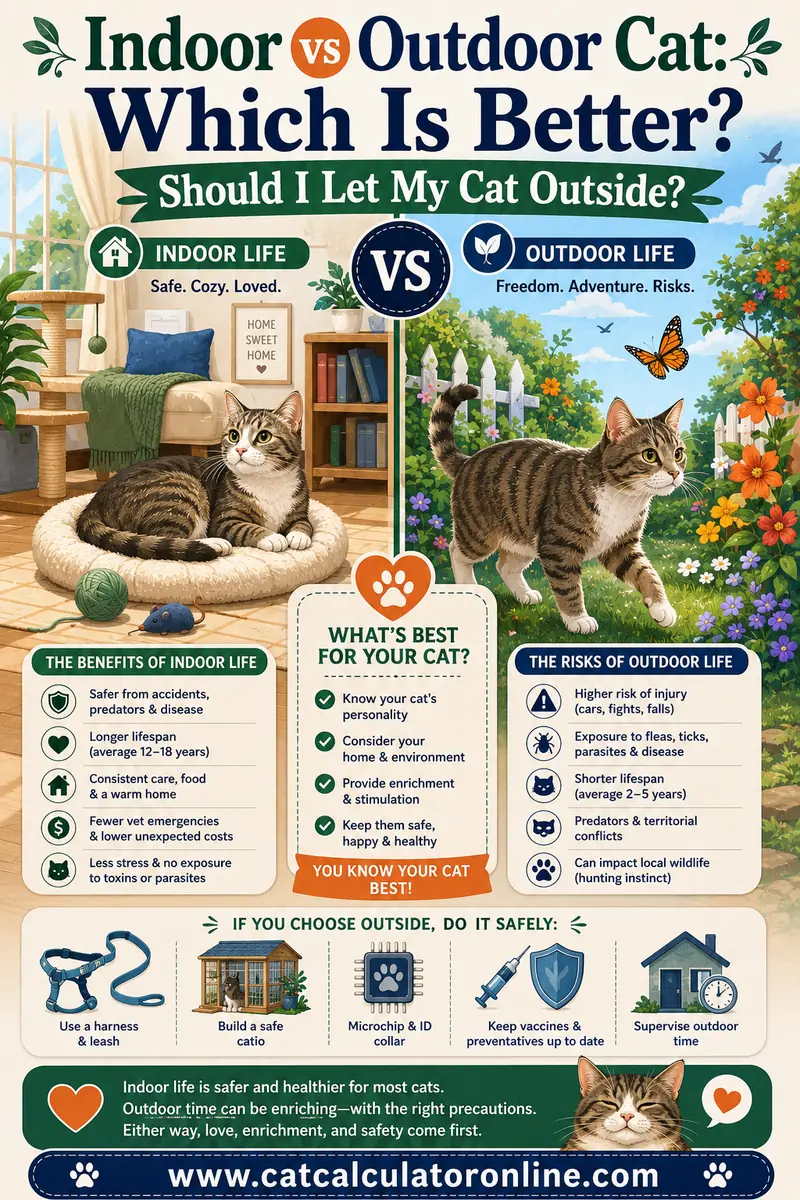
The indoor-outdoor decision is bigger than hunting alone. Both sides are set out in indoor versus outdoor cats.
What To Do When She Brings One In
A calm, quick routine makes this much less unpleasant for everyone.
Say nothing to the cat. No praise, no telling off. Any strong reaction is attention, and attention makes a behavior more likely.
Shut her out of the room first. Trying to rescue a live mouse with a cat present rarely ends well.
For live prey, make an exit. Open a door or window, dim the lights, and leave the room for ten minutes. Many animals leave on their own.
Use a box and card if it will not move. Place a container over it, slide card underneath, and release it in cover well away from the house — not in the open.
Wear gloves for anything dead. Double-bag it and put it in the outside bin. Wash your hands thoroughly regardless.
Call a wildlife rescue for an injured animal, especially a bird. Cat saliva causes infections that need antibiotics quickly, so an apparently fine bird still needs assessment.
If you are pregnant, hand the disposal to someone else. The toxoplasmosis risk is low but real, and it comes mainly from feces and soil rather than from the animal itself.
Cats That Never Bring Anything Home
If your cat has never presented you with so much as a beetle, nothing is wrong with her.
Hunting is largely learned. Kittens acquire the skill from watching their mother between about six and twenty weeks. A kitten raised without that exposure often never develops it.
Hand-reared and early-orphaned cats frequently do not hunt. They have the drive but not the technique.
Indoor cats have nothing to catch. The drive shows up as ambushing your ankles, chasing toys, and the sudden late-evening sprints described in cat zoomies.
Age flattens it. Older cats with stiff joints or poorer eyesight simply stop succeeding.
Some are just poor hunters, and plump, comfortable, well-fed cats often fall in that group.
Breed is not a reliable predictor. Individual temperament and what she learned as a kitten matter far more than her breed.
When Prey-Bringing Becomes a Health Question
Hunting has genuine medical consequences, and they are easy to stay on top of.
Worms are the main one. Cats that hunt regularly need worming considerably more often than indoor cats — commonly every one to three months rather than twice a year. The schedule is in cat worming.
Fleas travel on prey. Regular flea prevention matters more for a hunting cat, and untreated infestations cause tapeworm too.
Rodenticide is the serious risk. A cat that eats a poisoned rodent can be poisoned in turn. If you know or suspect neighbors use rodent bait, treat any bleeding, weakness or pale gums as an emergency and call your vet immediately.
Bite and scratch injuries turn into abscesses. A hot, painful swelling a few days after a hunting scuffle usually needs antibiotics.
Vomiting after eating prey is common but not automatic. Fur, feathers and bone come back up. Repeated vomiting, or vomiting with lethargy, is a vet visit.
Call your vet the same day if she is off her food, hiding, weak, breathing oddly or has an obvious wound. The broader warning list is in signs your cat is sick.
Frequently Asked Questions
Why does my cat bring me dead mice?
Most likely because she carries prey to the safest place she knows before dealing with it, and that place is your house. The popular explanations — that it is a gift, or that she is teaching you to hunt — are unproven folklore, extended from how mother cats train their own kittens.
Is my cat trying to teach me to hunt?
There is no evidence for it. Queens genuinely do bring prey to kittens during a specific developmental window, but applying that to adult neutered cats and their owners is an interpretation rather than a finding. Both male and female cats bring prey home at similar rates.
Will feeding my cat more stop her hunting?
No. Hunting is triggered by movement rather than hunger, and well-fed cats hunt readily. Never reduce her food either. Trial evidence suggests a high-meat, grain-free diet and daily wand play each reduce prey brought home, but simply increasing portions of the same food does not.
Should I tell my cat off for bringing prey home?
No. She has no way of connecting your reaction to the behavior, and punishment produces fear rather than learning. Any strong response, positive or negative, counts as attention. Remove the animal quietly and change the conditions instead, with a curfew, play and a bright collar cover.
Do bells on collars stop cats hunting?
Results are mixed. Some cats catch noticeably less with a bell, and others learn to move without ringing it. Brightly colored collar covers work considerably better for birds, which have excellent color vision, though they do little for mice and voles. Always use a quick-release collar.
Is it dangerous if my cat eats a mouse?
Usually not, but it carries real risks: worms, fleas, tapeworm and, most seriously, secondary poisoning if the rodent has eaten bait. Keep worming and flea treatment current for a hunting cat, and call your vet immediately if she becomes weak, bleeds or has pale gums.
The honest answer to this one is less charming than the version you usually hear, and more useful. Your cat almost certainly is not giving you a present or running a hunting course for a slow pupil. She is doing what small predators do: taking a catch to the safest cover available, which happens to be your kitchen floor, and then losing interest because the chase and the meal are driven by different things entirely. That is also why feeding her more changes nothing, and why a dawn and dusk curfew, real daily play with a wand toy, a bright collar cover and a high-meat food are the measures that actually shift the numbers. Keep her worming up to date, deal with the casualties calmly, and check how old your hunter is in human years with the free cat age calculator.