How Much Dry Food to Feed a Cat
A typical adult cat needs roughly 50 to 65 grams of dry food a day — considerably less than most people pour. Dry food is calorie-dense, usually around 350 to 400 kcal per 100 g, so a cat's entire daily requirement of 200 to 250 calories fits into a portion that looks almost insultingly small in a bowl. The single most useful change most owners can make is to weigh the food rather than scoop it: a heaped cup and a level cup can differ by 40%, which on a cat's daily intake is the difference between holding weight and gaining steadily. This page covers portions, the water issue, and how to adjust. Get a starting figure from the cat food calculator.
Dry Food Portion Guide
Assuming dry food only, at roughly 380 kcal per 100 g.
| Cat weight | Daily calories | Dry food per day | Per meal (×2) |
|---|---|---|---|
| 3 kg | ~165 kcal | ~43 g | ~22 g |
| 4 kg | ~200 kcal | ~53 g | ~26 g |
| 5 kg | ~240 kcal | ~63 g | ~31 g |
| 6 kg | ~275 kcal | ~72 g | ~36 g |
| 7 kg | ~310 kcal | ~82 g | ~41 g |
Those portions look small, and they are correct. Around 55 g is roughly a third of a standard measuring cup. Most owners pour considerably more than this, which is the main reason dry-fed cats are more likely to be overweight.
Adjust for lifestyle. Active or outdoor cats may need 10–20% more; very sedentary indoor cats often need slightly less than the table suggests.
And check your own bag's calorie figure, because dry foods range from around 320 to over 420 kcal per 100 g. A cat switched from a 340 kcal food to a 420 kcal one without changing the portion is being fed nearly 25% more.
Weigh It, Don't Scoop It
The single most valuable habit in dry feeding.
Scoops are wildly inconsistent. A level cup and a heaped cup of the same kibble can differ by 40%. Kibble size and shape change the density too, so the same cup holds different amounts of different foods.
On a cat that difference is enormous. A cat needing 55 g a day, given 75 g because the scoop was generous, is eating over a third more than it needs — every day, indefinitely.
Digital kitchen scales cost very little and remove the problem completely. Weigh the day's total in the morning, split it into meals, and you are done.
If you must use a scoop, weigh what your scoop actually holds once, mark the level with a pen, and always fill to that mark.
The portion will look wrong at first. A correctly weighed portion of dry food looks meagre in a large bowl, and many owners add "just a bit more" on instinct. Use a small bowl and the portion looks right.
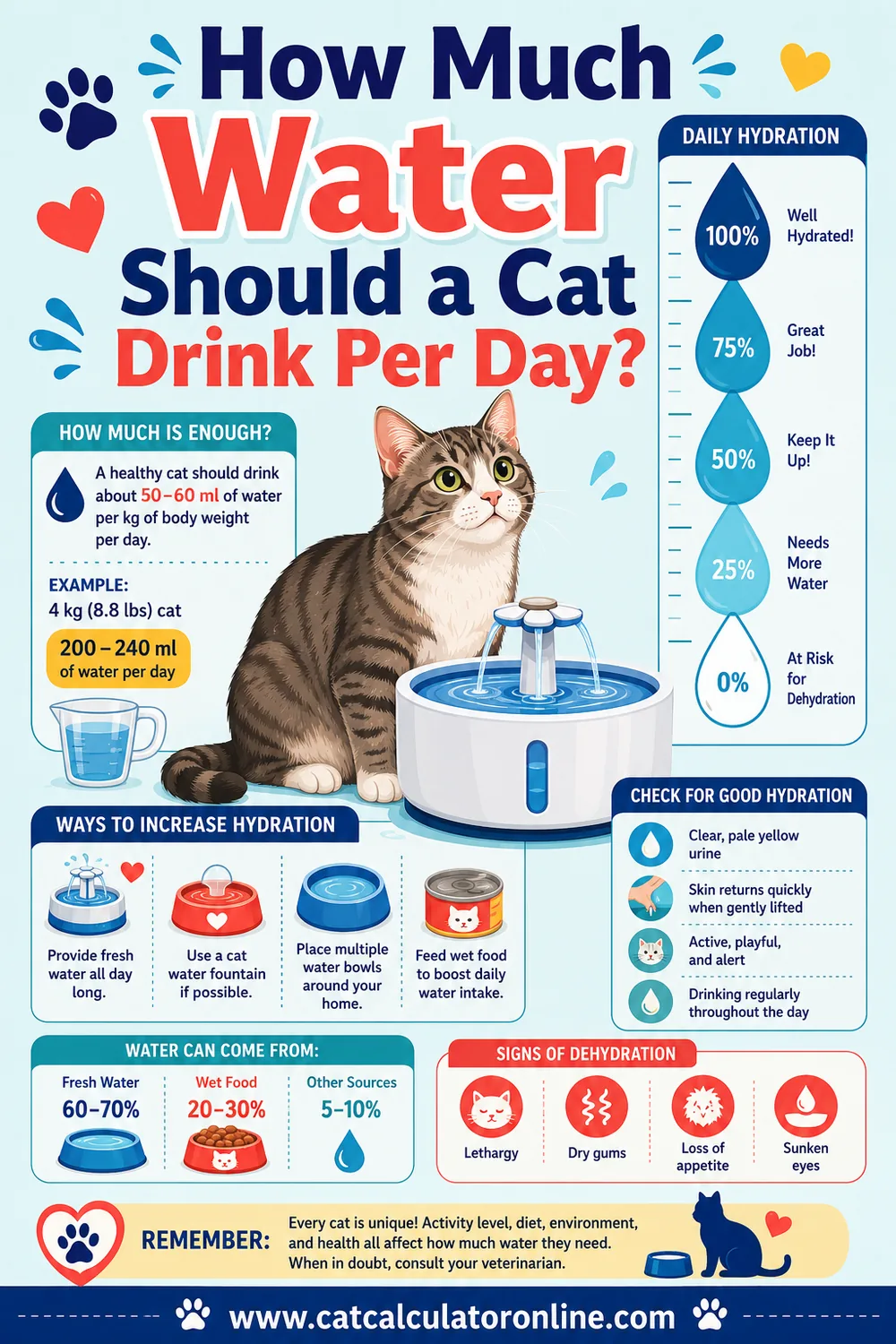
Water Is the Real Issue With Dry Food
The part that matters more than the portion.
Dry food contains under 10% water; wet food is around 75–80%. A cat eating only dry food takes in a fraction of the fluid a wet-fed cat does from its meals.
Cats have a weak thirst drive. They descend from desert-dwelling ancestors and evolved to get most of their water from prey. They do not reliably drink enough to fully compensate for a dry diet, which means a dry-fed cat often runs at lower total fluid intake than a wet-fed one.
Why this matters. Lower fluid intake means more concentrated urine, which is associated with urinary tract problems — a particular concern in male cats, where a blockage is a genuine emergency — and it puts more demand on kidneys that are already the most common site of trouble in older cats.
So if you feed dry, make water easy:
- Several bowls in different rooms, away from food and from the litter tray
- Wide, shallow bowls, since many cats dislike their whiskers touching the sides
- Ceramic or glass rather than plastic, which can hold odors
- A pet water fountain, which many cats prefer because moving water is more attractive to them
- Fresh water daily, not topped up
And watch for changes. A cat that suddenly starts drinking much more than usual has changed for a reason — the detail is in how much water should a cat drink.
Free Feeding vs Measured Meals
The other decision that determines whether dry feeding works.
Free feeding — a full bowl left down all day — is the single most common route into feline obesity. It works only for cats that self-regulate, and a substantial proportion of cats do not.
Its one genuine advantage is convenience, plus suitability for kittens and for very underweight cats that need constant access.
Measured meals give you control over exactly how much goes in, which is the whole basis of managing weight.
A middle option: weigh the day's total in the morning and put it out in two or three portions, so the cat still has food available at intervals but the daily total is fixed. This is often the practical compromise in a busy household.
Puzzle feeders are worth considering for dry food specifically. They slow eating, provide mental stimulation and make a small portion last longer, which addresses the "my cat is always hungry" problem better than more food does.
The full comparison is in free feeding vs scheduled feeding for cats.
Adjusting the Portion
Same method as any feeding plan, and it is the part that makes the chart accurate for your cat.
Weigh the cat monthly, on the same scales, and write it down. A box on kitchen scales, zeroed first, works well for a cat.
Steady weight means the portion is right.
Gaining? Reduce by about 10% and re-check in a month.
Losing unintentionally? Increase by 10% — and if it continues, that is a vet conversation. Unexplained weight loss is a key early illness signal in cats.
Feel as well as weigh. Ribs easy to find under a thin covering, a waist visible from above, a belly that tucks up from the side. More in is my cat overweight.
And never reduce sharply. Rapid weight loss in cats can trigger hepatic lipidosis, a serious liver condition. Any deliberate weight-loss plan should be gradual and vet-supervised.
Does Dry Food Clean a Cat's Teeth?
Worth addressing, because it is the most repeated claim about dry food and it is largely overstated.
Standard kibble does very little for dental health. Most cats crush a piece of kibble once or swallow it whole, so there is minimal scraping action against the tooth surface. The idea that dry food cleans teeth the way a brush does is not well supported.
Specific dental diets are different. Some prescription and dental-specific kibbles use larger, fibrous pieces designed to be chewed through rather than crushed, and there is better evidence for those. They are a distinct product from ordinary dry food.
What actually helps: tooth brushing, veterinary dental checks, and professional cleaning when needed. Dental disease is extremely common in cats and largely invisible until it is advanced.
Do not choose dry over wet for dental reasons alone. If dental health is the concern, the answer is a dental-specific product or an actual dental routine, discussed with your vet.
Kittens, Seniors and Special Cases
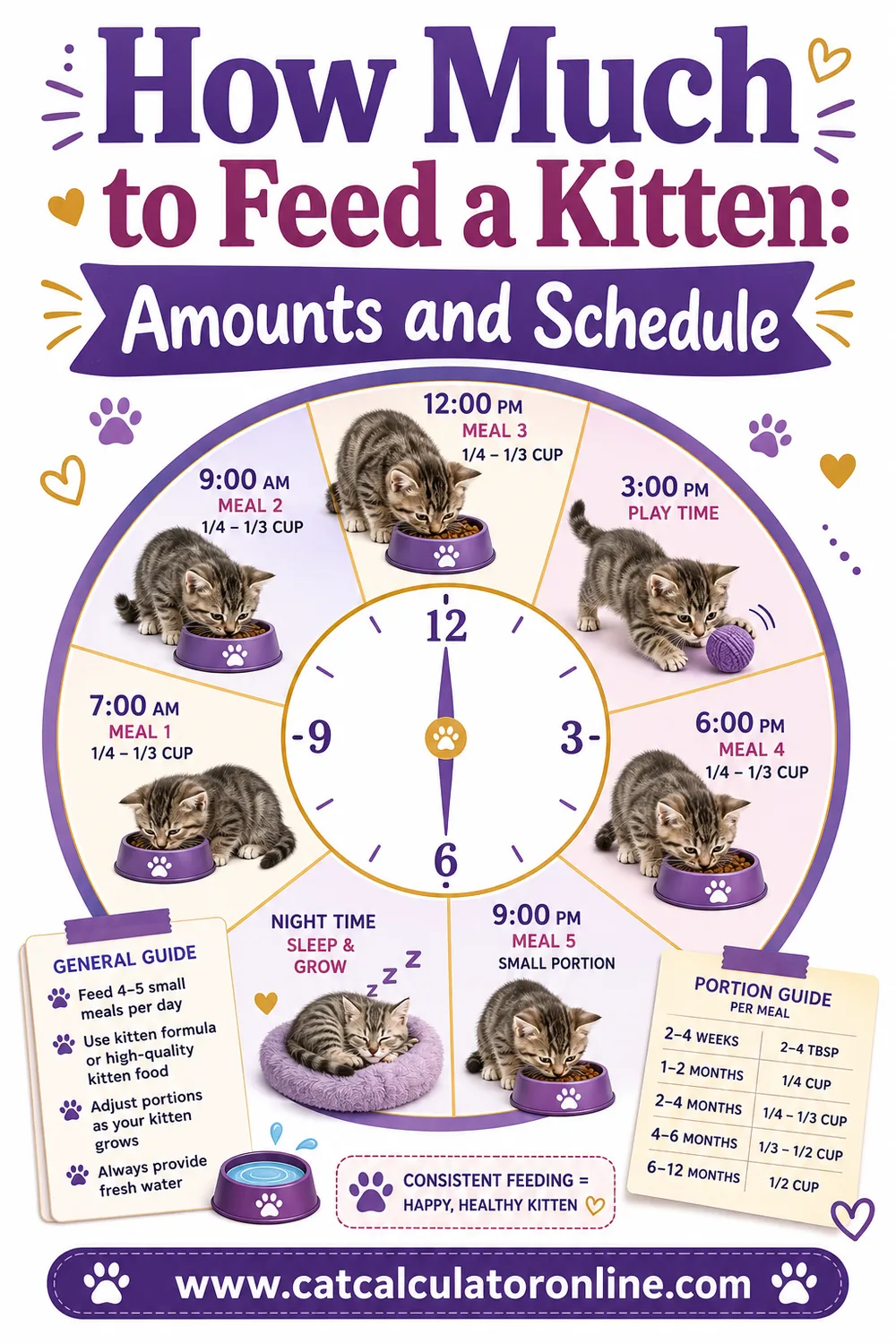
Kittens need substantially more per kilogram and should be fed kitten-specific food, which is more calorie- and nutrient-dense. Free access to food is more appropriate for young kittens than for adults. Portions are in how much to feed a kitten.
Older cats often need more rather than less, because absorption becomes less efficient with age. Many senior cats also find dry food harder to eat as dental problems develop, which is a common and easily missed reason for reduced appetite.
Overweight cats need a vet-set target weight and deliberately gradual loss.
Cats with kidney or urinary problems are frequently moved onto wet food specifically for the fluid content, and prescription diets should be fed to instruction rather than to a general chart.
And any cat that stops eating for more than a day or two needs veterinary attention — cats tolerate fasting badly and are at real risk of hepatic lipidosis.
Storing Dry Food Properly
Rarely discussed, and it affects both palatability and whether the cat eats the portion at all.
Fat in kibble goes rancid on contact with air. The coating that makes dry food palatable is the first thing to degrade, which is why cats often go off the last third of a bag. That is usually the food changing rather than the cat becoming fussy.
Keep the food in its original bag, and put the bag inside an airtight container rather than tipping the kibble in loose. The bag has a barrier liner the container does not, and it carries the batch code and best-before date you would need if there were ever a recall.
Roll the bag down and clip it after every use to push the air out.
Store somewhere cool and dark. Heat accelerates the fat going off, so not next to a radiator, a boiler or a sunny window.
Buy a bag size you will finish in about a month. Large bags are cheaper per kilogram and a poor deal if the last quarter gets refused or thrown away — for a single cat eating 55 g a day, a 2 kg bag lasts around five weeks.
Wash the container between bags rather than topping up on top of old residue, which is where the stale fat accumulates.
And if a cat suddenly refuses a food it has always eaten, check the bag's age and smell it before concluding the cat has become difficult.
Common Dry Feeding Mistakes
Scooping instead of weighing. The biggest single source of overfeeding.
Not checking kcal per 100 g when switching food. Brands vary by 25% or more.
Free feeding a cat that does not self-regulate.
Topping the bowl up rather than measuring a fixed daily total.
Adding treats on top instead of taking them out of the daily allowance.
Assuming dry food cleans teeth and skipping actual dental care.
Not making water easy. This matters far more on a dry diet than a wet one.
Using a large bowl, which makes a correct portion look inadequate.
Reducing sharply to cut weight. Gradual only, and vet-supervised.
Never weighing the cat. Without that number, portioning is guesswork — the reference figures are in how much should I feed my cat.
Frequently Asked Questions
How much dry food should I feed my cat per day?
Most adult cats need around 50 to 65 grams a day, depending on weight and activity. Check the calorie figure on your bag, since dry foods range from about 320 to over 420 kcal per 100 g.
Is 100g of dry food too much for a cat?
For most adult cats, yes — 100 g of typical dry food is around 380 calories, well above the 200 to 250 calories an average cat needs. That portion would suit a very large or highly active cat, not a typical indoor one.
Should I weigh my cat's dry food?
Yes. A heaped scoop and a level scoop can differ by 40%, which on a cat's daily intake is the difference between maintaining weight and gaining steadily. Digital kitchen scales solve it entirely.
Does dry food clean a cat's teeth?
Standard kibble does very little, because most cats crush or swallow it without meaningful scraping. Specific dental diets with larger fibrous pieces are different, but ordinary dry food is not a substitute for dental care.
Do cats on dry food need more water?
Yes. Dry food is under 10% water compared with around 75–80% in wet food, and cats have a weak thirst drive. Provide several wide, shallow bowls away from food and litter, and consider a fountain.
Is it better to feed wet or dry food?
Both can be complete and balanced. Wet food delivers far more water, which suits cats prone to urinary problems and older cats; dry is cheaper, more convenient and easier to portion precisely. Many owners feed both.
Dry food portions are smaller than instinct suggests — around 50 to 65 grams a day for a typical adult cat, because the food is calorie-dense. Weigh it rather than scooping it, check the calories per 100 g whenever you change brand, split it into measured meals rather than leaving a bowl down, and make water genuinely easy to reach since a dry diet supplies almost none. Then adjust by 10% based on monthly weighing. Get your cat's starting portion from the free cat food calculator.