How Long Can a Cat Go Without Water?
Less time than without food. A cat that has drunk nothing for 24 hours needs veterinary attention, and serious dehydration can develop within two to three days. Water is the more urgent of the two, which is why a cat that has both stopped eating and stopped drinking is a more pressing problem than one that has only gone off its food. The complicating factor is that cats are difficult to monitor: they have a weak thirst drive, they often drink from places you cannot see, and a cat eating wet food gets most of its water from meals rather than from the bowl. This page covers the timeline, how to check for dehydration at home, and how to get a reluctant cat drinking more. Portion and moisture figures are in the cat food calculator.
The Timeline
| Time without water | Risk | What to do |
|---|---|---|
| A few hours | None | Normal, especially on wet food |
| 12–24 hours | Rising | Check the bowl is accessible; watch closely |
| 24 hours, none at all | Real | Phone the vet |
| 24–48 hours | Serious | Veterinary appointment |
| 2–3 days | Severe | Urgent — organ damage becomes likely |
| Any of the above + vomiting or diarrhea | Serious | Same day — fluid loss accelerates it |
| Kitten, over 12 hours | Serious | Same day |
Water is more urgent than food. A cat can survive longer without eating than without drinking, and dehydration causes damage sooner. The food equivalent is in how long can a cat go without food.
Vomiting and diarrhea shorten every interval above, because the cat is losing fluid as well as not taking it in.
And in hot weather everything moves faster.
How to Check for Dehydration at Home
Three checks, none of which need equipment.
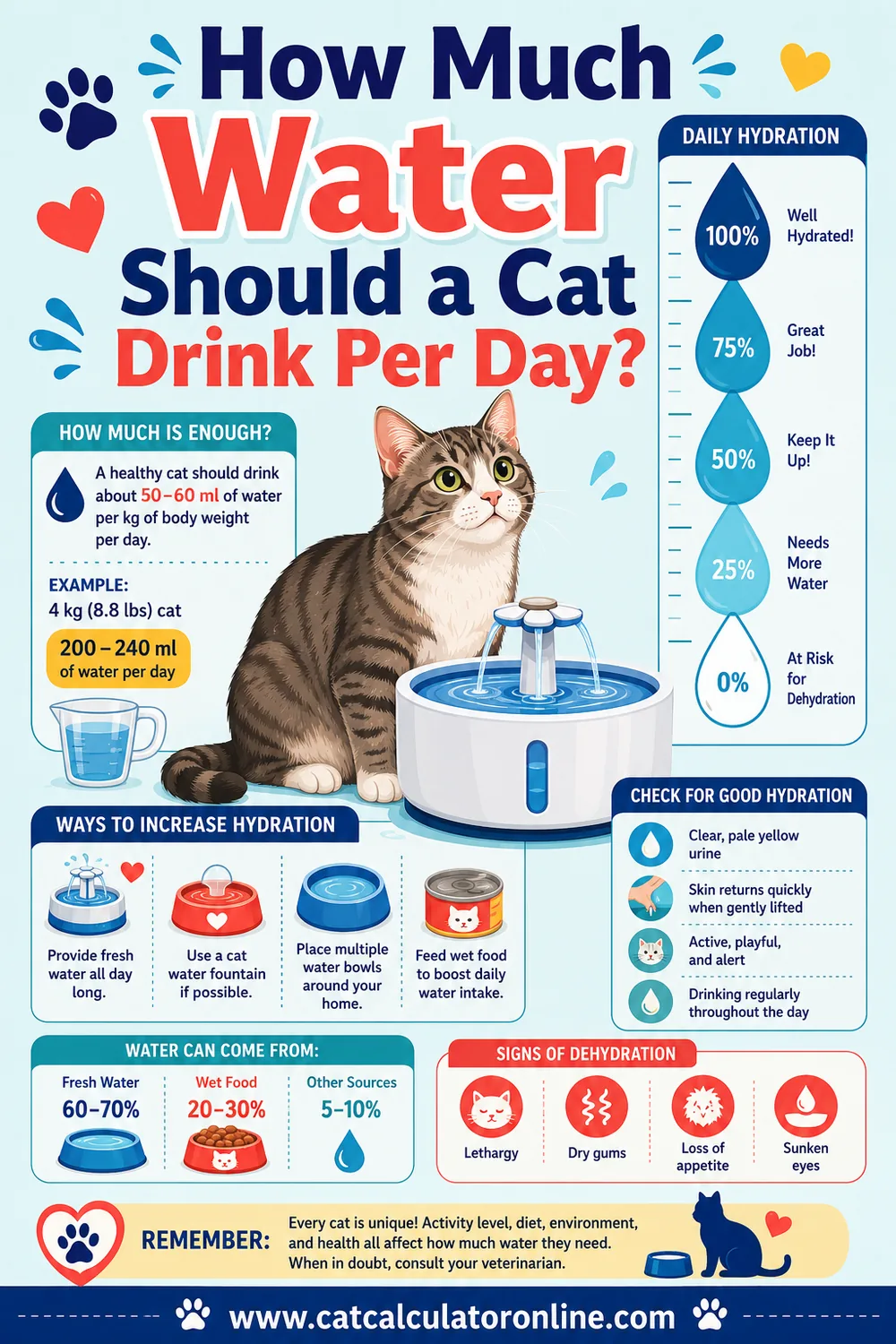
The skin tent test. Gently lift the loose skin over the shoulders and let go. In a well-hydrated cat it springs straight back. If it falls back slowly, or stays tented, the cat is dehydrated. Note that older cats have less elastic skin, so this test over-reads slightly in seniors.
The gums. Press a finger against the gum and lift it away. The pale spot should refill with color within about two seconds. Gums that are dry or tacky rather than moist and slippery also suggest dehydration.
Eyes. Sunken or dull eyes suggest significant dehydration and mean the cat needs to be seen now rather than watched.
Alongside those, watch for lethargy, weakness, reduced appetite, a cat that is not urinating, or urine that is unusually dark and concentrated.
None of these are precise. They tell you whether to worry, not how bad it is. If two or more are abnormal, that is a vet visit rather than a home fix — dehydration in cats is treated with fluids, which is straightforward and effective when done early.
Why Cats Do Not Drink Much
The physiology behind the whole problem.
Cats evolved from desert-dwelling ancestors and are adapted to obtain most of their water from prey, which is roughly 70% water.
Their thirst drive is correspondingly weak. A cat does not reliably feel thirsty enough to compensate for a dry diet the way a dog would.
Which means a dry-fed cat frequently runs at lower total fluid intake than a wet-fed one, even with water freely available.
The consequences are not immediate but they are real: more concentrated urine, which is associated with urinary tract problems, and more demand on kidneys that are already the commonest site of trouble in older cats.
And it means a cat's water bowl usage is a poor guide to its hydration. A cat eating four pouches of wet food a day is taking in a substantial amount of water at mealtimes and may barely touch the bowl. That is normal, not a warning sign.
So judge hydration by the cat, not by the bowl — the checks above rather than how much has gone.
Wet Food Versus Dry Food
The single biggest factor in a cat's total water intake.
Wet food is roughly 75–80% water. Dry food is under 10%.
Which means a cat on wet food gets most of its daily requirement from meals without ever choosing to drink, while a dry-fed cat has to actively drink to make up a much larger shortfall.
This is the main clinical argument for wet food, and it is a genuine one — particularly for male cats, cats with any urinary history, and older cats with reducing kidney function.
It does not mean dry food is unsafe. It means a dry-fed cat needs water made genuinely easy, and it means you cannot assume the cat is compensating.
A practical middle ground is combination feeding — some wet, some dry — which gets meaningful water into the cat alongside the convenience and cost of kibble. The portion arithmetic is in how much wet food to feed a cat and how much dry food to feed a cat.
And adding a splash of water to wet food increases intake further at no cost, which many cats accept without objection.
How to Get a Cat Drinking More
Cats are particular about water, and small changes make a disproportionate difference.
Several bowls, in different rooms. Cats will not cross a house for water, and a single bowl in the kitchen is often simply too far.
Away from food, and well away from the litter tray. Cats instinctively avoid drinking next to where they eat or toilet.
Wide, shallow bowls. Many cats dislike their whiskers touching the sides of a deep, narrow bowl, and will drink less from one.
Ceramic or glass rather than plastic, which holds odors and can taint the water.
Fresh water daily, changed rather than topped up.
Filled to the brim, which lets a cat drink without putting its head into the bowl — most cats prefer this.
A pet fountain. Many cats strongly prefer moving water, and a fountain is often the single most effective change. Clean it regularly, as they build up film quickly.
Away from noisy appliances, since a bowl beside a washing machine gets avoided.
And do not be surprised by odd preferences — taps, shower trays, watering cans, glasses of water. A cat that drinks from unusual places is telling you something about its bowl. The wider picture is in how much water should a cat drink.
Drinking More Is Also a Warning Sign
The opposite problem, and arguably the more important one to notice.
A cat that suddenly starts drinking noticeably more — emptying the bowl, seeking taps, standing at the sink — has changed for a reason.
The three common causes are chronic kidney disease, hyperthyroidism and diabetes. All three become more likely with age, all three are common, and all three are considerably more manageable when found early.
Increased thirst is frequently the very first sign, appearing before weight loss or any change in behavior. It is one of the most useful observations an owner ever makes, and it is very often dismissed as the cat simply liking the tap.
How to notice it properly. Use the same bowl in the same place and note roughly how often you refill it. A rough baseline is enough — "much more than she used to" is a perfectly good reason to book an appointment.
In a cat over about ten, increased drinking should prompt a vet visit rather than a bigger bowl. The senior checks are in senior cat health checklist.
When It Is an Emergency
Two situations that override everything else on this page.
A male cat straining in the litter tray and producing little or nothing is a potential urinary blockage. This is a genuine, life-threatening emergency and needs veterinary attention immediately, not in the morning. Signs include repeated trips to the tray, straining, crying out, licking at the genitals, and a hard abdomen.
A cat that is not urinating at all, for the same reason.
Also same-day: collapse, obvious weakness, sunken eyes, gums that are dry or slow to refill, or dehydration alongside repeated vomiting.
And any cat that has stopped both eating and drinking, which combines both risks and needs seeing rather than monitoring.
Do not attempt to rehydrate a seriously dehydrated cat at home. Syringing water into a reluctant cat risks aspiration and does not correct meaningful dehydration. Fluids given by a vet, under the skin or intravenously, correct it quickly and safely — and it is a routine, inexpensive treatment when done early.
Multi-Cat Homes and Hidden Water Problems
Several situations where a cat is drinking less than you think, and none of them are obvious.
One bowl for several cats is not enough. Cats are territorial about resources, and a more confident cat can block a timid one from the bowl without any visible aggression — simply by being nearby. The usual guidance is one water station per cat plus one, spread around the house.
Water next to food is avoided by many cats, and in a multi-cat home the food area is also where tension concentrates.
A bowl in a corridor or a corner puts a cat in a position where it cannot see what is behind it while drinking, which some cats will not do.
Automatic waterers and fountains need cleaning, and a fountain that has developed a film or a smell gets used far less. Cats notice this well before people do.
Outdoor cats drink from puddles, ponds and neighbors' bowls, so a full bowl at home means very little about their intake either way.
And in cold weather, outdoor water sources freeze — a cat reliant on them can be genuinely short of water while its indoor bowl looks untouched.
The practical fix is the same in every case: more water stations, spread out, away from food and litter, in wide shallow bowls, refreshed daily. It costs nothing and it removes most of the hidden problems at once.
Frequently Asked Questions
How long can a cat survive without water?
A cat that has drunk nothing for 24 hours needs veterinary attention, and serious dehydration can develop within two to three days. Water is more urgent than food, and vomiting or diarrhea shortens the timeline further.
How can I tell if my cat is dehydrated?
Lift the skin over the shoulders — it should spring straight back rather than falling slowly. Check that the gums are moist rather than tacky. Sunken eyes, lethargy and dark concentrated urine are further signs.
My cat never drinks from its bowl — is that normal?
It can be, if the cat eats wet food, which is 75–80% water and supplies most of its needs at mealtimes. A cat on dry food that never drinks is a different matter and worth investigating.
How do I get my cat to drink more water?
Several wide, shallow bowls in different rooms, away from food and the litter tray, filled to the brim, in ceramic or glass, changed daily. Many cats strongly prefer a fountain, which is often the most effective single change.
Why has my cat suddenly started drinking a lot more?
Increased thirst is the classic early sign of kidney disease, hyperthyroidism or diabetes, all of which are common in older cats. It warrants a vet visit rather than simply providing more water.
When is not drinking an emergency?
If a male cat is straining in the litter tray and producing little or nothing, that is a possible urinary blockage and a life-threatening emergency needing immediate attention. Collapse, sunken eyes or dehydration with repeated vomiting are also same-day.
Cats can go less time without water than without food — 24 hours with nothing warrants a call, and serious dehydration can develop inside two to three days. Judge hydration by the cat rather than the bowl, since a wet-fed cat gets most of its water from meals; use the skin tent and gum checks instead. Make drinking easy with several wide, shallow bowls away from food and litter, and treat a sudden increase in drinking as a signal worth acting on. If you are weighing up wet against dry, the moisture and portion figures are in the free cat food calculator.