How to Move House With a Cat (Without Losing Your Mind — or Your Cat)
The safe way to move house with a cat comes down to three things: keep her secured in one room on moving day (escapes spike when doors are propped open), set up a single "safe room" at the new home before she arrives, and keep any outdoor cat strictly indoors for at least two to four weeks at the new address. Cats bond to territory as much as to people, which is why moving ranks among the most stressful events in a cat's life — but a staged plan turns chaos into a manageable transition.
This guide walks the whole timeline, from the weeks before to the first month after. One quick companion tip: stress hits older cats harder, so knowing your cat's life stage helps you calibrate how gently to take things — our free cat age calculator tells you in seconds.

📦 Where are you in the move?
Tap your current phase for the one thing that matters most right now:
Tap a phase above for the key move.
Why Is Moving So Stressful for Cats?
Dogs bond mostly to their people. Cats bond to their people and, deeply, to their territory. Your cat has spent months or years building a detailed mental and scent map of your home — every rubbed doorframe and scratched post is marked as hers, and that map is her security system.
Moving deletes the map overnight. She wakes up somewhere that looks wrong, smells wrong, and sounds wrong, with none of her scent anywhere. That's why a confident, sociable cat can spend her first week at a new house flattened under a bed: it's not drama, it's a territorial animal with no territory.
Understanding this reframes the whole job. You're not just transporting a cat from address A to address B — you're helping her rebuild her map as quickly and calmly as possible. Every step below serves that goal.
What Should I Do in the Weeks Before the Move?
The pre-move period is about two things: protecting her routine and defusing the carrier.
- Keep routines steady. Feed at the same times, play at the same times, keep her sleeping spots untouched. Cats take enormous reassurance from predictability, and the boxes appearing everywhere are already telling her something's up.
- Get the carrier out now — not on moving day. Leave it open in a corner with soft bedding inside and toss treats in every day or two. A carrier that's been furniture for three weeks is dramatically easier to load on the big day. (This also pays off at every future vet visit.)
- Pack gradually, and pack her favorite room last. A slow trickle of boxes is less alarming than a weekend blitz, and keeping her core room intact until the end preserves one island of normal. Bonus: most cats find the boxes themselves delightful.
- Update paperwork early. Line up a vet near the new address if you're changing areas, and ask your current clinic for records. If your move involves flights or a long drive, read our how to travel with a cat guide — long-distance transport has its own checklist.
- Consider a pheromone diffuser. A feline calming diffuser plugged in at the old home during packing week, then at the new home, takes the edge off for many cats. It's a supporting act, not a headline fix.
If your cat is elderly, anxious, or has health conditions, mention the move to your vet in advance. They may have specific advice for her situation.
How Do I Keep My Cat Safe on Moving Day?
Moving day is the single riskiest day of the entire process. Doors get propped open for hours, strangers tromp through every room, and a panicked cat plus an open front door is how cats get lost. One decision prevents nearly all of it: your cat spends the day locked in one room, or out of the house entirely.
Option 1: The sealed room. Before the movers arrive, empty one room completely — a bathroom or small bedroom works. Put in her litter box, water, food, carrier (open, with bedding), and something that smells like you. Close the door and tape a big sign on it: "CAT INSIDE — DO NOT OPEN." Tell every mover directly, too; signs get missed. She stays there until the house is empty and it's time to load her into the carrier and go.
Option 2: Board her for the day. A cattery, a trusted friend's spare room, or a day at the vet's boarding facility removes all risk. This is often the kindest choice for nervous cats — the noise of a house being emptied is genuinely frightening even from behind a closed door.
Either way, feed her only a light meal a few hours before travel — a full stomach and a car ride are a bad pairing.
Do not let her roam the house "because she'll be fine." The number of cats lost on moving day from precisely that reasoning is the reason every guide, including this one, leads with the sealed room.
How Do I Transport My Cat to the New Home?
Simple rules, no exceptions:
- She travels in her carrier, full stop. A loose cat in a car is dangerous for her and for the driver — a panicked cat under the pedals is an accident waiting to happen.
- Secure the carrier on the floor behind a seat or belted onto the back seat, level and stable. Drape a light towel over it; darkness settles most cats.
- Keep the car calm. Moderate temperature, no loud music, no opening the carrier to comfort her mid-journey — a scared cat can bolt out of a cracked door at a fuel stop faster than you can react.
- For long moves, plan water breaks with the carrier closed inside the closed car, and never leave her in a hot vehicle. Our traveling with a cat guide covers multi-hour and multi-day journeys properly.
Crying in the car is normal and usually settles. It sounds heartbreaking; it isn't an emergency.
How Do I Set Up the New Home? (The Safe-Room Method)
Don't release your cat into a whole strange house. To a territorial animal, an entire unfamiliar building is overwhelming — she can't map it all at once, so she'll bolt for the nearest gap and stay there. Instead, shrink the problem: one room, set up before she comes out of the carrier.
Choose a quiet room and equip it with:
- Her litter box — with familiar litter, in a corner she can see the door from. (Moving is a bad week to switch litter brands. If you're also adjusting your box setup for the new home, our how many litter boxes per cat guide has the formula.)
- Water and food — placed well away from the litter box.
- Unwashed bedding and familiar items — her blanket, your worn t-shirt, her scratching post. Scent is the whole game; these items are the first pins in her new map. Resist the urge to wash everything for the fresh start.
- Her carrier and hiding options — the carrier stays, door open, plus a box or a gap behind furniture. Hiding is coping, not a problem to fix.
- A pheromone diffuser, if you're using one.
Bring her in, set the carrier down, open the door — and let her come out when she's ready. That might be minutes; it might be hours. Sit quietly, read, talk softly, let her drive. She may explore, or she may go straight under the bed until 3 a.m. Both are normal.
Keep her in this room for at least a few days — some cats need a week or more. She's ready to see more of the house when she's eating normally, using the box, and greeting you with relaxed body language in the safe room.
When Can She Explore the Rest of the House?
Gradually, and on her schedule. Open the safe-room door and let her expand her range one area at a time, always with a clear path back to base. Don't carry her from room to room to "show her around" — being deposited in unmapped territory is stressful, and walking it herself is how she builds the map.
You'll see the classic surveying routine: slow perimeter walks, sniffing at cat height, cheek-rubbing furniture and doorframes. That rubbing is her marking the house as hers — every rubbed corner is a claimed corner. Most cats have the run of a new home within a week or two; timid cats can take a month. Keep meals and the litter box in predictable spots while she settles.
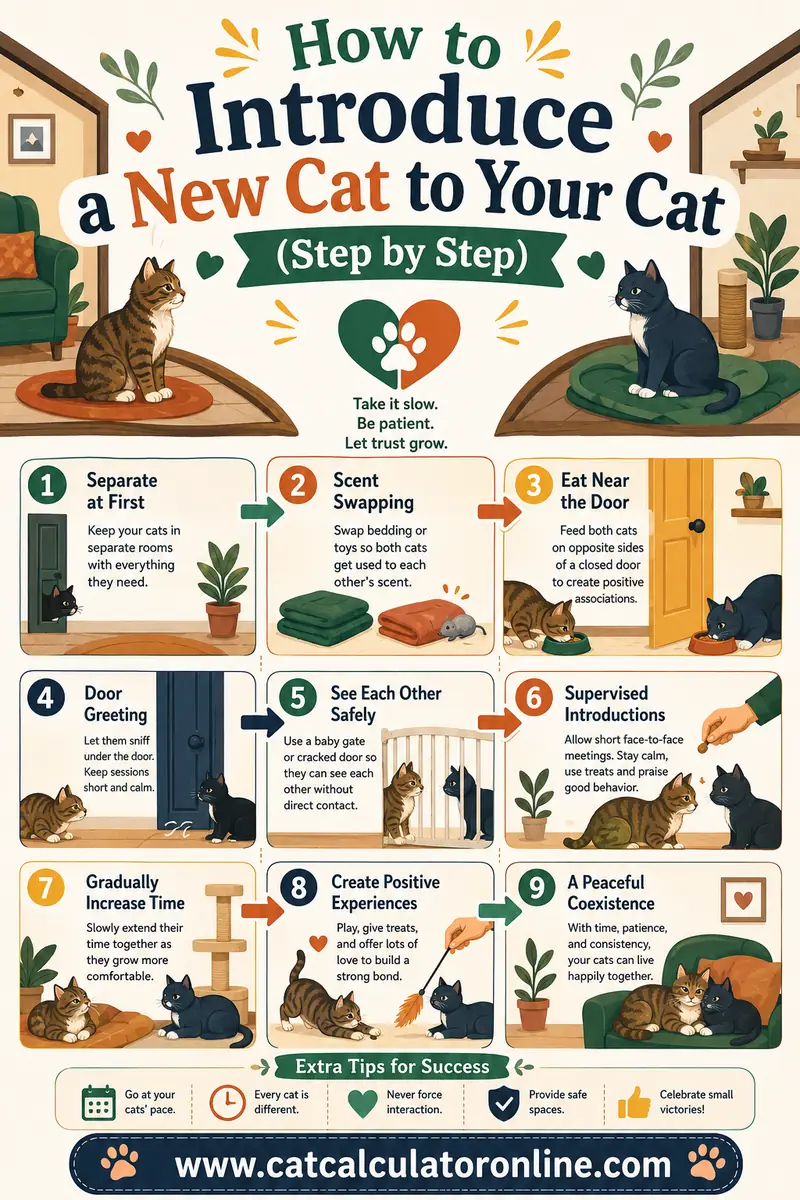
If you're introducing her to a resident pet at the new address as part of all this, slow everything down further and follow a proper protocol — our how to introduce a new cat guide applies almost unchanged.
When Can an Outdoor Cat Go Outside Again?
This is the question with the most at stake, so here's the plain answer: keep any outdoor cat strictly indoors for a minimum of two to four weeks at the new address — longer for nervous cats.
The reason is sobering. A cat released too early doesn't recognize the new territory as home yet. Disoriented cats can wander far, and some actively attempt to travel back to the old house — there are enough of these stories that every rescue organization warns about it. The old map doesn't clear until the new one is built, and building it takes weeks of living in, smelling, and marking the new home.
When the time comes:
- First outings before breakfast. A slightly hungry cat comes back when called for food.
- Go out with her the first few times, keeping sessions short.
- Check the new territory first — busy roads, neighbor dogs, gaps in fencing.
- Reconsider the whole question. A move is a natural moment to weigh up indoor vs outdoor life — some new locations make indoor (or indoor-plus-supervised) the safer call.
And before any of this: update her microchip registration to the new address and get a new ID tag made — immediately, not "soon." A microchip pointing at your old house is how found cats fail to make it home. Do this in week one, even for indoor cats, because moves are exactly when accidental escapes happen.
What Stress Signs Should I Watch For?
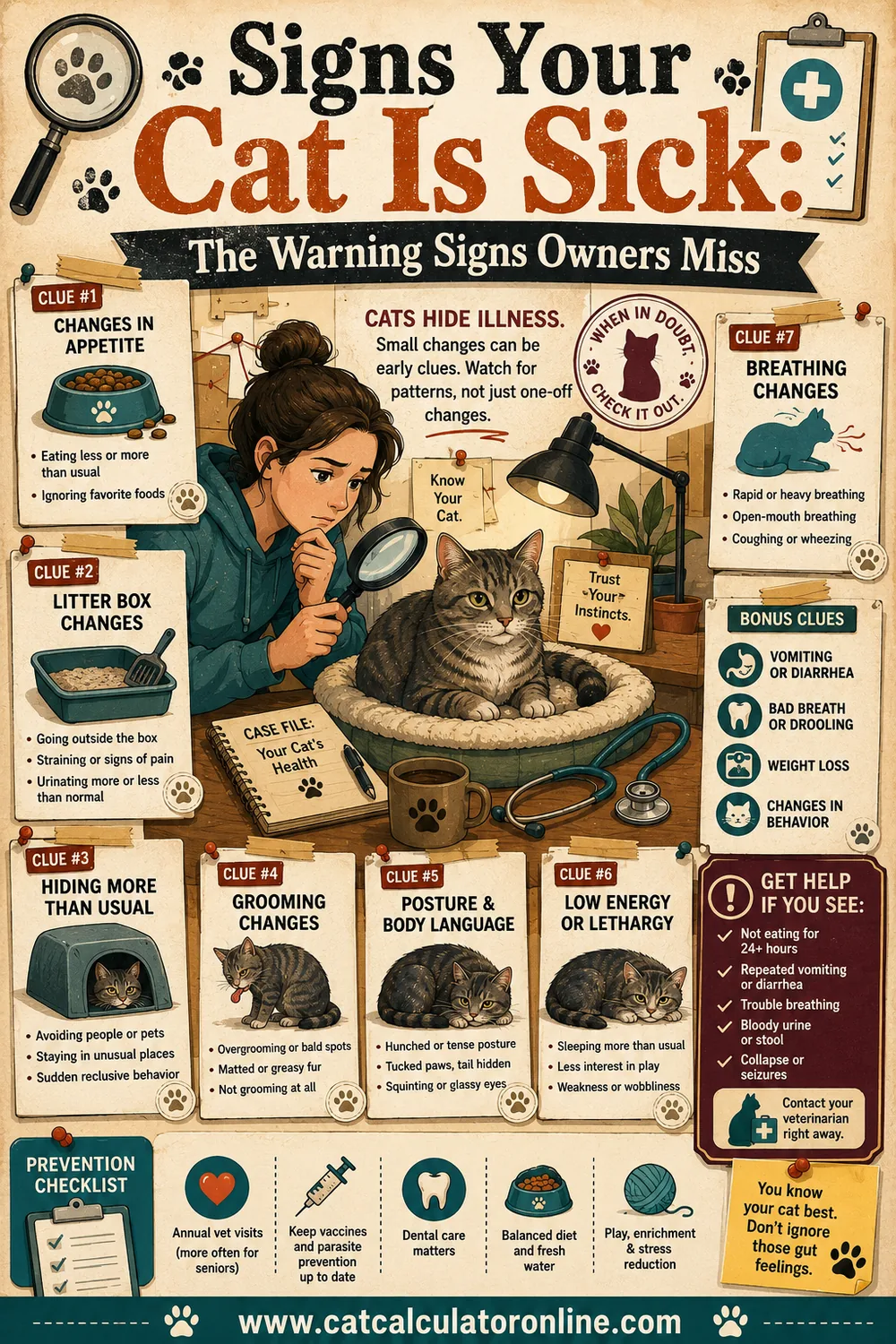
Some settling-in wobble is expected: hiding, a skipped meal on day one, extra caution. But keep an eye on the line between normal adjustment and something that needs help.
Normal for the first days: hiding, reduced appetite (but still eating something), extra vocalizing, clinginess or aloofness, less play.
Call your vet if you see: not eating for more than 24 hours (this one is genuinely important — cats can develop serious liver problems from short fasts), litter box avoidance beyond the first day or two, vomiting or diarrhea that persists, or hiding so complete she won't emerge even at night to eat. Our signs your cat is sick guide covers the full red-flag list — moving stress can also unmask underlying issues, especially in older cats.
Most cats, though, surprise their owners. Two weeks in, the flattened-under-the-bed refugee is patrolling her new kingdom like she signed the deed herself.
The Whole Move at a Glance
| Phase | What to do |
|---|---|
| 2–4 weeks before | Keep routines steady; carrier out as furniture; pack slowly; her room last; line up vet records |
| Moving day | Cat sealed in one emptied room with litter, water, carrier + "DO NOT OPEN" sign — or boarded for the day |
| The journey | Carrier only, secured and level, towel draped over; never opened in transit |
| Arrival | One safe room ready first: litter, water, food, unwashed bedding, hiding spots; let her exit the carrier on her own |
| First week | Safe room until relaxed and eating; update microchip + ID tag; then expand access room by room |
| Weeks 2–4+ | Outdoor cats stay strictly indoors 2–4 weeks minimum; first outings hungry and supervised |
FAQ
How long does it take a cat to adjust to a new home?
Most cats settle into basic routines within one to two weeks and feel fully at home within a month. Confident cats can adjust in days; anxious or senior cats may take six weeks or more. The safe-room method meaningfully shortens the timeline because it gives her a manageable territory to claim first.
Should I let my cat explore the whole new house right away?
No. A whole unfamiliar house overwhelms a territorial animal — she'll bolt for a hiding spot and stall there. Start her in one prepared room with her litter, food, water, and familiar-smelling items, and expand her access gradually once she's relaxed and eating normally.
How long should I keep my cat indoors after moving house?
A minimum of two to four weeks, and longer for nervous cats. Released too early, cats can become disoriented, wander, or attempt to return to the old address. Wait until she's confidently territorial indoors, then start with short, supervised, pre-breakfast outings.
My cat isn't eating after the move. Should I worry?
A picky first day is common, but a cat who eats nothing for more than 24 hours needs a vet call — cats are prone to serious liver complications from even short fasts. Try warming her wet food slightly and feeding in the quiet safe room; if she still won't eat, don't wait it out.
Should I wash my cat's bedding before the move for a fresh start?
No — do the opposite. Unwashed bedding, blankets, and even your worn clothing carry the scent of the old home, and that scent is what makes the new house feel safe. Save the laundry day for a month from now, once the new place smells like her too.
Do I really need to update the microchip right away?
Yes, in the first week. Moves are peak season for accidental escapes — unfamiliar exits, propped doors, visiting tradespeople — and a chip registered to your old address can stop a found cat from getting home. Update the registry, and put a tag with your current phone number on her collar too.
The Bottom Line
Moving house with a cat goes wrong in predictable places — the propped-open door on moving day, the too-early release into the whole house, the outdoor cat let out in week one — and every one of them is preventable. Seal her in one room (or board her) while the movers work, set up a scent-rich safe room before she arrives, expand her territory at her pace, keep outdoor cats in for two to four weeks, and update that microchip immediately.
Older cats feel upheaval more than young ones, so it helps to know exactly where yours is in life. Check her life stage with our free cat age calculator — it takes 30 seconds, and it'll tell you whether you're moving with the feline equivalent of a college kid or a retiree who'd appreciate the process taken slow.