Can Cats Eat Eggs? Cooked Yes, Raw No — Here's Why
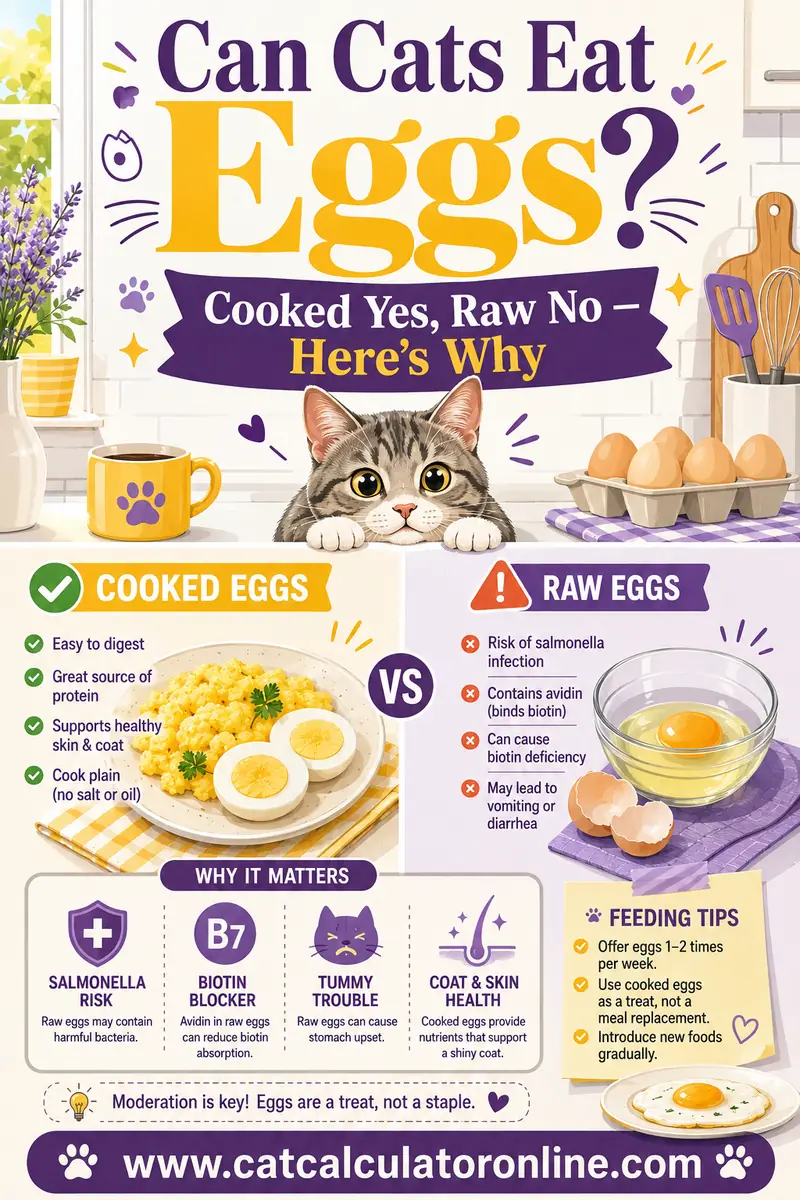
Yes, cats can eat eggs — as long as they're fully cooked and completely plain. A cooked egg is one of the best sources of complete protein you can offer a cat, with all the essential amino acids she needs. What's not safe is raw egg, which carries a risk of Salmonella and E. coli, and whose whites contain avidin, a protein that blocks biotin absorption.
Eggs are a treat, though, not a meal. Keep them inside the 10% rule — treats of all kinds should be no more than 10% of daily calories. Our free cat food calculator tells you what that daily number is for your cat in about ten seconds.
🥚 Is this egg okay for my cat?
Tap a preparation to see the verdict:
Tap an egg preparation above to see whether it’s safe for your cat.
Are Eggs Good for Cats?
Cooked eggs are genuinely good food for cats, which isn't something you can say about most human leftovers.
Cats are obligate carnivores — their bodies are built to run on animal protein. Egg is a complete protein, meaning it contains all the essential amino acids cats need, including taurine, in a form that's easy to digest.
What a cooked egg brings to the bowl:
- High-quality protein for muscle maintenance, especially useful for seniors losing condition
- Taurine, essential for heart function and vision
- Vitamin A and B vitamins, including B12
- Selenium and riboflavin, which support skin and coat health
- Healthy fats in the yolk that help with coat condition
- Almost no carbohydrate, which suits a carnivore's metabolism
Eggs are also a handy option for cats who need tempting: a cat recovering from illness, or a fussy senior who's gone off her usual food, will often take a little plain scrambled egg when nothing else appeals. Ask your vet first if she's genuinely unwell — appetite loss deserves a proper look.
What eggs are not is a balanced diet. There's no meaningful calcium in the edible part of an egg, and the calcium-to-phosphorus ratio is wrong for a cat fed eggs regularly. They're a supplement to a complete diet, never a replacement.
Why Can't Cats Eat Raw Eggs?
Raw egg is one of those things that sounds natural and turns out to carry two separate, well-documented problems.
Bacterial risk
Raw eggs can carry Salmonella and E. coli, both on the shell and inside the egg. In cats this can cause vomiting, diarrhea, fever and lethargy, and it hits kittens, seniors and immunocompromised cats hardest.
There's a household angle too: a cat who eats raw egg can shed bacteria in her stool and on her fur, which puts the people in the house — especially children — at risk. Cooking eliminates the problem entirely.
Avidin and biotin
This is the one most owners haven't heard of. Raw egg white contains a protein called avidin, which binds to biotin (vitamin B7) and stops the body absorbing it.
Biotin matters for skin, coat and metabolism. A cat fed raw egg white regularly can develop biotin deficiency, which shows up as:
- A dull, thin or patchy coat
- Flaky, irritated skin
- Hair loss, often starting around the face
- Lethargy and poor overall condition
The fix is straightforward: cooking denatures avidin, so it can no longer bind biotin. A properly cooked egg is completely free of this problem.
One taste of raw egg isn't going to cause a deficiency — this is about repeated feeding over weeks and months. But given that cooking solves both issues at once, there's no argument for feeding raw.
Cooked vs. Raw Eggs for Cats: The Comparison
| Preparation | Safe? | Notes |
|---|---|---|
| Hard-boiled, plain | Yes | The cleanest option. Chop a small piece, no seasoning |
| Scrambled, dry-cooked, plain | Yes | No butter, oil, milk, salt or pepper. Cool before serving |
| Poached, fully set | Yes | Fine as long as the yolk is firm, not runny |
| Fried in oil or butter | No | Too much added fat; usually salted too |
| Soft-boiled / runny yolk | No | Undercooked egg carries the same bacterial risk as raw |
| Raw egg white | No | Avidin blocks biotin absorption, plus bacterial risk |
| Raw egg yolk | No | Bacterial risk remains, even without the avidin issue |
| Omelette with cheese, onion or ham | No | Onion and garlic are toxic; dairy and salt cause upset |
| Egg substitute / liquid egg products | No | Often contain additives, salt and flavourings |
| Finely ground eggshell | Only if powdered | A calcium source, but unnecessary on a complete diet |
The pattern is simple: cooked and plain is fine, everything else isn't. Most of the "no" entries fail because of what's added, not because of the egg.
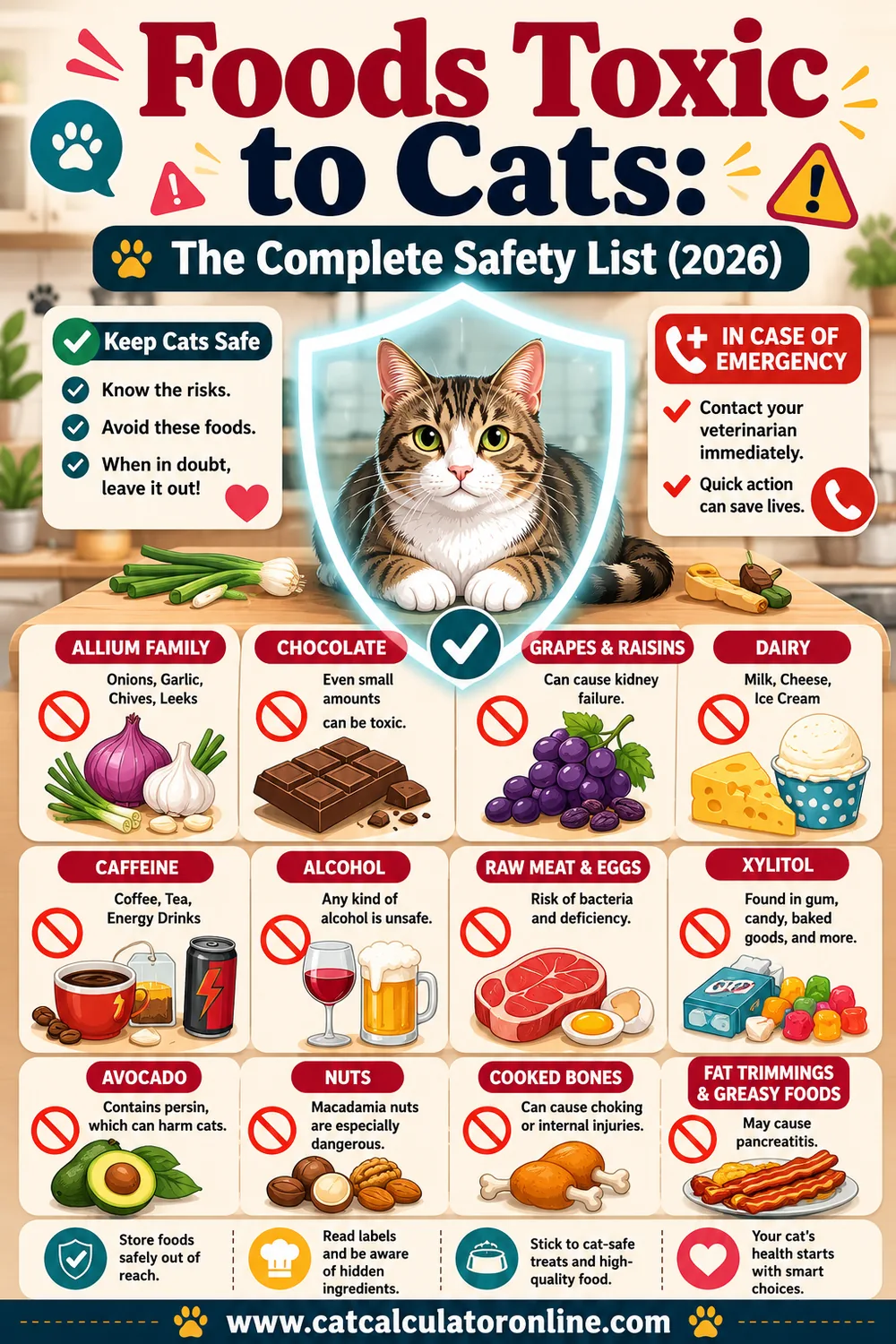
Onion and garlic deserve a specific warning, because they're in so many egg dishes. Both damage a cat's red blood cells and can cause anemia — see our full list of foods toxic to cats for the details.
How Much Egg Can a Cat Eat?
Less than you'd think. A whole large egg contains roughly 70 calories, and a typical 4–5 kg (9–11 lb) indoor adult cat needs somewhere around 200–250 calories a day.
That means one whole egg is close to a third of her entire daily intake — far too much for a treat.
Apply the 10% rule: treats should stay under 10% of daily calories, or about 20–25 calories a day for that same cat. In egg terms:
- A treat portion is about one tablespoon of cooked egg, roughly a quarter of an egg or a little less.
- Offer it two or three times a week at most, not daily.
- Count it against the day's treat budget. Egg today means no chicken scraps and no dental chews.
- Reduce her regular meal slightly on egg days if she's prone to putting on weight.
Portion by size: a small cat or a senior gets a teaspoon or two, an average adult gets about a tablespoon, and a large cat can have a slightly bigger spoonful. Kittens over about 12 weeks can have a tiny taste, but their calories are better spent on complete kitten food during growth.
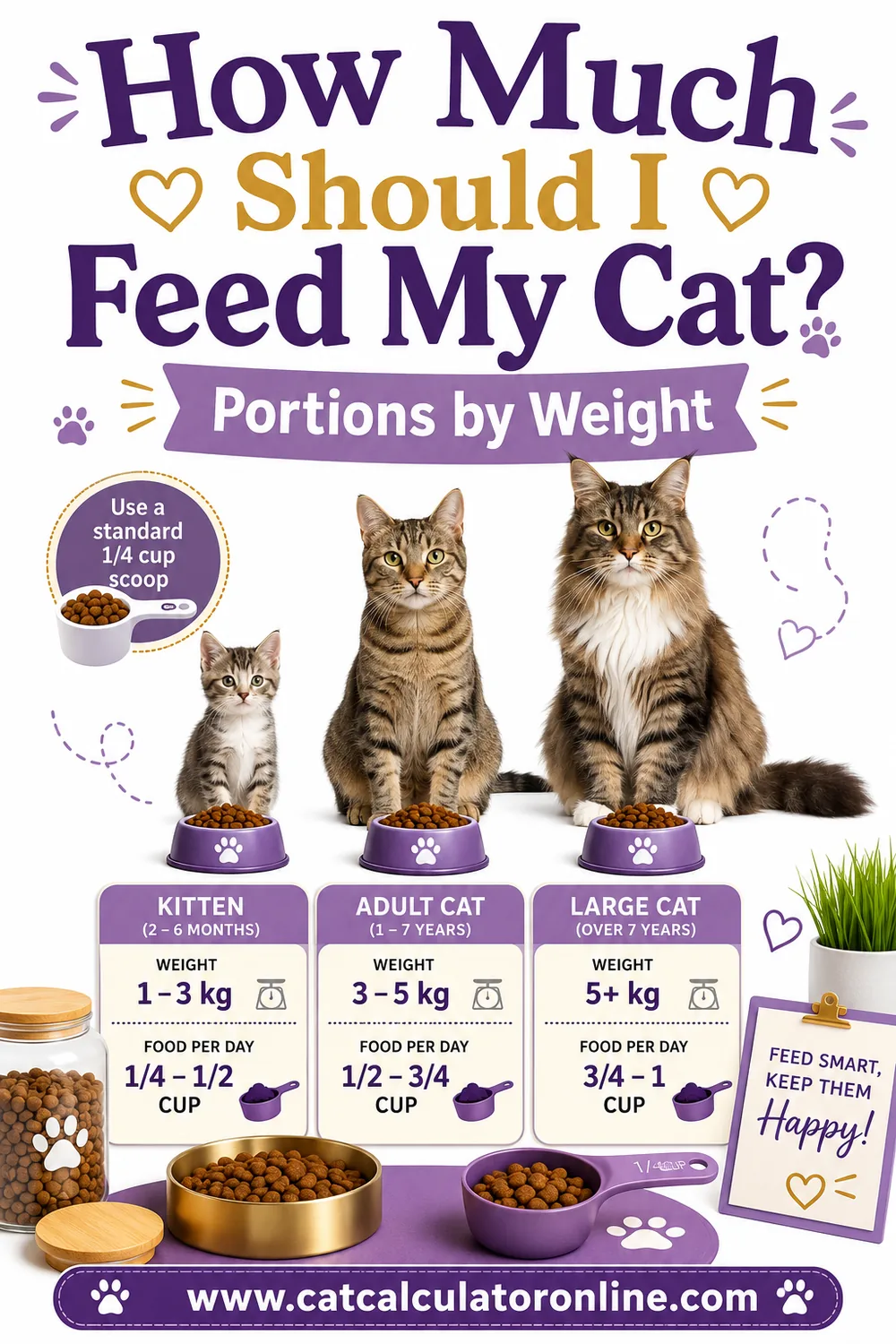
For your cat's actual daily number — which varies with weight, age, activity and whether she's spayed — run it through our cat food calculator. And how much should I feed my cat covers how to split that total across meals.
How to Prepare Eggs for Your Cat
The safest preparations are also the laziest, which is convenient.
Hard-boiled:
- Boil for 10–12 minutes until the yolk is fully firm.
- Cool completely and peel.
- Chop a small piece finely — about a tablespoon.
- Serve plain, on its own or mixed into her usual food.
Scrambled:
- Crack the egg into a non-stick pan with no oil, butter or milk.
- Cook over low heat, stirring, until fully set with no wet or glossy patches.
- Let it cool to room temperature.
- Serve about a tablespoon.
Rules that apply either way:
- No salt, pepper, herbs, cheese, onion, garlic or ketchup. Plain means plain.
- Cook it through. No runny yolks, no soft centers.
- Cool it down. Cats won't eat food that's too hot and can burn their mouths trying.
- Introduce it slowly. Offer a teaspoon the first time and wait 24 hours to check for vomiting, diarrhea or itching.
- Store leftovers in a sealed container in the fridge and use within two days.
Eggs are a fairly common food allergen in cats, so that slow introduction matters. Signs of a reaction include itching, over-grooming, ear problems, or digestive upset. If any of that shows up, stop and mention it to your vet.
What About Eggshells?
Ground eggshell is a real calcium source — it's mostly calcium carbonate — and you'll see it recommended in homemade-diet circles.
Two caveats matter:
- It has to be finely ground to a powder. Shell fragments are sharp and can irritate or injure the mouth and digestive tract. Baking then grinding to a fine powder in a clean grinder is the standard approach.
- It's unnecessary if your cat eats complete cat food. Commercial diets already contain calcium in a carefully balanced ratio with phosphorus. Adding more can push that ratio out of balance, which causes its own problems.
Eggshell supplementation is really a homemade-diet tool, and homemade diets for cats should always be formulated with a veterinary nutritionist. Getting the calcium-to-phosphorus ratio wrong is one of the most common and most damaging DIY mistakes.
Signs an Egg Didn't Agree With Your Cat
Most cats handle plain cooked egg without any drama. Watch for these in the 24 hours after a new food:
- Vomiting or diarrhea
- Excessive gas or an obviously uncomfortable belly
- Itching, scratching or over-grooming — possible signs of a food allergy
- Recurring ear irritation over weeks, another allergy marker
- Loss of appetite or unusual lethargy
One-off mild upset usually just means the portion was too big. Repeated reactions mean egg isn't for her. Anything severe or persistent — repeated vomiting, lethargy, refusing food — is a call to the vet, and our guide to signs your cat is sick covers the quieter warning signs cats tend to hide.
FAQ
Can cats eat scrambled eggs?
Yes, as long as they're cooked plain — no butter, oil, milk, salt or pepper — and fully set with no runny parts. Let them cool, then serve about a tablespoon as an occasional treat. Scrambled egg is often the easiest preparation for a cat to eat and digest.
Can cats eat raw eggs?
No. Raw eggs carry a risk of Salmonella and E. coli, and raw egg white contains avidin, a protein that binds biotin and can cause a deficiency over time. Cooking destroys avidin and kills the bacteria, so there's no reason to feed egg raw.
How much egg can I give my cat?
About one tablespoon of cooked egg, two or three times a week, is right for a typical adult cat. A whole large egg is roughly 70 calories — close to a third of a small cat's daily requirement — so a whole egg is far too much in one sitting. Keep all treats under 10% of daily calories.
Are eggs good for a cat's coat?
Cooked eggs supply high-quality protein, biotin, riboflavin and healthy fats, all of which support skin and coat condition. Raw egg white does the opposite, because avidin blocks biotin absorption. If your cat's coat is dull or patchy, that's worth a vet visit rather than a diet experiment.
Can kittens eat eggs?
A tiny taste of plain cooked egg is fine for a kitten over about 12 weeks, but it shouldn't be a regular thing. Growing kittens need nearly all their calories to come from a complete, balanced kitten food that's formulated for development. Check with your vet before adding any human food.
Can cats eat eggshells?
Only if ground to a fine powder — shell fragments are sharp and can injure the mouth or gut. Even then, eggshell is unnecessary for cats eating complete commercial food, which already contains balanced calcium. Adding extra calcium can upset the calcium-to-phosphorus ratio.
The Bottom Line
Cooked, plain eggs are one of the better human foods you can share with a cat. They're complete protein, easy to digest, low in carbs, and useful for tempting a fussy or recovering cat to eat.
Raw eggs are a different story: bacterial risk plus avidin, which blocks biotin absorption and can leave a cat with a dull coat and flaky skin over time. Cooking solves both problems, so there's no upside to feeding raw.
Keep the portion to about a tablespoon, a couple of times a week, with no butter, salt, onion, garlic or cheese anywhere near it. Everything else your cat eats should come from a complete cat food built for her age and size.
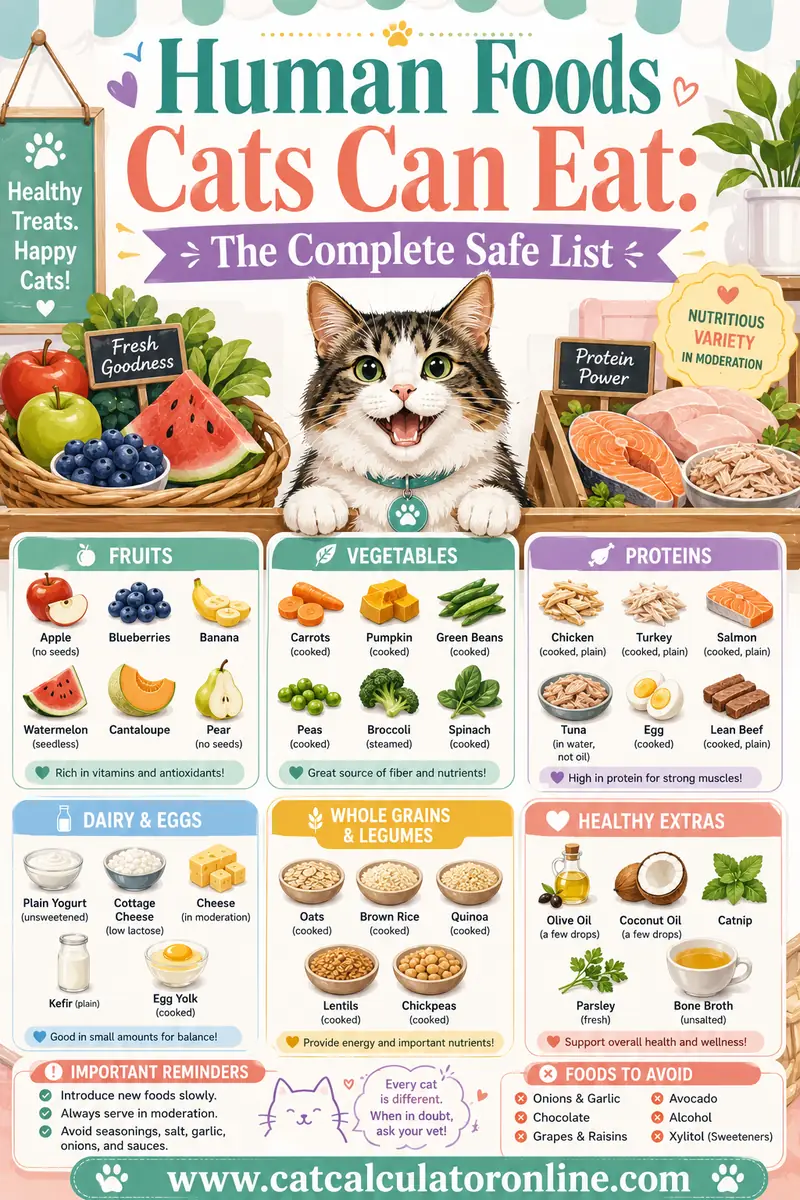
Not sure how much that should be? Our free cat food calculator gives you a daily target in seconds. And if you're working out what else is shareable from your kitchen, see human foods cats can eat and the full list of foods toxic to cats.