How Much Water Should a Cat Drink Per Day?
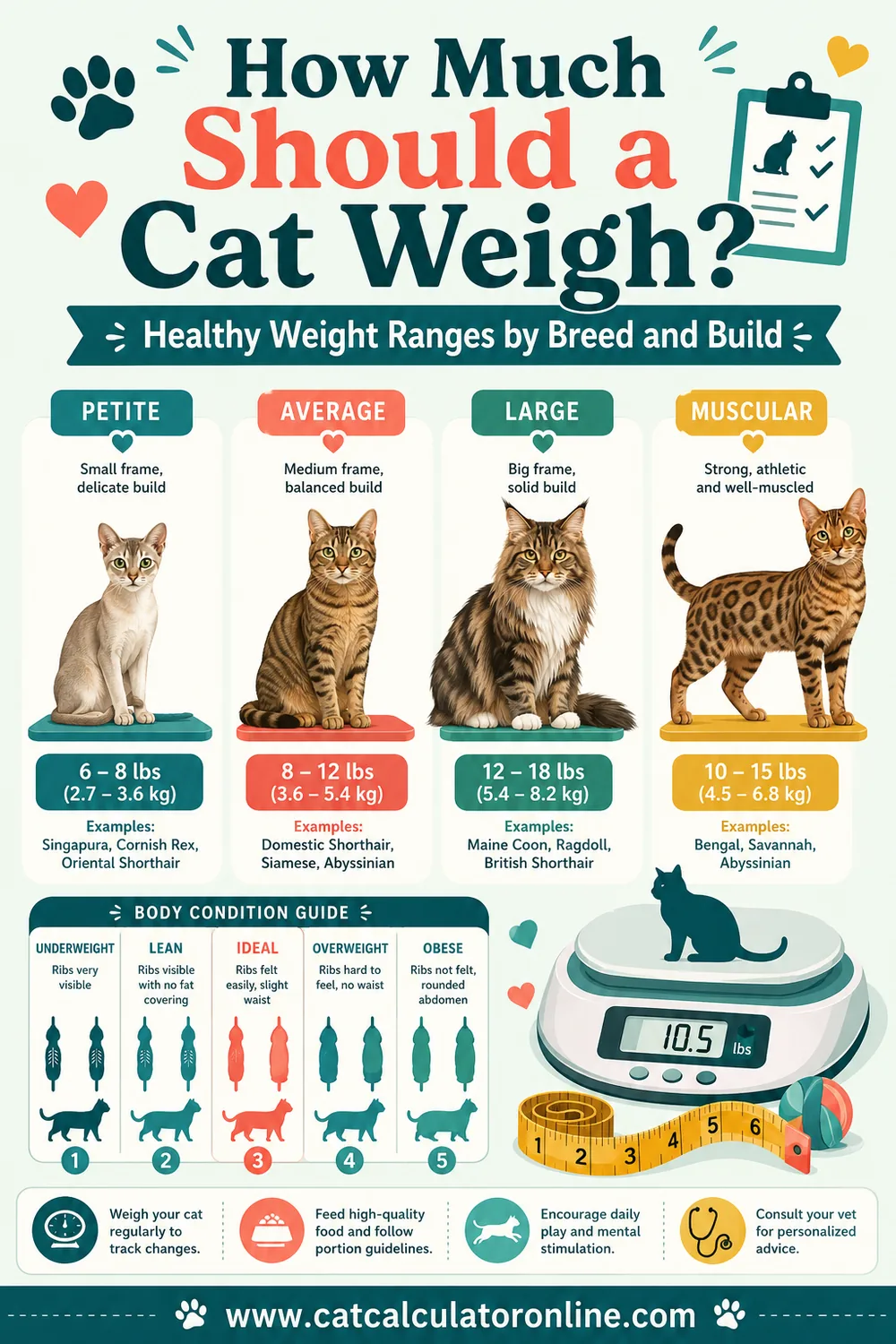
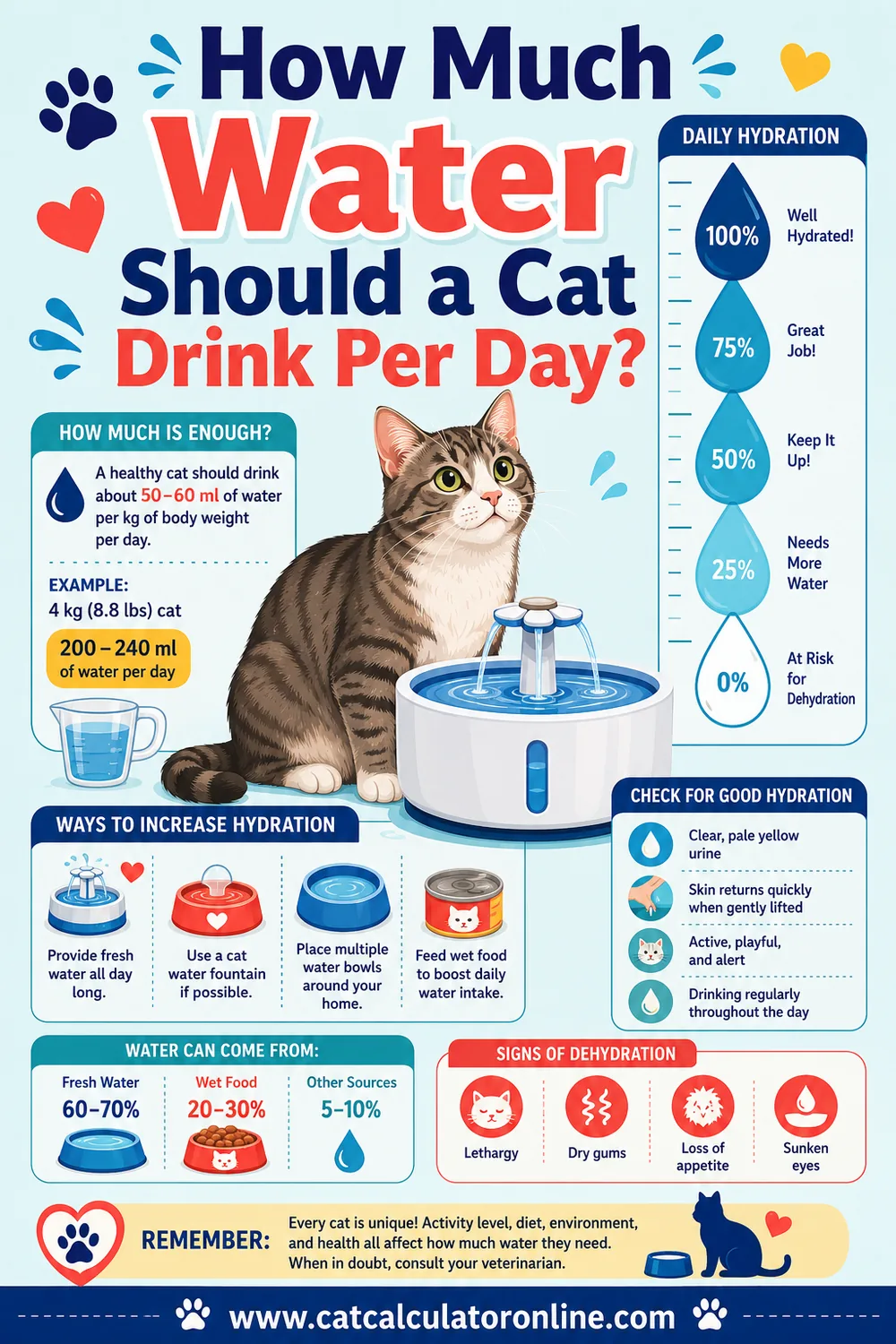
A cat needs roughly 50 to 70 ml of water per kilogram of body weight per day — about 3.5 to 4.5 ounces per 5 pounds. That total includes moisture from food, which is why a cat eating wet food may barely touch the bowl while a dry-food cat needs to drink noticeably more. A 10-pound cat needs somewhere around 7 to 9 ounces a day, from all sources combined.
Since food is a big part of that total, what you feed changes what your cat has to drink. Our free cat food calculator helps you sort out the daily food amounts, and the water math below fills in the rest.
💧 Daily water needs by weight
Tap your cat’s weight to see the rough daily total (food moisture included):
Tap a weight above. These are ranges, not targets — a cat eating wet food gets much of this from meals.
Daily Water Needs by Weight
| Cat's weight | Weight in kg | Total daily water (ml) | Total daily water (oz) |
|---|---|---|---|
| 5 lb | 2.3 kg | 115 – 160 ml | 4 – 5.5 oz |
| 6 lb | 2.7 kg | 135 – 190 ml | 4.5 – 6.5 oz |
| 8 lb | 3.6 kg | 180 – 255 ml | 6 – 8.5 oz |
| 10 lb | 4.5 kg | 225 – 320 ml | 7.5 – 11 oz |
| 12 lb | 5.4 kg | 270 – 380 ml | 9 – 13 oz |
| 15 lb | 6.8 kg | 340 – 475 ml | 11.5 – 16 oz |
| 18 lb | 8.2 kg | 410 – 570 ml | 14 – 19 oz |
Important: these are totals from all sources, not bowl-only targets. A cat on canned food might drink a third of this from the bowl and still be perfectly hydrated. A dry-food cat has to drink nearly all of it.
Hot weather, exercise, nursing kittens, and certain medications all push the number up. Confirm what's right for your cat with your vet, especially if there's a health condition in the picture.
Why Cats Are Bad at Drinking Water
Domestic cats descend from desert-dwelling ancestors, and it shows. They evolved to get most of their water from prey — a mouse is roughly 70% moisture — so they never developed a strong thirst drive. A dog will drink when it's dry. A cat often just... doesn't.
That's fine when a cat eats prey-like food. It's a problem when a cat eats kibble that's about 10% moisture and then doesn't top up at the bowl. Chronic mild dehydration is linked to urinary tract problems, and hydration is a central part of managing kidney disease, which is common in older cats.
So with cats, water isn't something to assume. It's something to actively encourage.
How Much Water Comes From Food
This is the piece most owners miss.
| Food type | Moisture content | Water from a day's food (10 lb cat) |
|---|---|---|
| Wet / canned | 70 – 80% | Roughly 150 – 200 ml |
| Combo (wet + dry) | Mixed | Roughly 80 – 120 ml |
| Dry only | ~10% | Roughly 15 – 20 ml |
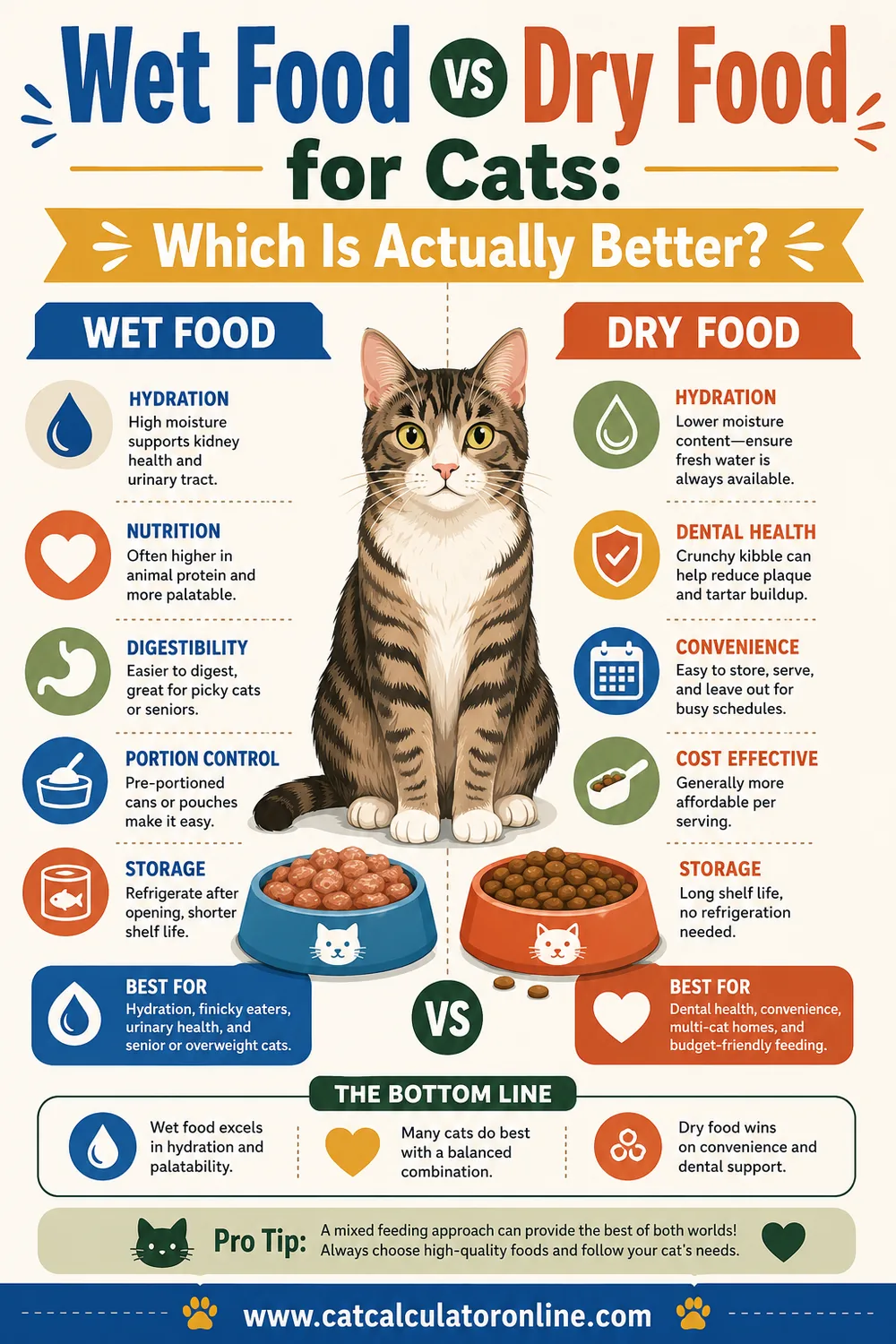
A 10-pound cat eating only canned food gets a large share of the daily requirement straight from meals. The same cat on dry food alone gets almost nothing and has to make up the entire difference by drinking.
That's the strongest practical argument for including wet food, and it's why vets so often recommend it for cats with urinary or kidney issues. Our wet food vs dry food guide covers the full trade-off.
If your cat is dry-food-only and rarely drinks, adding even one wet meal a day meaningfully changes the picture.
Signs Your Cat Isn't Drinking Enough
Cats hide problems well, but dehydration leaves clues:
- Skin tent test. Gently lift the skin at the back of the neck. It should snap right back. If it stays tented for a moment, that's a dehydration sign — check with your vet, and note that the test is less reliable in very thin or very old cats.
- Dry or tacky gums. Healthy gums feel slick. Sticky gums suggest low fluid.
- Sunken-looking eyes.
- Small, hard, dry stool or straining in the litter box.
- Very concentrated urine — small, dark, strong-smelling clumps.
- Lethargy or reduced appetite.
If several of these show up together, that's a vet call, not a wait-and-see.
How to Get Your Cat to Drink More
Cats have opinions about water, and small changes often produce surprisingly big results.
Fix the bowl
- Go wide and shallow. Deep, narrow bowls press on a cat's whiskers, which many cats dislike. A wide ceramic or stainless dish is more comfortable.
- Skip plastic. It holds odors and can develop scratches that harbor bacteria.
- Fill it higher than you think. Many cats prefer not to dip their head deep into a bowl.
Fix the location
- Move water away from the food bowl. In the wild, cats avoid drinking near a kill because of contamination. That instinct persists, and a water bowl right next to dinner gets used less.
- Move it away from the litter box too. Obvious once you say it out loud.
- Put out multiple bowls. One per floor, one in the quiet corner your cat actually likes. More opportunities means more drinking.
Try a fountain
Many cats prefer moving water — it's fresher and more interesting, and some cats find still water suspect. A pet fountain is one of the more reliably effective upgrades, though a few cats ignore them entirely. Clean it regularly; a slimy fountain is worse than a clean bowl.
Make the water more tempting
- Add a splash of water to wet food to make a gravy
- Try a spoonful of low-sodium, onion-free and garlic-free chicken broth in water (ask your vet first)
- Try a different water source — some cats object to heavily chlorinated tap water
- Refresh it daily; cats notice stale water
Add moisture through food
The single most effective lever is diet. Adding wet food, or mixing a few tablespoons of water into what your cat already eats, raises total intake without requiring your cat to cooperate at all.
When a Change in Thirst Means See the Vet
This section matters more than everything above it.
A noticeable increase in drinking is one of the most important warning signs in cats. If your cat suddenly starts emptying the bowl, camping at the tap, or drinking from places she never used to, that's not just a quirky new habit — it's a symptom worth investigating.
Increased thirst, often paired with increased urination, is commonly associated with:
- Chronic kidney disease — very common in older cats
- Diabetes mellitus — often with increased appetite and weight loss
- Hyperthyroidism — often with weight loss despite a big appetite
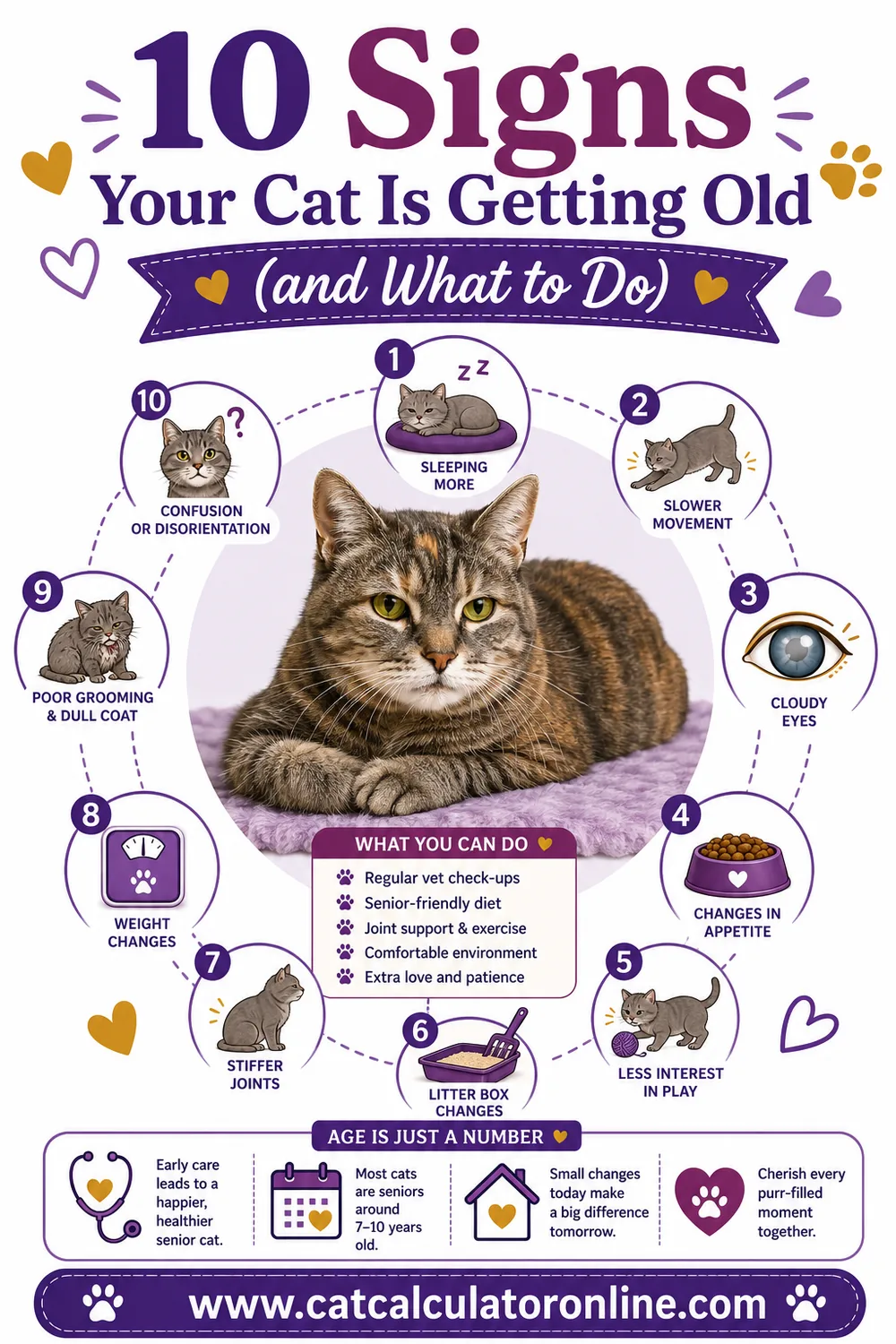
All three are far more manageable when caught early, and all three are conditions your vet can screen for with routine bloodwork. That's a big part of why senior cats are recommended for twice-yearly checkups. Our signs your cat is getting old guide covers the other changes worth watching.
Book a vet visit if you notice:
- A clear, sustained increase in drinking
- Larger or more frequent urine clumps in the litter box
- Weight loss, especially with a normal or increased appetite
- Straining to urinate, crying in the box, or blood in the urine — this is an emergency in male cats, who can develop life-threatening urinary blockages
- A sudden drop in drinking alongside lethargy
You don't have to measure precisely to catch this. Just notice how often you're refilling the bowl. A change in that rhythm is the signal.
Can a Cat Drink Too Much Water?
Healthy cats self-regulate — they won't overhydrate from a bowl. But excessive drinking (vets call it polydipsia) is a symptom, not a habit. The concern isn't the water itself; it's what's driving the thirst.
The rough clinical threshold is around 100 ml per kilogram per day — noticeably above the normal 50 to 70 ml range. If your cat seems to be drinking near or beyond that, mention it at your next appointment.
FAQ
How much water should a cat drink a day?
Roughly 50 to 70 ml per kilogram of body weight per day, which is about 3.5 to 4.5 ounces per 5 pounds. A 10-pound cat needs somewhere around 7 to 11 ounces total. That figure includes moisture from food, so a cat on wet food will drink much less from the bowl.
Is my cat drinking too little water?
Possibly, if she eats only dry food and rarely visits the bowl. Watch for sticky gums, skin that stays tented when gently lifted, small hard stools, and dark concentrated urine. Adding wet food is the fastest fix; a fountain and multiple bowls also help.
Why is my cat suddenly drinking so much water?
Increased thirst is a common early sign of kidney disease, diabetes, or hyperthyroidism, especially in older cats. It's worth a vet visit and bloodwork rather than waiting to see if it settles.
Does wet food count toward a cat's water intake?
Yes, significantly. Wet food is about 70 to 80% moisture, so a cat eating canned food gets a large share of daily water from meals. Dry food is only around 10% moisture and contributes almost nothing.
Do water fountains actually help cats drink more?
For many cats, yes. Moving water is fresher and more appealing, and some cats strongly prefer it to a still bowl. Not every cat cares, so try one before buying several — and clean it regularly.
Should I put the water bowl next to the food bowl?
No. Cats instinctively avoid drinking near food, and bowls placed side by side often get used less. Move water to a separate spot, and put out more than one bowl around the house.
The Bottom Line
Aim for roughly 50 to 70 ml per kilogram a day — about 7 to 11 ounces for a 10-pound cat — counting moisture from food. Because cats have a weak thirst drive, diet does most of the heavy lifting: wet food gets you most of the way there, dry food leaves the whole job to the bowl.
Then pay attention to changes. A cat that starts drinking noticeably more deserves a vet visit, not a bigger bowl.
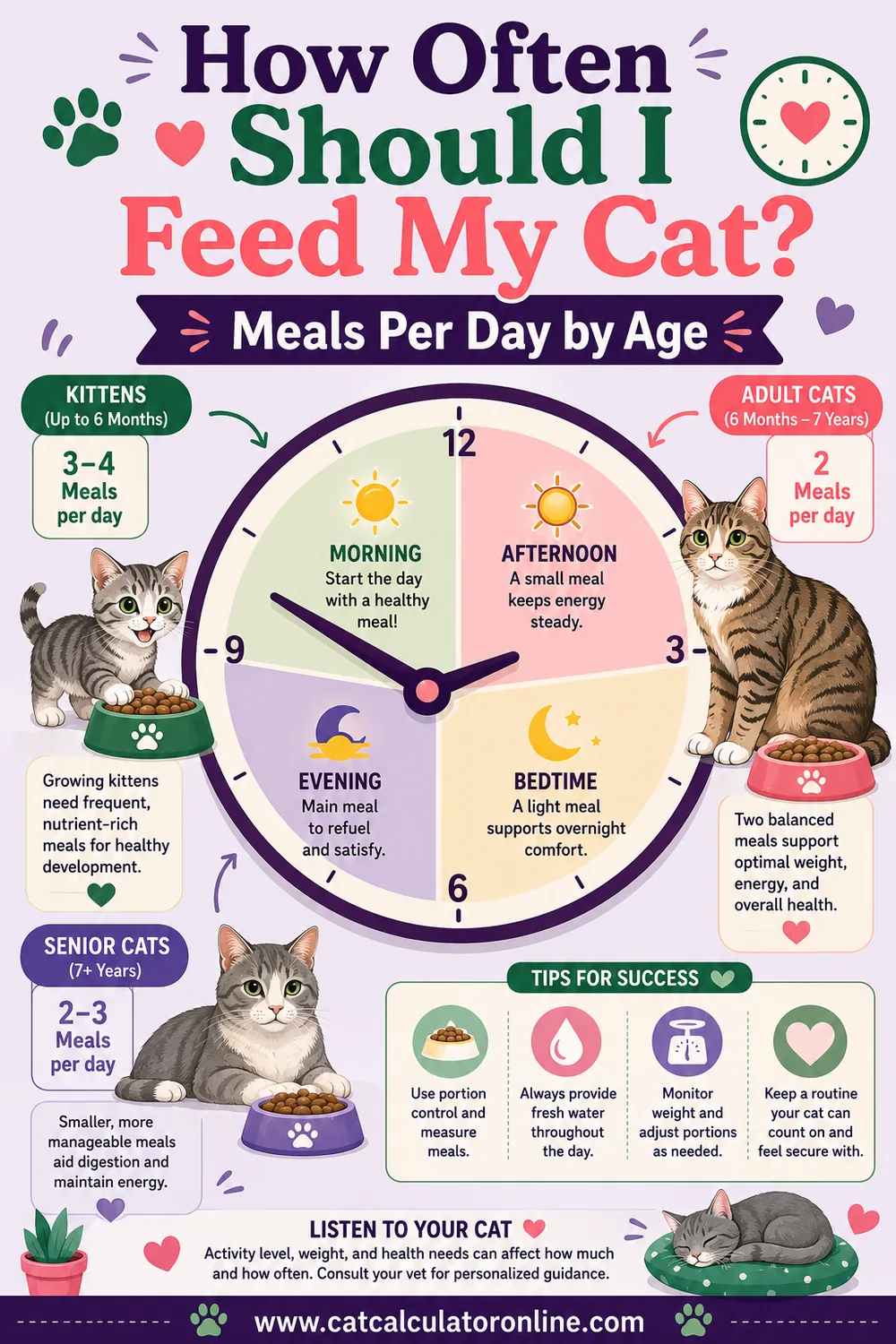
Sort out the food side first with our free cat food calculator, then read the wet food vs dry food comparison and check how often you should be feeding — hydration, portions and schedule all work together.