How Often Should You Groom a Cat?
Short-haired cats need brushing once or twice a week; long-haired cats need it daily. That daily figure surprises people, and it isn't negotiable — a Persian or Maine Coon left unbrushed for two weeks will have mats that can't be combed out. The common assumption that cats groom themselves is only half true: they manage surface cleaning well and do nothing at all about the dead undercoat that causes matting and hairballs. This page covers the schedule by coat type, how to brush a cat that objects, and the situations where a cat genuinely can't cope alone. Grooming is a real recurring cost for long-haired breeds — the cat cost calculator puts it in context.

How Often by Coat Type?
| Coat | Brush | Also needs | Examples |
|---|---|---|---|
| Short | 1–2 × week | Nail check monthly | Domestic Shorthair, Siamese, Bengal, Burmese |
| Dense short | 2–3 × week | Undercoat rake in moult | British Shorthair, Russian Blue |
| Medium | 2–3 × week | Daily check of ruff and trousers | Ragdoll, Norwegian Forest, Turkish Angora |
| Long | Daily | Regular mat checks, sometimes clipping | Persian, Maine Coon, Himalayan |
| Curly (Rex) | Weekly, gently | Skin oils build up; occasional bath | Cornish Rex, Devon Rex |
| Hairless | Weekly bath | Skin cleaning, ear cleaning | Sphynx |
During moulting seasons — typically spring and autumn — increase whatever you're doing. Daily brushing for a few weeks makes a substantial difference to both hairballs and the amount of hair around the house.
Indoor cats moult more evenly year-round because artificial light disrupts the seasonal cycle, so there's less of a defined peak and more of a constant background shed.
Why Can't Cats Just Groom Themselves?
They do a lot — a healthy cat spends a good portion of its waking hours grooming — and there are three things they can't manage.
Dead undercoat. A cat's tongue removes loose surface hair, but the soft undercoat that sheds seasonally sits below that and needs mechanical removal. Left in place, it tangles, mats, and forms the base layer of matting.
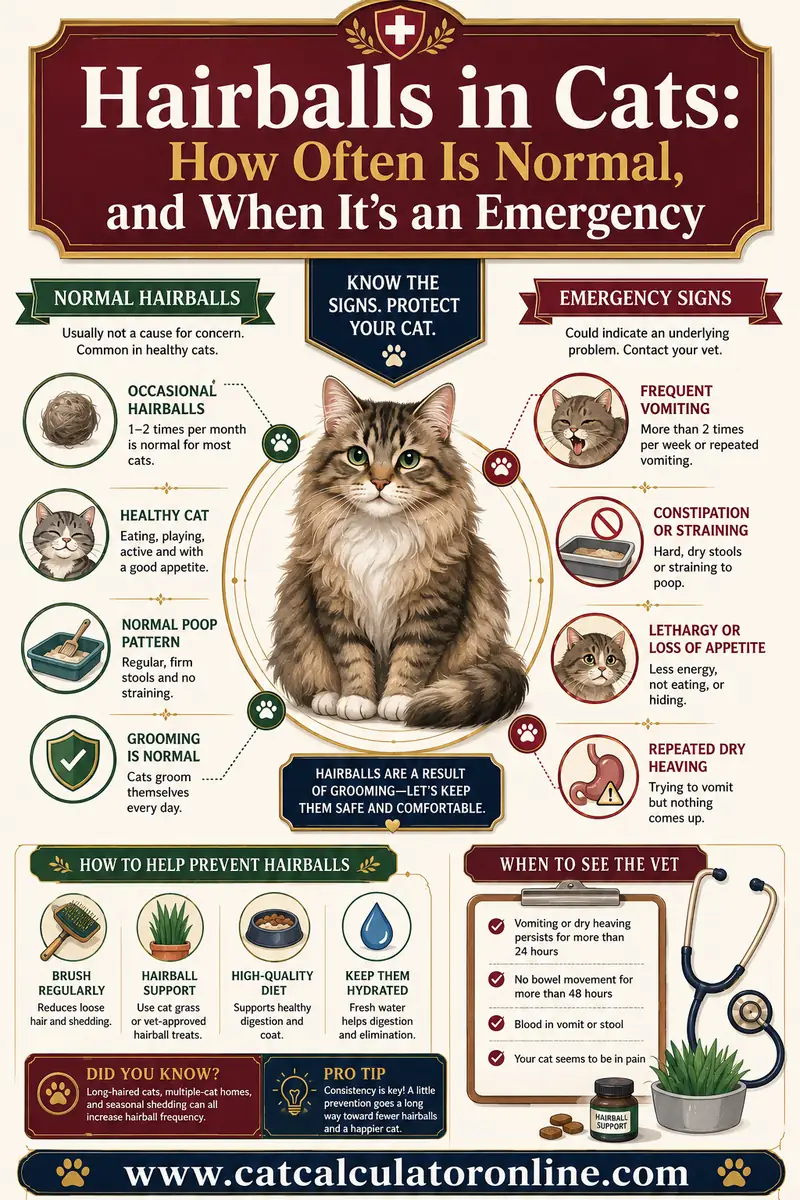
Hair they swallow. Everything a cat licks off, it swallows. Most passes through; some forms hairballs. Brushing removes that hair before it goes down, and it's the most effective hairball prevention there is — see hairballs in cats.
Places they can't reach. The back, the base of the tail and the hindquarters are difficult for any cat and impossible for some. Which brings us to the cats who genuinely can't cope.
Cats that need help regardless of coat length:
- Overweight cats — they physically cannot reach their back and rear. Matting there is common and is a welfare problem, not vanity
- Senior and arthritic cats — twisting to groom hurts, so they stop. A scruffy coat in an older cat is often the first visible sign of joint pain
- Cats recovering from illness or surgery
- Long-haired cats generally, whose coats simply exceed what a tongue can manage
- Cats with dental pain, who groom less because it hurts
A coat that has become greasy, clumped or matted is worth mentioning to your vet, because in an adult cat it usually signals that something is making grooming difficult rather than that the cat has become lazy. More on this in how to care for a senior cat.
How Do You Brush a Cat That Objects?
Most cats who dislike brushing were introduced to it badly, and it's fixable with patience.
Start absurdly small. Two or three strokes, then stop and give a treat. Genuinely two strokes. You're building an association, not doing the job.
Begin with the good places. Cheeks, chin, the top of the head and along the back are where most cats enjoy being touched. Save the belly, legs and tail for much later, and expect some cats never to accept the belly at all.
Stop before they ask you to. The single most useful rule. End the session while your cat is still enjoying it, not after the ears go back. A cat that always gets stopped at the right moment stays willing.
Watch for the warnings: tail flicking or thumping, ears rotating back or flattening, skin rippling along the back, a turned head, or a low growl. Any of those, stop.
Time it well. After a meal, when the cat is sleepy and settled, works far better than an alert cat mid-afternoon.
Sit beside them, not over them. Looming is intimidating.
Use the right tool. A lot of "hates being brushed" is really "hates that brush" — a slicker brush on a thin-coated cat is genuinely uncomfortable. Options are compared in cat grooming tools guide.
Build up over weeks, adding one new area at a time. A cat that tolerates two minutes today can usually manage ten within a month or two.
If your cat becomes aggressive, stop and reassess. Pain is a common cause — a cat that suddenly objects to being touched somewhere specific may be sore there.
What Should a Grooming Session Include?
Brushing is the core, and a few other checks fit naturally alongside it.
Brushing, following the coat direction, working in sections on a long-haired cat and getting right down to the skin rather than skimming the surface.
Mat check — run your fingers through the coat, paying attention to the armpits, behind the ears, the ruff, the trousers at the back legs, and the base of the tail. Those are where mats form first. What to do about them is in how to deal with cat matting.
Eyes — wipe away discharge with a damp cloth, using a separate area of cloth for each eye. Flat-faced breeds need this daily.
Ears — look, don't poke. Clean visible wax at the outer ear only. Dark crumbly discharge, a strong smell or head shaking means a vet visit, not more cleaning.
Nails — check monthly and trim as needed, more often for indoor and older cats whose nails don't wear down.
Skin — while you're brushing, feel for lumps, scabs, fleas and flea dirt. Weekly hands-on contact is genuinely useful early detection, and it's how a lot of problems get found while they're still small.
Teeth — a quick look at the gum line takes seconds and dental disease is extremely common in cats.
How long? Five to ten minutes for a short-haired cat once or twice a week. Ten to twenty minutes daily for a long-haired one. If that sounds like a lot, it's the honest cost of a long-haired breed, and worth knowing before choosing one.
When Should You Start, and Does It Change With Age?
Start with kittens, well before it's needed. A short-haired kitten doesn't require brushing at eight weeks, and brushing it anyway is the best investment you'll make. Thirty seconds a day, handling paws, ears and mouth alongside it, produces an adult cat that accepts grooming, nail trims and vet examinations without a fight. Kittens raised without this frequently become adults who cannot be handled, and that limits their veterinary care for life.
Adults follow the schedule by coat type. The main thing to watch is consistency — a long-haired cat groomed enthusiastically for a month and then neglected for three ends up in the same state as one never groomed at all.
Middle age is where obesity creeps in, and with it the first patches a cat can't reach. If you notice a slightly clumped area over the back or near the tail base in a cat that used to be immaculate, weight is the likely cause. Is my cat overweight covers the body condition check.
Seniors need more from you and tolerate less. Arthritis makes twisting painful, so grooming drops off exactly when the coat needs more help. Keep sessions short, work in several short bursts rather than one long one, be gentle over bony areas, and use a soft brush rather than anything with firm pins. Older skin is thinner and more easily damaged.
Very old or ill cats may need you to do essentially all of it, including cleaning around the rear. That's ordinary nursing care rather than a sign of anything having gone wrong.
What About Bathing and Professional Grooming?
Most cats never need a bath. They're efficient self-cleaners, and bathing strips coat oils and stresses most cats considerably. Exceptions: something toxic or sticky in the coat, a medicated shampoo prescribed by your vet, a Sphynx (weekly, because there's no coat to absorb skin oils), and severely matted or soiled cats that a groomer is handling.
If you must bathe: cat-specific shampoo only, warm not hot water, a non-slip surface, and speed. Never use dog shampoo, which can contain permethrin — fatally toxic to cats.
Professional grooming is worth budgeting for with long-haired breeds. Typically £30–£60 a session, every six to twelve weeks. What a groomer offers that you can't easily do at home: a full de-shed treatment, safe mat removal, a lion clip for cats whose coats have become unmanageable, and sanitary trims for cats who can't keep themselves clean.
Some cats need sedation for grooming, which a vet rather than a groomer must handle. That's not a failure — for a severely matted, frightened or painful cat, it's the humane option.
Never use scissors on mats yourself. Cat skin is thin and lifts with the mat, and cutting mats out with scissors is one of the more common causes of serious lacerations vets see. Clippers or a professional, not scissors.
One thing groomers wish owners knew: book before the coat is a problem, not after. A routine appointment on a well-maintained cat is quick, calm and cheap. The same cat brought in with widespread matting needs a long, uncomfortable session that often ends in a full clip, costs considerably more, and leaves the cat far less willing next time.
Regular brushing is what keeps you out of all of this. Ten minutes a day on a long-haired cat costs nothing and prevents the £60 de-matting session, and reduces shedding around the house considerably — covered in how to reduce cat shedding.
Frequently Asked Questions
How often should I brush my cat?
Once or twice a week for short-haired cats, two or three times for medium coats, and daily for long-haired breeds like Persians and Maine Coons. Increase to daily for all coats during spring and autumn moulting seasons.
Do cats really need brushing if they groom themselves?
Yes. Cats manage surface cleaning well but can't remove the dead undercoat that causes matting, and everything they lick off, they swallow — which is where hairballs come from. Brushing removes that hair before it becomes a problem.
My cat hates being brushed — what can I do?
Start with two or three strokes and a treat, work only on the cheeks, head and back at first, and always stop before your cat asks you to. Build up over weeks. Often the objection is to the specific brush rather than to brushing.
Do cats need baths?
Almost never. Cats are efficient self-cleaners, and bathing strips coat oils and causes significant stress. Exceptions are something toxic in the coat, a vet-prescribed medicated shampoo, and hairless breeds like the Sphynx, which need weekly washing.
How much does professional cat grooming cost?
Typically £30–£60 per session, every six to twelve weeks for long-haired breeds. De-matting and full clips cost more. Regular home brushing dramatically reduces how often professional grooming is needed.
Why has my cat stopped grooming itself?
In an adult cat this usually means something is making it difficult — arthritis, dental pain, obesity, or general illness. A coat that's become greasy, clumped or matted is worth a vet appointment rather than just extra brushing.
If you're choosing a cat rather than already living with one, treat the grooming column as a genuine commitment. A Persian is a daily job for fifteen years, and rehoming centers see a steady stream of long-haired cats surrendered in poor coat condition by owners who hadn't understood that.
The pattern is straightforward: match the frequency to the coat, keep sessions short and positive, and use the time to check skin, ears, nails and teeth while you're there. For long-haired cats, daily brushing isn't a nicety — it's the difference between a comfortable cat and a de-matting appointment. See how grooming fits into the yearly running costs with the cat cost calculator.