How Many Litter Boxes Per Cat? The n+1 Rule Explained
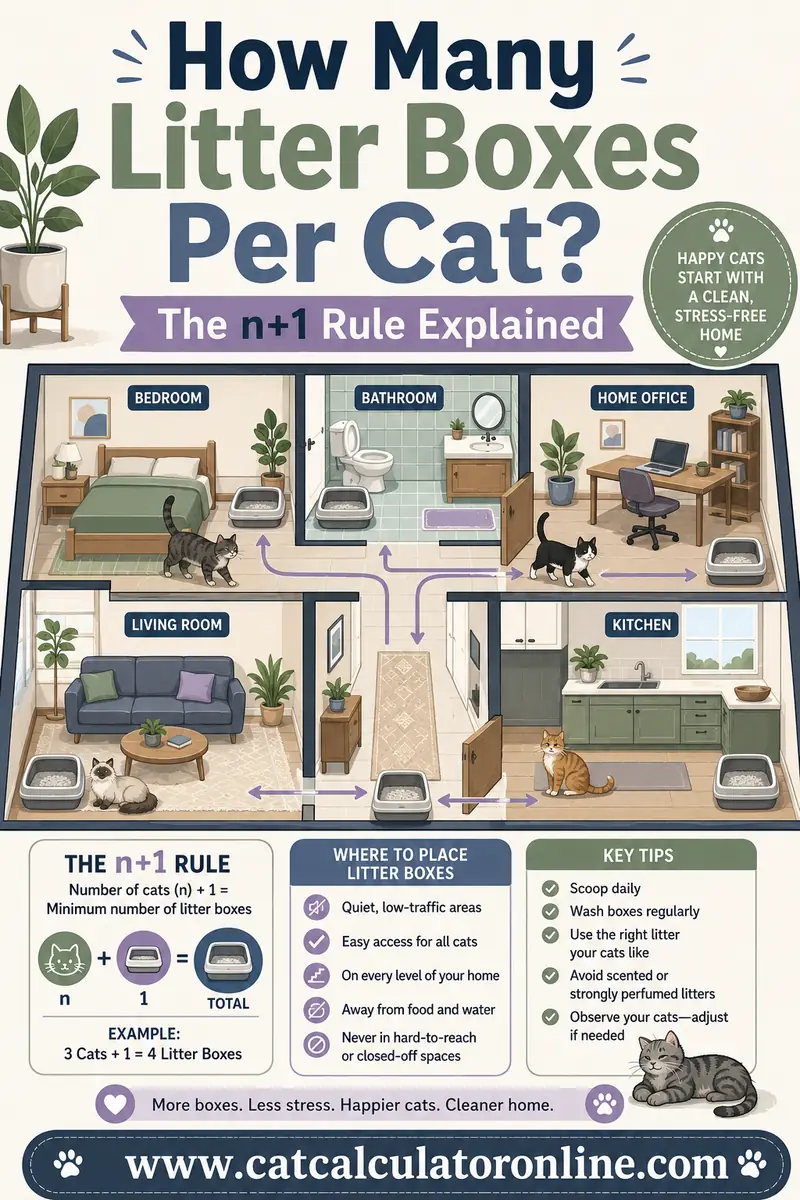
The standard guideline is n + 1: one litter box per cat, plus one spare. One cat needs two boxes, two cats need three, three cats need four. And the boxes have to be in separate locations — two boxes side by side read as a single box to a cat, so they don't count twice.
That one rule solves a surprising number of household problems before they start. Below you'll find the box counts, where to put them, what size and depth actually work, and how often to scoop and deep clean. If you're setting up for a new arrival, our free cat age calculator will tell you what life stage your cat is in — kittens and seniors both need different box setups than a healthy adult.
🧮 How many boxes do you need?
Tap the number of cats in your home:
Tap a number above to see how many boxes the n+1 rule gives you.
What the n+1 Rule Actually Means
The n+1 rule is simple arithmetic: count your cats, add one, and that's your box number. It's the guideline most veterinary behaviourists give, and it exists because litter box problems are one of the top reasons cats end up surrendered to shelters. Extra boxes are cheap insurance.
| Cats in the home | Litter boxes needed |
|---|---|
| 1 | 2 |
| 2 | 3 |
| 3 | 4 |
| 4 | 5 |
| 5 | 6 |
| 6 | 7 |
The "+1" isn't padding. It covers the realistic situations that come up constantly: one box gets soiled and nobody's scooped yet, one cat is sitting near a box and another doesn't want to walk past her, one box is in a room where the washing machine just started spinning. A cat who can't find an acceptable box doesn't hold it — she finds a different surface.
Why side-by-side boxes don't count as two
Cats care about locations, not units. Two boxes touching each other are, from a cat's point of view, one big bathroom in one place. If a confident cat is blocking that spot, both boxes are unavailable at once.
So the rule is really "n+1 boxes in n+1 separate places." Different rooms is the gold standard. Different corners of a very large room is an acceptable compromise. Two boxes shoulder to shoulder is not.
Does one indoor cat really need two boxes?
Yes — and it's the most commonly skipped part of the guideline. A single cat with two boxes will often use one for urine and one for stool, which is completely normal cat behavior. Having a second box also gives you an early-warning system: if she suddenly abandons one box, you know something changed about it.
Where to Put the Litter Boxes
Placement causes more problems than box count does. A cat will reject a perfectly clean box in the wrong place, and owners rarely suspect location as the culprit.
Quiet, but not trapped. Cats are vulnerable while they're going, so they want somewhere calm. But they also want an escape route. A box wedged into a dead-end closet, or one where a cat can be cornered, is a box she may stop trusting. Aim for a low-traffic spot with a clear line of sight and at least two ways out.
Never right next to food and water. This one is close to universal. Cats don't eliminate where they eat, and putting the box beside the bowls creates a conflict they resolve by going somewhere else. Keep them in different rooms if you can, or at least several feet apart with something between them.
At least one box per floor. In a two-story home, a cat napping upstairs shouldn't have to make a decision about whether the trip downstairs is worth it — especially an older cat or a kitten. Multi-floor homes should treat "one per level" as a hard minimum on top of the n+1 count.
Away from noisy appliances. Washing machines, dryers, boilers and automatic feeders all startle cats mid-use. One bad scare can put a cat off a box permanently.
Not behind a door that closes. Obvious once it happens, easy to overlook. If a box lives in a bathroom or laundry room, the door needs a wedge or a cat flap.
In multi-cat homes, spread them out. Boxes clustered in one area let a single cat control access to all of them. Different rooms, different floors, different ends of the house.
Box Size, Depth and Type
Once you've got the count and the placement right, the box itself is the last variable — and it's an easy one to get wrong at the pet store.
Size: at least 1.5× your cat's length
Measure your cat from nose to the base of her tail, then aim for a box at least one and a half times that long. Most cats need a box she can turn around in comfortably, dig in, and squat in without her rear end hanging over the edge.
Most commercially sold cat boxes are too small for an average adult cat. A cheap under-bed storage tub is often a better box than anything in the cat aisle — bigger, cheaper, and easier to clean. Cut down one end if you need a lower entry.
Entry height for kittens and seniors
Standard box sides are around 5–6 inches. That's fine for a healthy adult and a genuine obstacle for others.
- Kittens need a very low entry — around 1–2 inches — so they can climb in without help.
- Arthritic and senior cats need the same. Stiff hips make a high step painful, and a cat in pain will choose the rug instead. If your cat is over 10, assume some degree of joint stiffness even if she isn't limping.
- Cutting a U-shaped notch into one side of a plastic tub with scissors or a knife (sand the edges smooth) turns any box into a low-entry box for free.
If you're not sure whether your cat has crossed into senior territory, when is a cat considered senior has the age brackets, and signs your cat is getting old covers the changes worth adapting for.
Litter depth: 2–3 inches
About 2 to 3 inches (5–8 cm) of litter is the sweet spot. That's deep enough for a cat to dig and cover properly, and shallow enough that the box doesn't become an unstable pit. Deeper isn't better — some cats actively dislike sinking in, and very deep litter is harder to scoop cleanly.
Litter type: unscented, fine-grained, clumping
Survey after survey lands in the same place: most cats prefer unscented, fine-grained clumping litter — the texture closest to soft sand under their paws.
- Scented litter is made for human noses. To a cat, whose sense of smell is far sharper than ours, a heavily perfumed box can be genuinely off-putting.
- Large-grained or crystal litters feel harsh underfoot for some cats.
- Liners catch claws and bunch up. Many cats hate them, and they mostly save you a few seconds.
- Covered boxes trap odor inside, where the cat is. They also block sightlines and create an ambush point in multi-cat homes. Some cats genuinely don't mind them, but if you're troubleshooting a problem, the lid is one of the first things to take off.
One exception worth knowing: for very young kittens, many vets recommend non-clumping litter, because kittens explore with their mouths and clumping clay can be harmful if swallowed. Switch to clumping once she's past the mouthing stage.
How Often to Clean the Litter Box
Cleanliness is the thing cats are least willing to compromise on. A cat rejecting a box is very often just telling you it's dirty.
| Task | How often | Notes |
|---|---|---|
| Scoop solids and clumps | At least once daily — twice is better in multi-cat homes | The single most important habit. Takes 60 seconds per box. |
| Top up litter | As needed, back to 2–3 inches | Scooping removes litter; keep the depth consistent. |
| Full change + wash (clumping litter) | Every 2–4 weeks | Empty completely, wash with mild unscented soap and warm water, dry, refill. |
| Full change + wash (non-clumping litter) | Every 5–7 days | Non-clumping litter saturates faster and needs full replacement. |
| Replace the box itself | Every 6–12 months, or sooner if scratched | Scratches in plastic hold odor that no amount of washing removes. |
| Wash mats and surrounding floor | Weekly | Tracked litter and stray drops build up. |
Don't use bleach, ammonia, or strong-smelling cleaners on the box. Ammonia in particular smells like urine to a cat and can encourage her to go there again — or worse, near there. Mild unscented dish soap and hot water is all you need. Rinse and dry thoroughly.
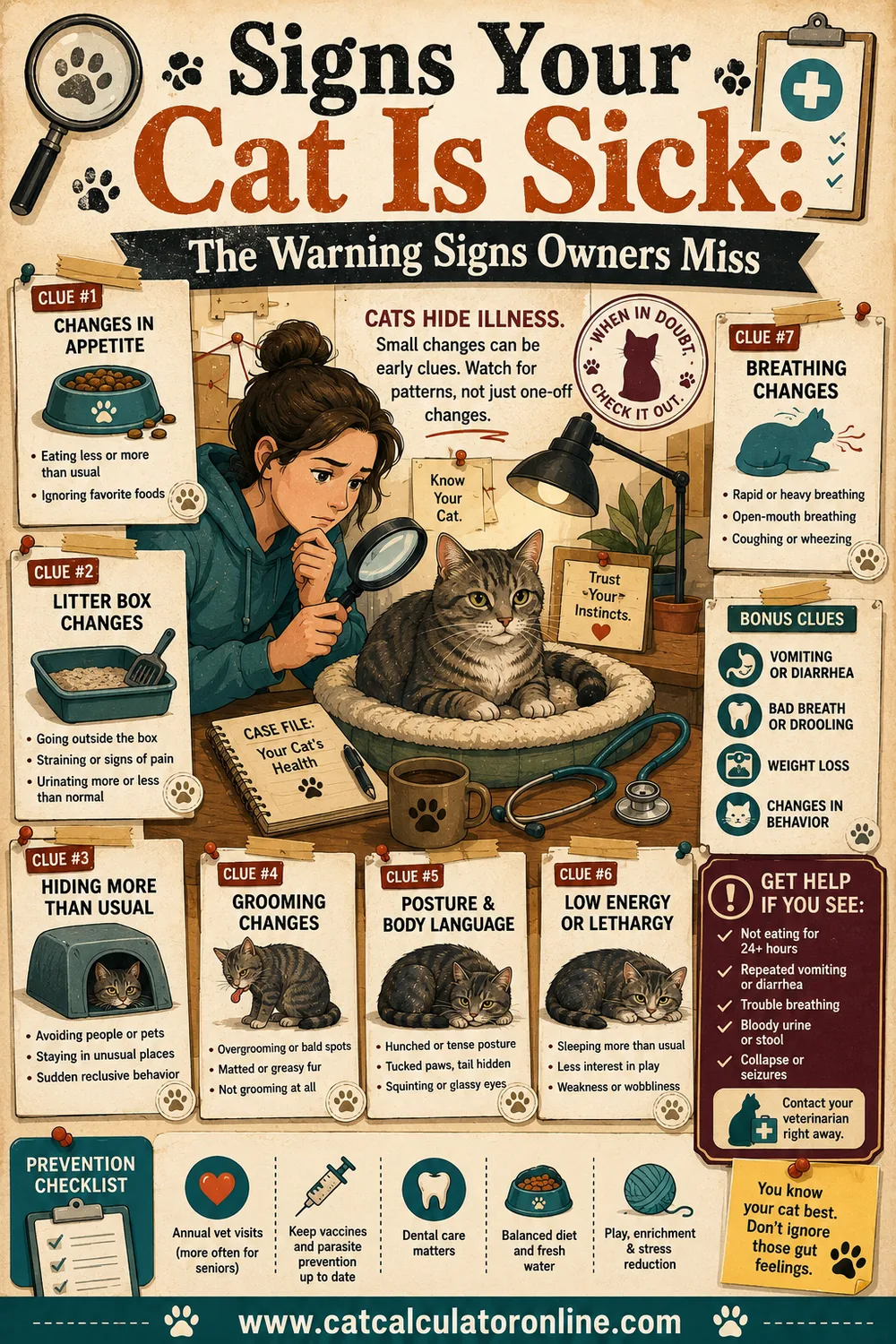
Scooping daily is also a health check. Clump size, frequency, blood, straining, diarrhea — the litter box is one of the best windows into a cat's health you have, and you only see the changes if you're looking every day. Signs your cat is sick covers what those changes can mean and when to call your vet.
What Litter Boxes Cost to Run
Litter is a real recurring line in a cat budget — usually the second-biggest after food.
A single-cat household typically goes through roughly 15–25 lbs of clumping litter a month, which lands somewhere around $15–$30 depending on brand and where you buy. Boxes themselves are a one-off $10–$40 each, replaced every year or so. Add scoops, mats and liners and you're looking at a few hundred dollars a year for one cat, scaling up with each additional cat — though not quite linearly, since bulk buying helps.
More boxes does mean more litter, but the difference is smaller than people expect: you're spreading the same volume of use across more boxes, not multiplying it. Our free cat cost calculator will fold litter into your full monthly and yearly estimate, and how much does a cat cost per year breaks down every other category.
Setting Up Boxes for a New Cat or Kitten
New cats need more boxes, closer together, not fewer.
When a cat first arrives, confine her to one room with a box she can see from wherever she's hiding. She's not going to explore a strange house to find a bathroom. As she gets confident and her territory expands, add boxes so that there's always one within easy reach of wherever she spends time.
For a kitten specifically: low-sided box, unscented litter, placed near where she sleeps and eats (but not right beside the food bowl). Put her in the box after meals, after naps and after play sessions. Most kittens have the instinct already — you're showing her where, not teaching her what. The new kitten checklist covers the rest of the setup.
Once the house is hers, spread the boxes out to their permanent, separated locations — one room at a time, moving a box only a few feet a day so she can follow the change.
FAQ
How many litter boxes for 2 cats?
Three. The n+1 rule means one box per cat plus one spare, and all three should be in separate locations rather than lined up together. Two cats sharing a single box is one of the most common causes of litter box problems.
Do two litter boxes side by side count as two boxes?
No. Cats judge boxes by location, so two boxes touching each other function as one bathroom in one place. If a cat is guarding that spot, both boxes are effectively unavailable. Put them in different rooms.
How deep should litter be in the box?
About 2 to 3 inches (5–8 cm). That's enough for a cat to dig and cover properly without the litter becoming unstable underfoot. Top it back up after scooping so the depth stays consistent.
How often should I completely change the litter?
With clumping litter, a full dump-and-wash every 2–4 weeks is typical if you're scooping daily. Non-clumping litter needs a complete change every 5–7 days. Wash the box with mild unscented soap and warm water — never ammonia-based cleaners.
Should I use a covered litter box?
Many cats dislike them. Covers trap odor inside where the cat is, block her view of the room, and create an ambush point in multi-cat homes. If your cat uses one happily, it's fine — but if you're troubleshooting any litter box issue, removing the lid is one of the first things to try.
Does one cat really need two litter boxes?
Yes. A single cat with two boxes often uses one for urine and one for stool, and the spare covers the times when one box is soiled or temporarily blocked. It also gives you an early warning: if she suddenly stops using one, something about that box or its location has changed.
The Bottom Line
Count your cats, add one, and put every box in a separate place — quiet, escapable, away from food and water, at least one per floor. Make the box at least 1.5× your cat's length with a low entry for kittens and seniors, fill it with 2–3 inches of unscented fine-grained clumping litter, skip the lid and the liner, and scoop it every single day.
Get those things right and most litter box problems never happen. If your cat is already going outside the box, that's a different conversation — start with a vet visit, because it's medical far more often than owners expect, and check signs your cat is sick for what else to watch for.
Setting up for a new cat? Try our free cat age calculator to see her life stage, and run the numbers on litter and everything else with the cat cost calculator.