When Do Kittens Lose Their Baby Teeth?
Kittens start losing milk teeth at about three months and finish by six or seven, swapping 26 deciduous teeth for 30 adult ones — and the fact that worries owners most, finding no teeth on the floor, is the least significant part of it, because kittens swallow the majority of them harmlessly. A little blood on a toy or a faint pink tinge in the water bowl is also normal. The one finding that genuinely needs a vet is a milk tooth still standing alongside its adult replacement, particularly a canine, because two teeth in one socket traps food and damages the gum. Track the age alongside the teeth with the kitten weight calculator.
The Short Answer
The whole timeline in six lines.
Milk teeth erupt from about two to six weeks, giving 26 deciduous teeth by six to eight weeks.
Nothing is lost between roughly eight weeks and three months. A kitten with a complete, clean milk set is somewhere in that window.
Losing starts at about three to four months, with the incisors going first.
Canines are replaced from about four to six months.
Premolars and the adult molars come in between about four and seven months.
All 30 adult teeth are normally present by six to seven months, which is why a cat with a full permanent set is at least about seven months old — a useful ageing cross-check alongside the signs in how to tell how old a kitten is.
Why 26 Becomes 30
A small anatomical fact that explains the numbers.
Kittens have 26 deciduous teeth: twelve incisors, four canines and ten premolars.
Adult cats have 30: twelve incisors, four canines, ten premolars and four molars.
Kittens have no deciduous molars at all. The four adult molars erupt into fresh bone at the back of the jaw with nothing to replace, which is where the extra four teeth come from.
Adult teeth are noticeably less needle-sharp. Milk canines are fine, translucent spikes; adult canines are thicker, whiter and blunter, which is why a six-month-old's play bite feels different from a ten-week-old's.
The permanent set is the last one. Cats do not regrow teeth, so damage from this point is permanent.
A missing adult tooth is worth mentioning at the neuter appointment. Sometimes it is simply late, sometimes it never formed, and occasionally it is unerupted under the gum — a vet can tell with a radiograph.
Adult teeth form under the milk ones from before birth. The permanent tooth pushes up, the root of the milk tooth above it is resorbed by the body, and the crown drops off with almost nothing holding it. That is why the process is normally painless and why so little bleeding is involved.
The two sets overlap by design. For a few days around each swap there may be a visible gap, a loose tooth, or both teeth present — which is normal briefly and a problem only when it persists.
The Teething Table
Everything by age, with what you would expect to see.
| Age | Teeth event | What you notice | Action |
|---|---|---|---|
| 2–3 weeks | Deciduous incisors erupt | Pinpricks along the front gum | None |
| 3–4 weeks | Deciduous canines erupt | Sharp needle fangs, nursing stings | Start weaning around now |
| 4–6 weeks | Deciduous premolars erupt | Can chew moistened food | Progress the weaning food |
| 6–8 weeks | All 26 milk teeth in | Complete sharp little set | Handle the mouth regularly |
| 3–4 months | Incisors replaced | Gappy front, blood on toys | Provide chew toys |
| 4–6 months | Canines replaced | Chewing peaks, some drooling | Check for doubled canines |
| 4–7 months | Premolars and molars | Less chewing, calmer mouth | Start brushing |
| 6–7 months | 30 adult teeth complete | Whiter, blunter teeth | Vet check any gaps or doubles |
Individual variation of a few weeks is normal. Breed and size shift the timing slightly, with larger breeds tending to run a little later.
The neuter appointment usually falls in the middle of this, which is convenient — the vet gets a good look at the mouth under anaesthetic, and any retained teeth can be removed at the same time. Timing is covered in when to neuter a cat.
What Is Normal and Not Worth Worrying About
Most of what alarms owners at this stage is unremarkable.
Swallowing the teeth. Kittens swallow most of their milk teeth with food, and they pass through without any problem. Finding none on the floor is the usual experience, not a warning sign.
Mild gum bleeding. A pink tinge on a toy, a faint smear on the food, or a slightly pink water bowl is normal as a tooth comes out. Steady bleeding is not.
Increased chewing. Chewing behavior peaks between about three and six months. Kittens gnaw at cables, shoes, plants and hands because the gums are irritated.
A little extra drooling.
Slightly slower eating, or a preference for wet food over dry for a week or two. A kitten that eats less enthusiastically but still eats is fine.
Slightly stronger breath. A mild change during teething is common. Persistently foul breath is not, and belongs to the problems below.
Never withhold food during teething. If dry food seems uncomfortable, moisten it or switch to wet for two weeks rather than reducing the amount. A kitten in a growth phase has no spare capacity to eat less.
A tooth found on the floor is a curiosity, not evidence of a problem. Milk incisors are so small they are easy to mistake for a grain of dry food, which is another reason people never see them.
Nipping and grabbing during this window is normal too, and separate from the chewing. It is play behavior peaking at the same time as sore gums, and the response is redirection onto a toy rather than telling the kitten off.
None of the above should stop a kitten growing. If weight gain flattens during teething, the teeth are not the explanation and the kitten needs checking.
Retained Deciduous Teeth: The Real Problem
The one finding on this page that genuinely needs an appointment.
A retained deciduous tooth is a milk tooth that has not fallen out while its adult replacement has already erupted, leaving two teeth in one place.
Canines are the classic site. You will see two fangs side by side, the slim milk tooth usually sitting just in front of the thicker adult one.
It is not a cosmetic issue. Two teeth crowded into one socket trap hair and food between them, and periodontal disease starts early at that spot. The adult tooth can also be pushed into the wrong position, causing a bite that traumatises the opposite gum.
Treatment is extraction of the milk tooth, usually straightforward, and frequently done during the neuter anaesthetic to save a second procedure.
Check at around five to six months. Lift the lip and look at the four canines. If any position has two teeth, ring the practice.
Do not pull a loose tooth yourself. Deciduous roots are long and fragile, and a fractured root left in the gum causes an abscess. Wobbly teeth come out on their own.
The longer-term consequences of early crowding are covered in dental disease in cats, which is by far the most common health problem in adult cats.
When to call the vet
Clear thresholds rather than vague concern.
Book an appointment for: two teeth in one position, particularly canines; an adult tooth clearly growing at the wrong angle; a tooth broken with a pink or dark spot in the middle; swelling of the face or under the eye; or a milk tooth still present at seven months.
Same-day call for: a kitten that stops eating altogether, bleeding that does not stop, obvious mouth pain, pawing at the face, or a foul smell with red, ulcerated gums.
Red, sore, inflamed gums beyond the immediate site of an erupting tooth are not teething. Gingivitis and stomatitis do occur in young cats and need proper treatment.
Cats hide pain extremely well. Reduced grooming, hiding, turning away from food, chewing on one side or a change in temperament are the signals to read, and the wider list is in how to tell if a cat is in pain.
Mention anything you noticed at the neuter appointment, since that anaesthetic is the best opportunity for a full oral examination in the first year.
Teething should be mildly irritating, never debilitating. A kitten that is genuinely unwell is not simply teething.
Managing the Chewing Phase
Practical and mostly about redirection.
Give things that are meant to be chewed. Soft rubber kitten toys, dental kitten treats designed for the age, and toys you can chill slightly in the fridge for a few minutes.
Do not let a kitten chew your hands, even during teething. Hand-biting learned at four months is very hard to remove at two years. Redirect onto a toy every time.
Protect the cables. Chargers, headphones and lamp flexes are the favorite targets and are genuinely dangerous. Use cable tidies, split-tube covers or bitter-tasting deterrent spray.
Check the houseplants. Chewing peaks at exactly the age kittens explore, and lilies in particular are lethal to cats.
Avoid hard chews. Bones, antlers, hard nylon and ice cubes can fracture a tooth. A cat's teeth are not built for that, and a fractured adult canine is a permanent problem.
Rotate toys weekly to keep interest up, which reduces the search for something new to gnaw.
Building Dental Habits Now
The teething window is the best training opportunity you will ever get.
Handle the mouth from the first week you have the kitten. Lift the lip, touch the gums, count the teeth. Thirty seconds a day, paired with a treat.
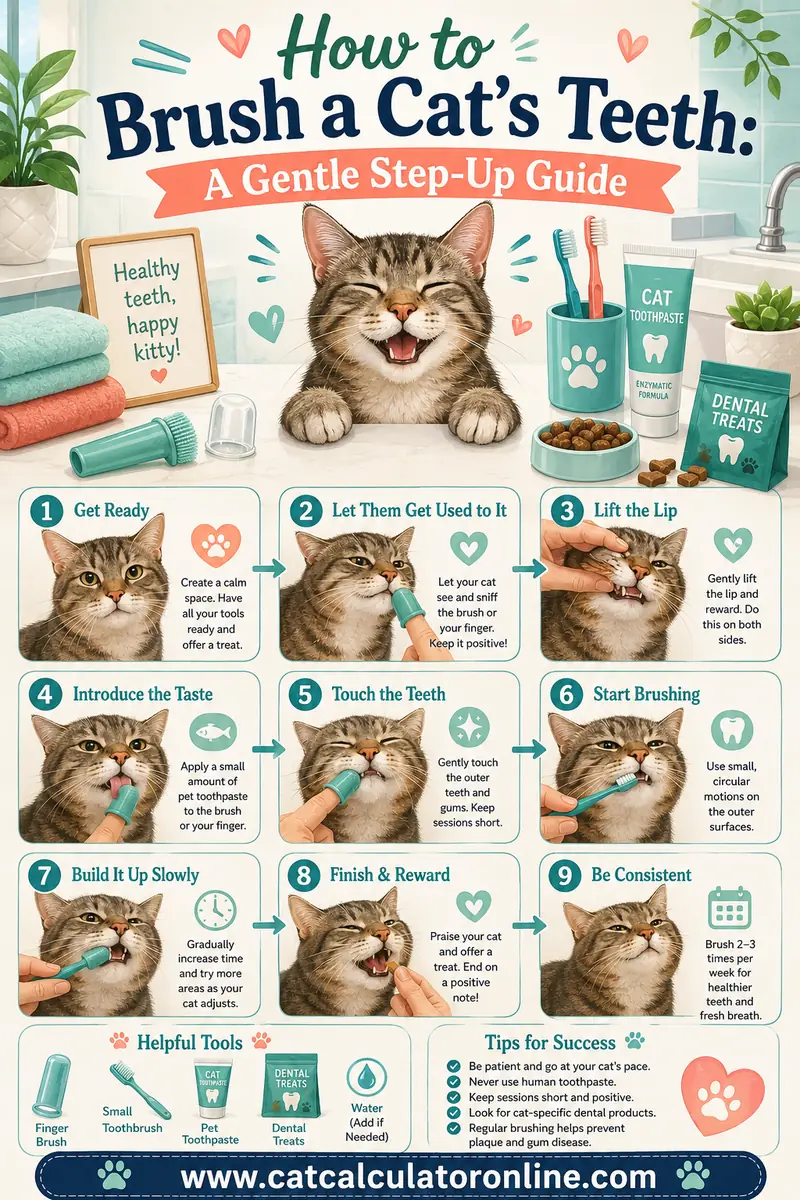
Start brushing during teething, gently, with a soft finger brush or a small soft toothbrush and a cat-specific enzymatic toothpaste. Never human toothpaste — fluoride and xylitol are unsafe for cats.
Build up in stages: touching the muzzle, then lifting the lip, then paste on a finger, then a brush, over a couple of weeks. Avoid the sorest areas while teeth are actually erupting.
Aim for daily, accept several times a week. A cat that accepts brushing at six months usually accepts it for life, and one introduced at six years usually does not.
The technique in detail is in how to brush cats teeth.
Feed for the mouth as well. Dry food alone does not prevent dental disease, but a kitten comfortable with a variety of textures is easier to feed later. Texture variety starts at weaning, which is covered in when can kittens eat solid food.
And book annual dental checks. Most cats show meaningful dental disease by three years, and it is much easier to prevent than to treat.
Frequently Asked Questions
At what age do kittens lose their baby teeth?
From around three to four months, starting with the incisors, then the canines at four to six months and the premolars and molars from four to seven. All 30 adult teeth are normally present by six to seven months.
I never find any kitten teeth — is that normal?
Yes, and it is what usually happens. Kittens swallow most of their milk teeth while eating, and they pass through harmlessly. Finding one on the carpet is the exception rather than the rule.
Is bleeding normal when a kitten loses teeth?
A little is. A pink tinge on a toy, a faint smear on food or a slightly pink water bowl are normal as a tooth comes out. Steady bleeding, obvious mouth pain or refusing to eat are not, and warrant a call.
What is a retained baby tooth in a kitten?
A milk tooth that has not fallen out after its adult replacement has erupted, leaving two teeth in one position. It is most common with the canines, traps food against the gum, and needs the milk tooth extracted by a vet.
Should I pull out my kitten's loose baby tooth?
No. Deciduous roots are long and fragile, and a fractured root left in the gum can abscess. Loose teeth come out on their own with normal eating and play. If one is still in place at seven months, see a vet.
How many teeth should an adult cat have?
Thirty: twelve incisors, four canines, ten premolars and four molars. Kittens have only 26, because they have no deciduous molars, which is where the extra four permanent teeth come from.
Kittens run through two full sets of teeth in seven months: 26 milk teeth in by six to eight weeks, replaced from about three months, and 30 adult teeth complete by six or seven. Swallowed teeth and a faint trace of blood are normal, and so is a chewing phase that peaks between three and six months — give it somewhere to go and keep it off your hands and the cables. The single thing worth an appointment is a milk tooth still standing beside its adult replacement, most often a canine, and around five to six months is when to look. Use the teething stage as a free age check alongside the kitten weight calculator.