Why Does My Cat Follow Me Everywhere? 8 Real Reasons Behind Your Shadow
Your cat follows you everywhere mostly because she's genuinely attached to you. Cats form real bonds with their people, and staying close to you is one of the clearest ways they show it — you're her source of safety, warmth, food, entertainment, and company, all on two legs. Mix in curiosity, routine, and the well-learned fact that following you sometimes produces snacks, and you get a small shadow with whiskers.
Despite the aloof reputation, a cat choosing to trail you from room to room is normal, healthy, and rather flattering. How much following is typical does shift with age — kittens shadow constantly, seniors sometimes get clingier for medical reasons — so if you'd like context, our free cat age calculator shows exactly where your velcro cat is in human years.
🐾 Why is she following you right now?
Tap the situation and get the most likely explanation:
Tap a situation above to see what the following means.
Is It Normal for a Cat to Follow You Everywhere?
Completely. It's one of the most common behaviors owners ask about, usually because it clashes with everything we're told about cats being solitary and indifferent.
The independent-loner image is outdated. Cats are flexible, social animals: feral cats often live in cooperative colonies, house cats form strong social ties with each other, and research on cat–human relationships has repeatedly found that many cats treat their owner as a source of safety — checking in with them, seeking them out in unfamiliar situations, and preferring their company over food or toys in some studies. Following you is that relationship in motion.
There's a range, of course. Some cats supervise you from a doorway; some need to be in the same room; some ride shotgun on your shoulder if permitted. All of it sits comfortably inside normal, as long as your cat also seems relaxed and can cope when you're away.
Does Following Me Mean My Cat Loves Me?
In most cases, yes — proximity is one of the most honest measures of feline affection.
Cats vote with their feet. A cat has no obligation to be in the room with you; the house is full of warm, quiet spots without you in them. Choosing the spot next to you, over and over, is a deliberate preference. Behaviourists look at exactly this — how much time a cat chooses to spend near a person — when assessing the bond.
Following rarely travels alone, either. Watch for the behaviors that tend to come with it:
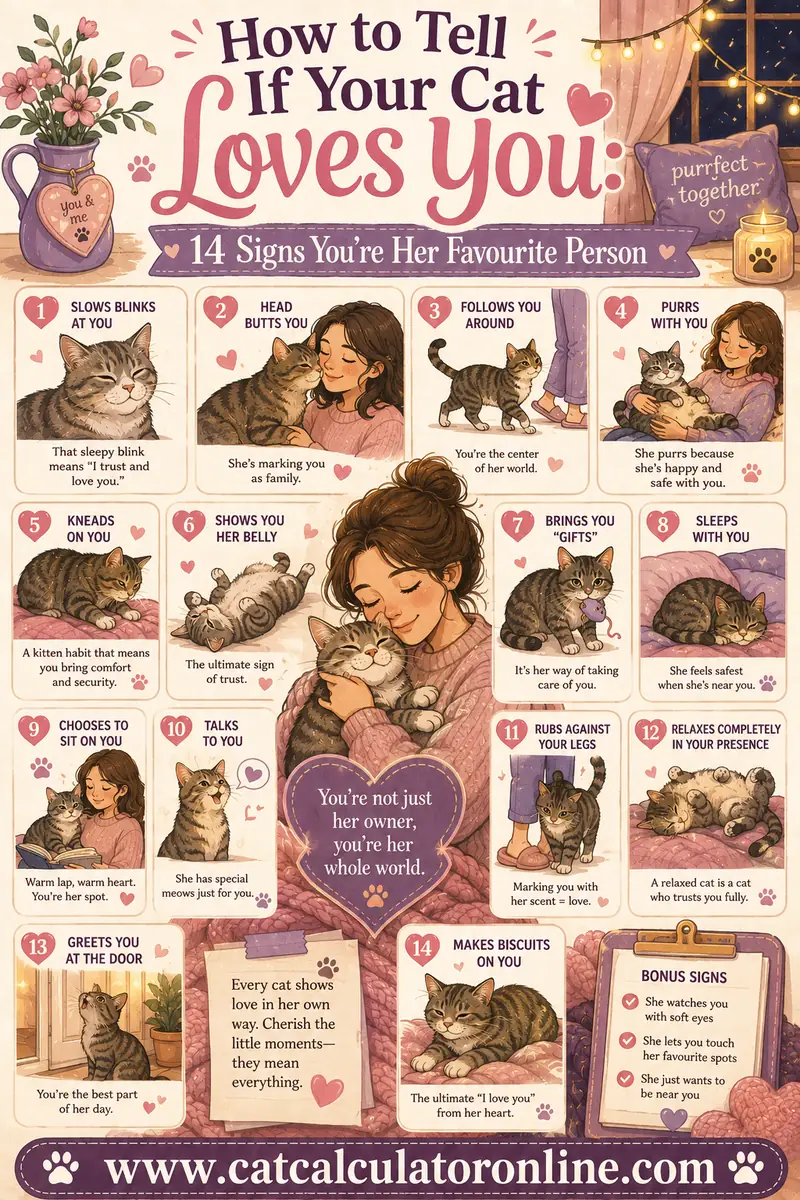
- Tail up as she trots after you — the classic friendly-greeting posture between bonded cats
- Slow blinks when you make eye contact along the way
- Settling within sight once you stop moving, even if she doesn't touch you
- Head bumps and cheek rubs on your legs when you pause
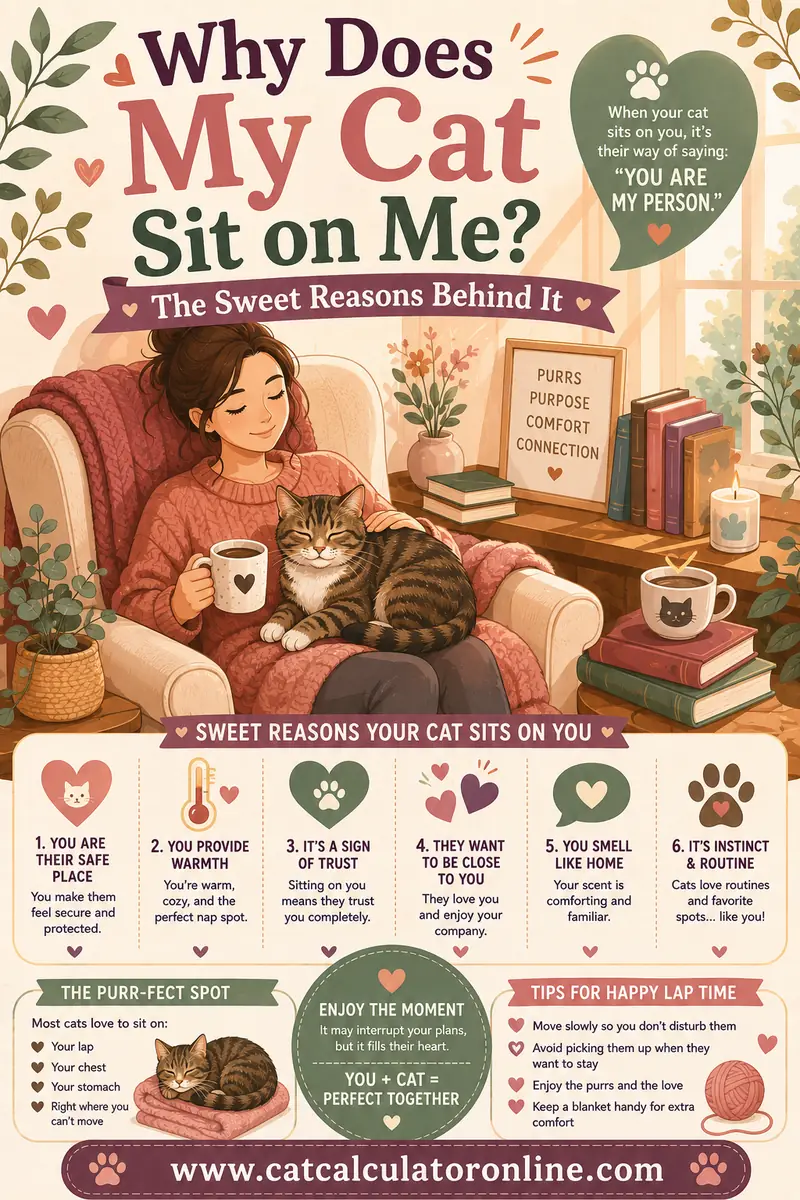
- Sleeping near or on you — the ultimate trust move, covered in why does my cat sit on me
If several of those sound familiar, the following is affection, plain and simple. For the full checklist, see how to tell if your cat loves you.
Is It Love — or Is It Dinner Time?
Let's be honest with each other, because your cat certainly won't be: some percentage of the shadowing is about food.
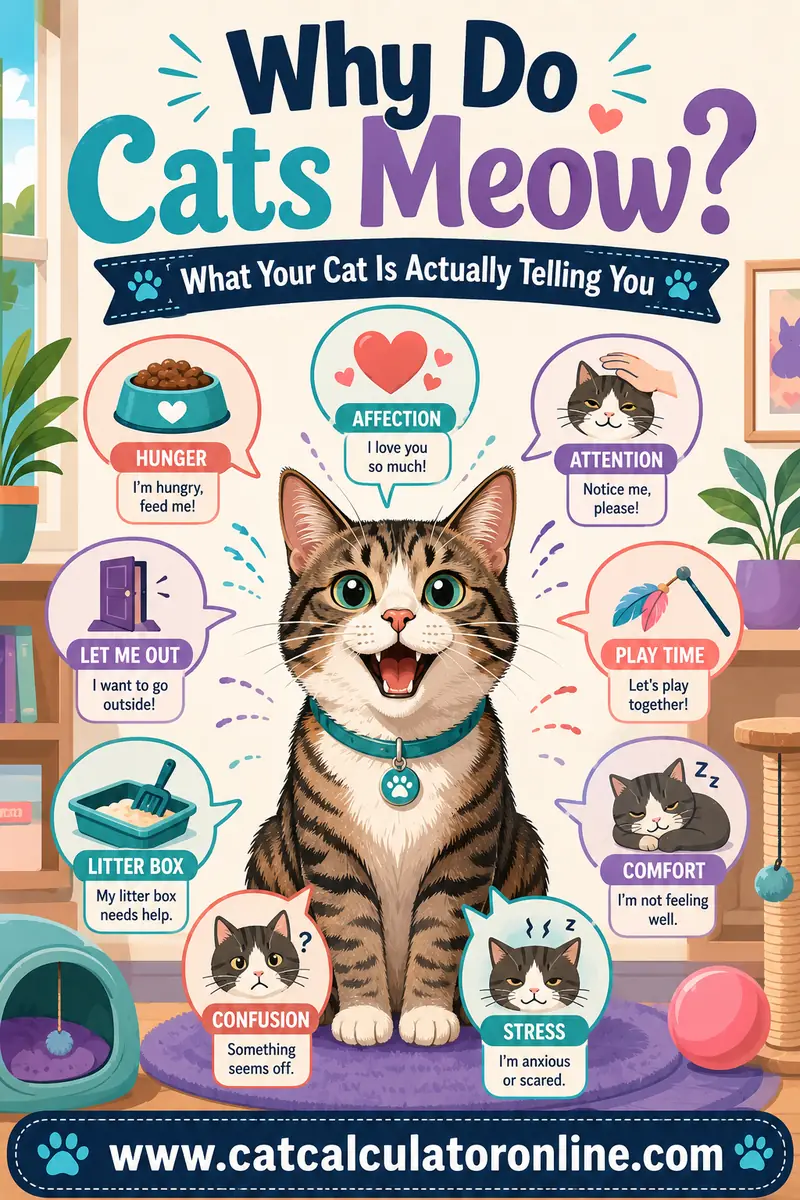
Cats are magnificent readers of routine. She has learned exactly which of your movements precede meals — getting up from your desk at a certain hour, walking toward the kitchen, opening a particular cupboard — and she front-runs those signals like a tiny trader. Following you in the pre-meal window, with extra meowing and figure-eights around your ankles, is her making sure the human doesn't forget the most important event of the day. Our why do cats meow guide covers how those demand-meows evolved specifically for us.
Here's the fair test: watch what she does after the bowl is full. If she eats and disappears about her business, that particular escort was catering. If she eats and then comes back to find you — hops on the sofa, settles in your office, resumes the shadowing with zero food on offer — the following runs deeper than the menu.
Most cats are both, and that's not a disappointment. Food is how the relationship started, thousands of years ago and in your kitchen alike. The affection that grew around the feeding routine is real. She can love you and love that you operate the can opener; the two have never been in conflict.
Why Does My Cat Follow Me to the Bathroom?
The bathroom escort is so universal it deserves its own explanation. Several forces converge on that small room:
- You're a captive audience. For once, you're seated, stationary, and not staring at a screen. From a cat's perspective this is prime attention time, and she knows roughly how long she's got.
- Closed doors are an outrage. Cats patrol their territory, and a door that shuts them out of part of it is both an insult and a mystery. Many cats don't even want in — they want the option. Hence the paw under the door.
- It's part of your predictable route. Bathroom trips happen at reliable times, in a reliable place. Cats attach themselves to routines, and yours includes this stop.
- The room itself is interesting. Cool tile, a bath mat, a sink she fits inside perfectly, dripping taps, the mysterious water chair. Great territory, frankly.
- Vulnerability logic, possibly. Some behaviourists suggest cats may keep company with their people at vulnerable moments the way bonded cats rest near each other. It's a nice theory; the captive audience and the closed-door outrage explain most of it on their own.
If the escort doesn't bother you, there's no reason to end it. If you'd like privacy, close the door consistently and ignore the protest — meowing that never works gets retired eventually. A treat-dispensing toy deployed just before you disappear buys goodwill.
Which Cats Follow the Most?
Following behavior isn't distributed evenly. A few patterns show up again and again:
Kittens follow the most, by a mile. A kitten is programmed to stay close to her mother — that's how she eats, learns, and stays safe. Rehomed into your house, she transfers that program to you. A kitten trailing your heels, crying when a door closes between you, and napping on your feet is developing exactly on schedule. Most cats relax the shadowing as they mature; see cat life stages explained for what changes when.
Some breeds are famous velcro cats. Siamese and their Oriental relatives are legendary people-followers who narrate the journey. Ragdolls are nicknamed "puppy cats" for trailing owners from room to room. Burmese, Tonkinese, Sphynx, Abyssinians, and Maine Coons all have strong reputations for wanting to be wherever you are. Adopt one of these and the following isn't a quirk — it's a feature you signed up for.
History shapes it too. Cats who were well-socialized with humans as young kittens tend to be more people-oriented for life. Rescues sometimes attach intensely to the person who made them feel safe. And an only cat in a quiet home often makes you her entire social calendar, where a cat with a bonded feline housemate splits the attention.
And individuals just vary. Two litter-mates raised identically can turn out one supervisor and one shadow. Personality is real in cats, and neither end of the range is a problem.
When Is Following Me a Warning Sign?
Here's the part worth reading carefully: the concern is almost never the following itself — it's a change in the following.
| What you're seeing | What it might mean | What to do |
|---|---|---|
| Steady shadowing she's done for years, relaxed body | Normal attachment and routine | Enjoy it — this is the good stuff |
| Intense following only around mealtimes | Food-schedule strategy | Nothing; maybe an automatic feeder if the 5am escort is wearing thin |
| A previously independent cat turns clingy over days or weeks | Possible illness or pain — cats often seek their person when unwell | Book a vet visit and mention the change |
| New clinginess plus yowling, night restlessness, or confusion in a senior | Possible cognitive decline, thyroid trouble, or blood pressure issues | Vet check; these are common, manageable senior conditions |
| Following with distress — crying at doors, panic when you leave, destructive behavior alone | Separation-related anxiety | Vet first to rule out illness, then enrichment and gradual-absence training |
| Constant underfoot behavior plus appetite or litter box changes | A health issue with clinginess as a side effect | Vet visit — track the other symptoms to share |
Two of those rows deserve emphasis.
Sudden clinginess in any adult cat is information. Cats hide illness remarkably well, but many quietly seek out their trusted person when something's wrong. A cat who never cared where you were and now can't leave your side may be telling you the only way she can. You know your cat's baseline better than anyone — trust a real deviation from it, and let your vet make the call.
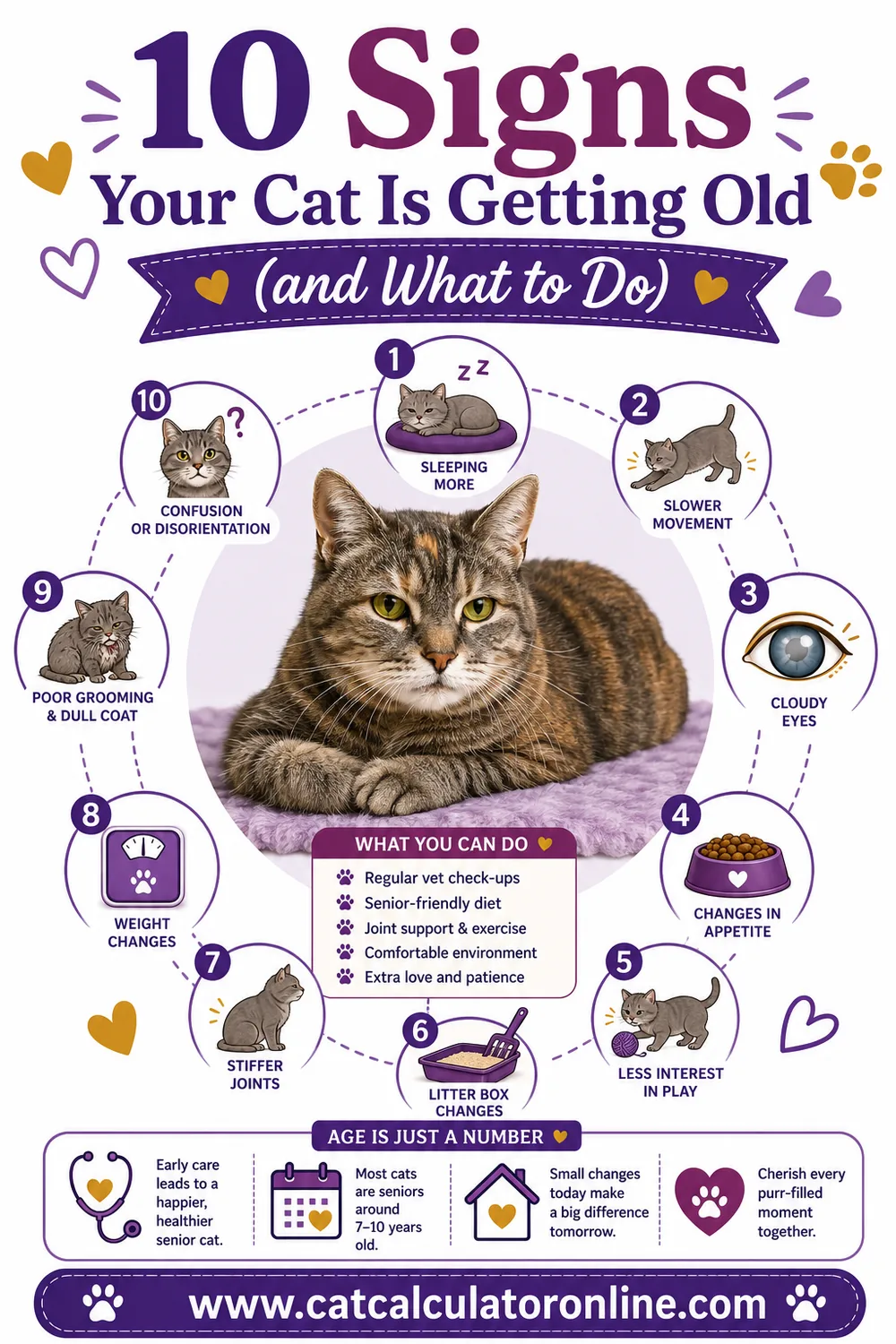
In seniors, new shadowing has specific medical suspects. Older cats who start following anxiously — especially with night-time yowling, disorientation, staring at walls, or changed sleep patterns — may be experiencing age-related cognitive decline, and clingy restlessness can also accompany hyperthyroidism or high blood pressure. All of these are common, all are manageable, and all do better caught early. Our guide to signs your cat is getting old walks through what's normal ageing and what isn't.
Should I Ever Discourage the Following?
If both of you are happy, no — there's nothing to fix. A cat who follows you and then settles calmly nearby is a bonded cat behaving beautifully.
It's worth gentle management in two situations:
When it's a tripping hazard. A cat weaving through your feet on the stairs is genuinely dangerous for you both. Teach a positive alternative: reward her for waiting at the top or bottom, or toss a treat ahead of you so she leads rather than tangles. Never punish the following itself — she's following you out of attachment, and punishing that is both unkind and confusing.
When she can't cope without you. If being apart from you produces real distress — persistent crying, not eating when you're out, destructive scratching at doors — the kindness is building her confidence, not more access to you. That looks like: enrichment she can do alone (food puzzles, window perches, foraging games), predictable routines, low-key departures and arrivals, and practicing short absences that grow gradually. If it's severe, your vet can help; occasionally anxiety like this has a medical driver or benefits from professional behavior support.
For everyone else: put a second cat bed in your office, narrate your chores to your supervisor, and accept the escort service. There are worse fates than being loved at ankle height.
FAQ
Why does my cat follow me everywhere and sleep with me?
That combination is full attachment: she wants to be near you when you're active and trusts you enough to be unconscious next to you. Sleep is a cat's most vulnerable state, so choosing your bed is a serious compliment. Warmth and routine sweeten the deal, but the driver is the bond.
Why does my cat follow me and no one else?
Cats often pick a favorite person and route most of their attachment through them. It usually tracks who feeds and plays with her, whose energy she prefers, and early positive associations — not who loves her most. Other family members can build their own credit with play sessions, treats, and letting her make the approaches.
Why does my cat follow me but not want to be petted?
Because company and cuddling are different currencies. Many cats want proximity — same room, within sight — without physical contact, and that's a real form of affection, not a rejection. Let her set the touching terms and you'll often find she drifts closer over time.
Is my cat following me because she's hungry?
Sometimes, and she'd like you to think so more often than it's true. Food-motivated following clusters around mealtimes and comes with meowing and leg-weaving. If she still seeks you out on a full stomach, the shadowing is about you, not the bowl.
Why has my older cat suddenly started following me everywhere?
A genuine change in clinginess in a senior is worth a vet visit. Cats often stick close to their person when they feel unwell, and in older cats new shadowing can accompany cognitive decline, thyroid problems, or blood pressure issues — all common and all manageable. Mention any night yowling, confusion, or appetite changes too.
Do cats follow you because they're bored?
Boredom can be part of it, especially for indoor-only cats with quiet days — you're the most interesting thing in the territory. If the following comes with pestering, add hunting-style play sessions and solo enrichment like food puzzles. A cat with a fuller day usually follows out of affection rather than desperation.
The Bottom Line
A cat who follows you everywhere is telling you that you're her safe place, her entertainment, her routine, and — around 5pm especially — her caterer. It's normal, it's healthy, and by feline standards it's practically a love letter. Enjoy the escort, keep her day enriched, and take one thing seriously: a sudden change in clinginess, in any direction, is your cue to check in with the vet.
Curious whether your shadow is a clingy teenager or a devoted senior in human terms? Our free cat age calculator tells you in one tap — then read how to tell if your cat loves you to decode the rest of her signals.