Domestic Shorthair Cat Lifespan
Domestic shorthairs typically live 13 to 17 years, and indoor ones reaching 18 to 20 is common rather than remarkable — which quietly makes the ordinary mixed-breed cat one of the longest-lived cats you can own. She has no pedigree, no breed club and no health certificates, and that is precisely her advantage: her ancestors were never bred within a closed population, so the inherited diseases that define pedigree breeds mostly pass her by. What decides her lifespan instead is almost entirely under your control, and it changes as she ages. Find out where she is in human terms with our cat age calculator.

How Long Do Domestic Shorthairs Live?
The range is wide, and the width itself is informative.
Thirteen to seventeen years is the usual figure, and indoor domestic shorthairs commonly reach 18 to 20. That puts them at or above almost every pedigree breed, which surprises people who assume a papered cat is a better-built one.
The spread from 13 to 20 is enormous in cat terms — it is the difference between a cat who dies before your children leave home and one who is still there afterwards. Very little of that spread is genetic.
Like every feline lifespan figure, these are estimates from imperfect data. Nobody counts every mixed-breed cat. The numbers come from veterinary records and insurance claims, which over-represent cats whose owners visit vets. Take the range and ignore anyone quoting a decimal place.
Where an individual cat lands depends on four things: whether she goes outside, what she weighs, whether her teeth are looked after, and whether anyone screens her bloods once she is past eleven.
What A Domestic Shorthair Actually Is
Worth defining, because the term gets used loosely and it is not a breed.
Domestic shorthair is a category, not a pedigree. It means a short-coated cat of no particular breed — a mixed-breed cat, a house cat, whatever your local term is. Its long-coated equivalent is the domestic longhair.
There is no breed standard, so there is no typical appearance. Tabby, black, white, tortoiseshell, calico, ginger, tuxedo — all are domestic shorthairs if the ancestry is mixed. Coat color and pattern say nothing about health or longevity.
She may well have pedigree ancestors somewhere. Domestic cats and pedigree cats have exchanged genes for centuries, which is why an ordinary shorthair occasionally turns up with a condition normally associated with a breed.
A typical lean adult sits at 8 to 12 lb (3.6 to 5.4 kg), with a fair spread either side. Males average a little heavier than females. There is no breed-standard weight, so body shape matters more than the scale.
Why They Do So Well
The mechanism is straightforward population genetics, and it is genuinely in her favor.
Most inherited feline diseases are recessive, needing two faulty gene copies to cause a problem. In a large, freely mixing cat population, two carriers of the same rare fault almost never meet. In a closed pedigree breed descended from a handful of founders, they meet constantly.
That is why breed-specific conditions exist and why mixed-breed cats mostly dodge them. Our page on whether mixed-breed cats live longer works through the genetics and the size of the advantage, and our cat breed lifespan chart shows how the breeds compare.
But the advantage is modest — around one to two years on average. It is not a license to skip vet visits, and it is completely erased by a busy road.
And it does nothing at all about the conditions that kill most cats. Kidney disease, thyroid disease, diabetes, dental disease, arthritis and cancer are age-related, not inherited. A long-lived cat gets more exposure to them, not less.
The Timeline: What Tends To Happen When
Most owners think about a cat's life in two stages, kitten and old. It is really five, and each has a different job.
| Age | Life stage | What matters most |
|---|---|---|
| 0 to 12 months | Kitten | Vaccinations, neutering, microchip, litter and handling habits |
| 1 to 6 years | Young adult | Portion control, dental routine, annual check-up |
| 7 to 10 years | Mature | Baseline bloodwork yearly; weight often peaks here |
| 11 to 14 years | Senior | Twice-yearly checks with bloods, urine and blood pressure |
| 15 years and over | Geriatric | Comfort, mobility, appetite and weight monitoring |
The most commonly wasted years are 7 to 10. She still looks and behaves young, so nothing seems urgent — and that is exactly when a baseline blood panel is most valuable, because every later result gains meaning from being compared to it.
The most commonly missed transition is at eleven. Twelve months between check-ups in a senior cat is roughly equivalent to a person in their seventies going four or five years without seeing a doctor. Our guide to common cat illnesses by age breaks down what tends to appear when.
Weight Is The Main Thing You Control
For a cat with no inherited disease to worry about, this becomes the central health issue of her life.
Judge by feel, not by the number. Run a flat palm along her side: the ribs should be easy to find under a thin covering, a bit like the back of your hand. From above, look for a waist behind the ribcage. From the side, a slight tuck up toward the back legs.
Weight creeps on in the quiet years, between two and seven. A cat who gains a pound a year for four years has gained around 40 percent of her body weight, and nobody notices because it happened slowly and she was never ill.
The consequences are specific. Excess body fat drives insulin resistance, and overweight cats develop diabetes at several times the rate of lean ones. It loads the joints, so arthritis arrives earlier. And it makes anaesthesia and illness harder to manage at every stage.
Losing it must be slow, and never by withholding food. A cat who stops eating can develop hepatic lipidosis, a serious liver condition, within days. Aim at roughly 0.5 to 2 percent of body weight per week with measured portions and a plan from your vet. Count treats — ten percent of daily calories is the usual ceiling.
A typical lean adult needs roughly 200 to 250 kcal a day, varying with size, age and activity. Measuring the food rather than eyeballing it does most of the work.
The Big Four Of Old Age
These four account for a large share of what shortens a domestic shorthair's life, and every one is easier to manage early.
Chronic kidney disease is the most common. Working kidney tissue is lost gradually, and because cats hide illness, roughly three-quarters of function has usually gone before you see thirst, weight loss or a poor coat. Found on routine bloods first, it responds far better.
Hyperthyroidism is the sneakiest. An overactive thyroid gland speeds everything up, so the cat eats ravenously and loses weight, often becoming restless or vocal at night. Owners frequently describe her as looking great for her age just before diagnosis. Treatment ranges from daily tablets to a radioiodine injection that is usually curative.
High blood pressure is the one with the cruellest presentation. It often causes no signs at all until a cat goes suddenly blind because the retina has detached. A two-minute cuff reading at a senior check prevents that.
Dental disease is the most ignored. Most cats have some gum disease by three, and they keep eating straight through the pain. Lift her lip: a thin red band along the gum line is early and reversible, brown tartar and receding gums are not.
Diabetes and arthritis round the list out, and both are strongly linked to weight. Diabetes in cats is frequently reversible if it is caught early and the weight comes off, which is not true in people and surprises most owners. Arthritis rarely shows as a limp; it shows as a cat who has quietly stopped jumping onto the worktop.
What these six share is that none of them announce themselves. A cat with early kidney disease, an early thyroid problem or a mouth full of painful teeth behaves normally, eats normally and looks well. That is not a failure of attention on your part — cats are prey animals as well as predators, and hiding weakness is built into the species. It is the entire argument for testing rather than watching.
If You Do Not Know Her Age
Half of domestic shorthairs arrive from a rescue with a guess attached to them, which complicates the timeline.
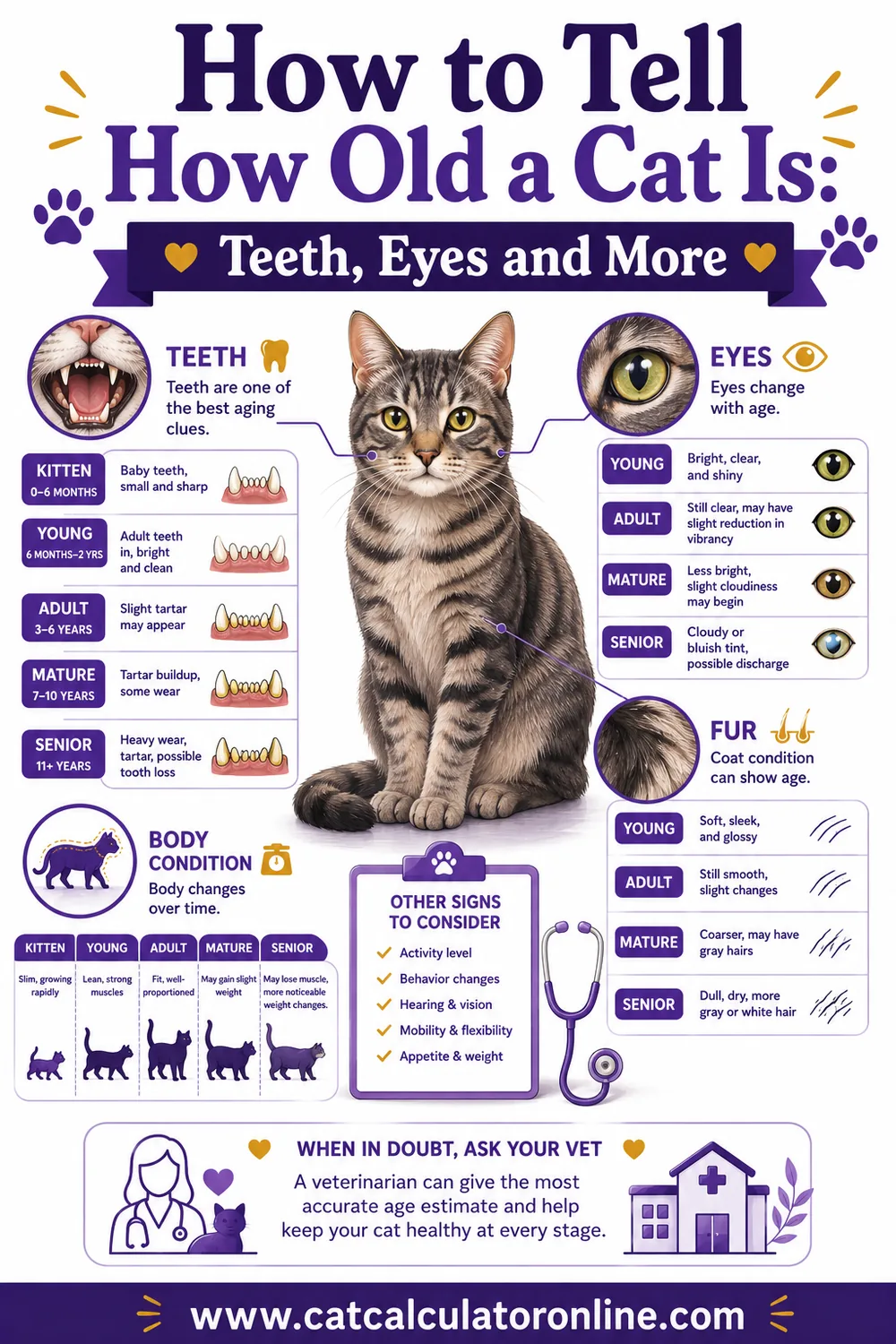
Vets estimate age rather than know it, and the error bars widen with every year. Teeth give a decent bracket in a kitten and a rough one in an adult. Once tartar, gum recession and lens changes are established, an eight-year-old and a twelve-year-old can look identical.
Useful signals include tooth wear and tartar, coat texture, muscle tone over the shoulders and hips, and a hazy blue-gray sheen in the lens that appears in most cats past about ten. Our guide on how to tell a cat's age goes through each of them.
When in doubt, assume older rather than younger. The cost of starting senior bloodwork two years early is one blood test. The cost of starting two years late can be a missed kidney diagnosis.
And record a baseline weight the week she arrives. Whatever her real age, that number becomes your reference point for everything that follows.
Reaching Twenty
If you want the top end of the range rather than the middle, the list is short and unglamorous.
Keep her indoors, or make outside safe. Indoor cats commonly live 12 to 18 years while cats with free outdoor access average dramatically less, and the causes are traffic, disease and predation rather than old age. Our page on how long indoor cats live sets out the full comparison, and a catio or cat-proof fencing splits the difference well.
Weigh her monthly and write it down. This is free, takes a minute, and is the single most sensitive home test there is. Half a pound is about five percent of body weight and invisible by eye.
Brush her teeth daily, ten seconds a side. It is the only home dental measure with strong evidence behind it.
From about eleven, book two vet visits a year with bloods, urine and blood pressure. This is the lever that buys whole years, and it is covered in detail in our guide on how to help your cat live longer.
Call a vet the same day for: straining in the litter box without producing urine, open-mouthed or labored breathing, sudden blindness or hugely dilated pupils, collapse, sudden hind-leg weakness, or a complete refusal to eat for 24 hours.
Frequently Asked Questions
How long do domestic shorthair cats live?
Domestic shorthairs typically live 13 to 17 years, and indoor ones commonly reach 18 to 20. Their mixed ancestry means fewer inherited diseases than pedigree breeds, so lifespan is shaped mainly by indoor living, body weight, dental care and senior health screening.
Is a domestic shorthair a breed?
No. Domestic shorthair is a category for short-coated cats of mixed, unregistered ancestry — what many people call a mixed-breed cat or house cat. There is no breed standard, so coat color, size and appearance vary enormously between individuals.
Do domestic shorthairs live longer than pedigree cats?
On average, slightly. Mixed-breed cats outlive pedigrees by roughly one to two years in large veterinary datasets, because greater genetic diversity makes inherited recessive diseases much less likely. Lifestyle differences still outweigh this genetic advantage.
What do domestic shorthair cats usually die from?
Mostly age-related conditions rather than inherited ones: chronic kidney disease, cancer, hyperthyroidism and heart disease, with dental disease and obesity contributing along the way. In outdoor cats, road traffic and infectious disease are major causes at younger ages.
How much should a domestic shorthair weigh?
A lean adult domestic shorthair typically weighs 8 to 12 lb (3.6 to 5.4 kg), with males averaging a little heavier. Judge condition by feel rather than the scale: ribs easily found under a flat palm and a visible waist viewed from above.
When should a domestic shorthair start senior health checks?
Start annual bloodwork around age seven, while she still looks young, so you have a baseline. Move to twice-yearly checks with blood, urine and blood pressure from about eleven, when kidney disease, thyroid problems and hypertension become common.
The plain tabby asleep on your sofa has better odds than almost any pedigree cat, and she got them by accident — centuries of unmanaged breeding left her with a genetic deck that rarely deals the same bad card twice. That advantage is yours to spend or waste. Keep her indoors or build her a catio, keep her lean enough that a flat palm finds her ribs, brush her teeth, and treat age seven as the cue for a baseline blood panel and age eleven as the cue for two visits a year. Weigh her monthly and write it down, because that one habit catches more than any other. Work out her age in human terms with the cat age calculator.