Cat Age Chart: Cat Years to Human Years (1–20+)
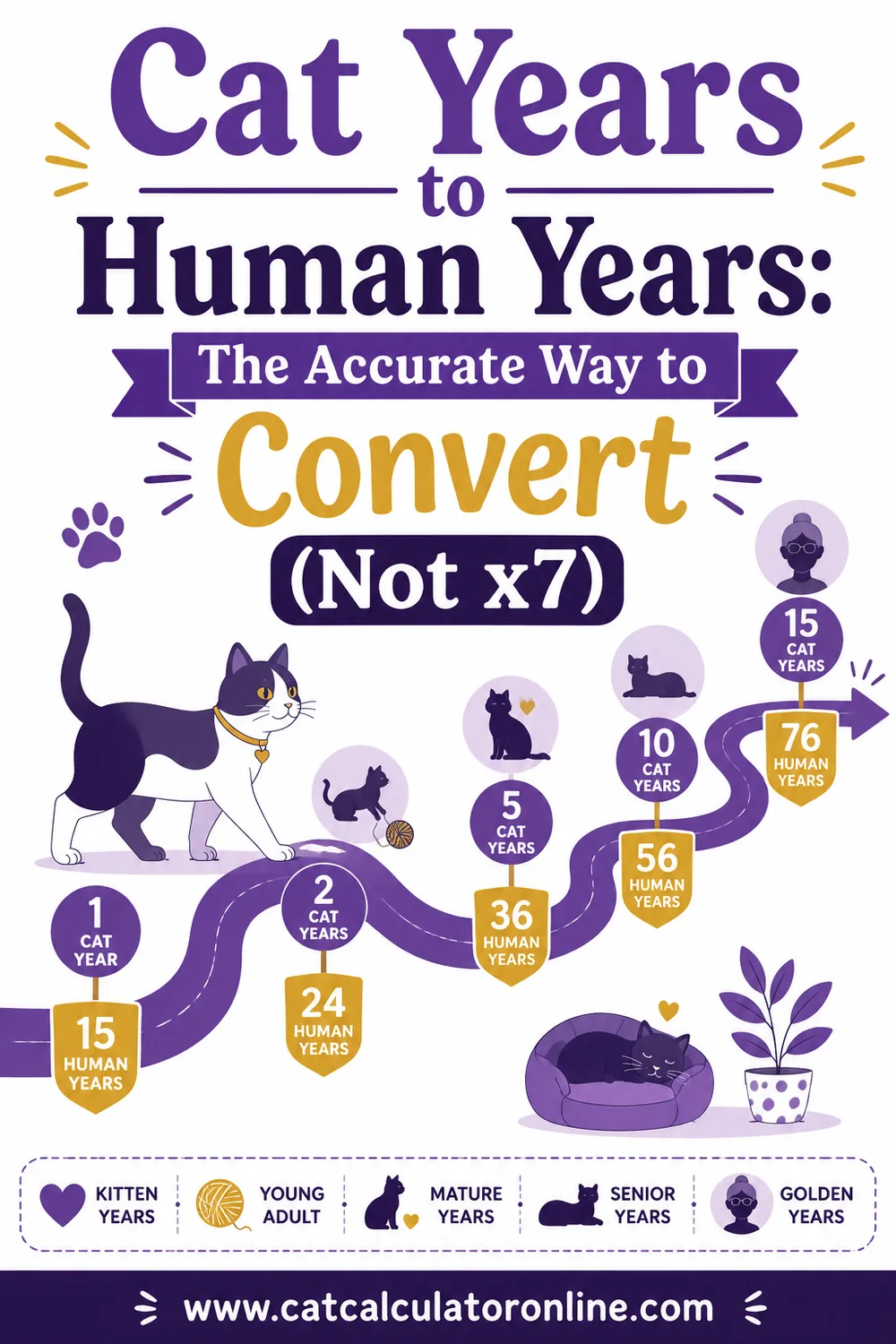
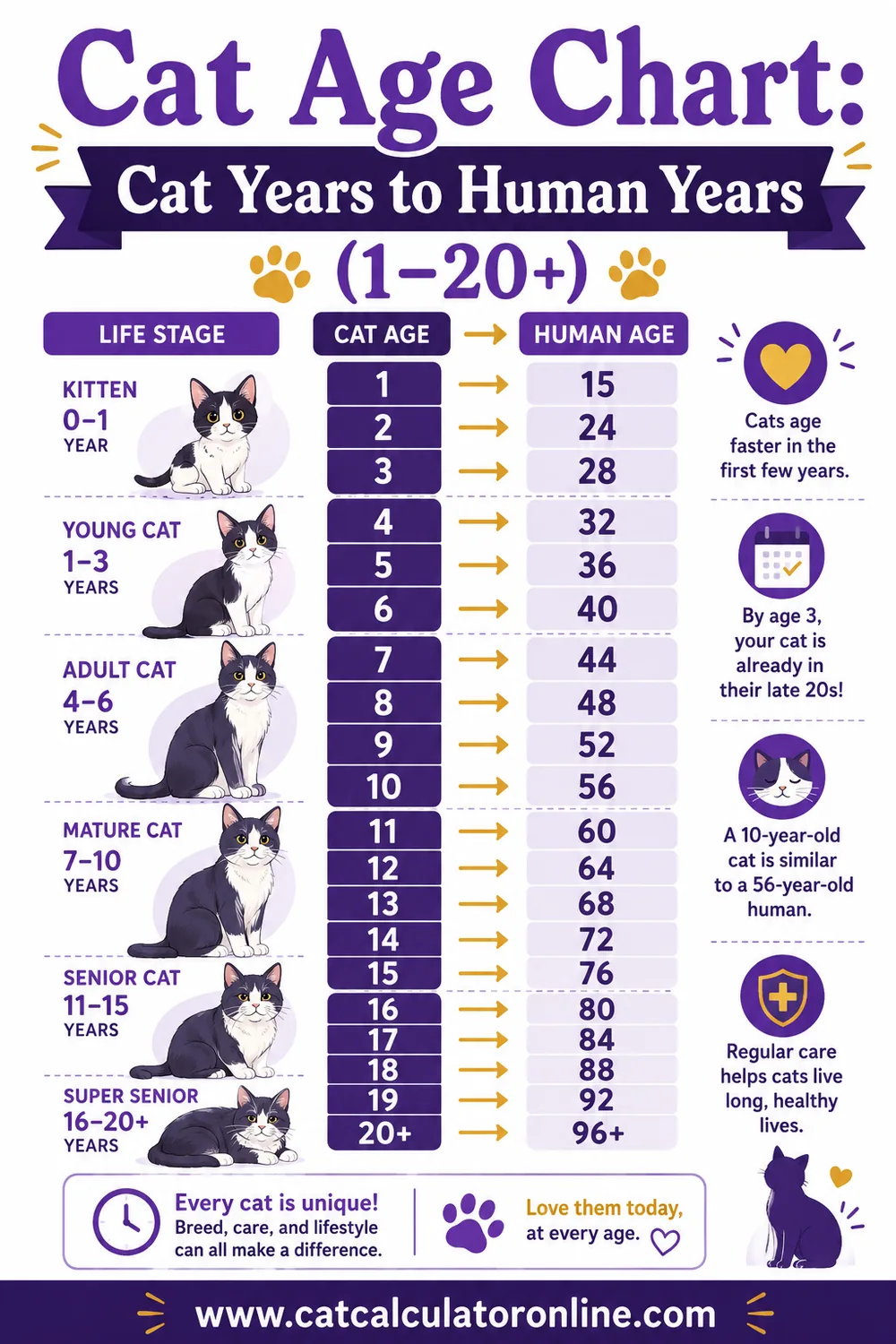
This cat age chart converts your cat's real age into human years for every year from 1 to 20, and tells you the life stage that goes with it. In short: a 1-year-old cat is about 15 in human years, a 2-year-old is about 24, and every year after that adds roughly 4 — so a 10-year-old cat is about 56 and a senior, while a 15-year-old is about 76.
Want your cat's number instantly? Our free cat age calculator does it in one tap. But if you like seeing the whole picture laid out, the full chart below is exactly what you came for.
🐾 Jump to an age on the chart:
Tap an age to see where it lands on the chart.
The Full Cat Age Chart (1 to 20 Years)
Here's the complete conversion, with the human-year equivalent and the AAHA life stage for each year of your cat's life.
| Cat's age | Human years | Life stage |
|---|---|---|
| 1 month | 1 | Kitten |
| 3 months | 4 | Kitten |
| 6 months | 10 | Kitten |
| 1 year | 15 | Kitten → young adult |
| 2 | 24 | Young adult |
| 3 | 28 | Young adult |
| 4 | 32 | Young adult |
| 5 | 36 | Young adult |
| 6 | 40 | Young adult |
| 7 | 44 | Mature adult |
| 8 | 48 | Mature adult |
| 9 | 52 | Mature adult |
| 10 | 56 | Senior |
| 11 | 60 | Senior |
| 12 | 64 | Senior |
| 13 | 68 | Senior |
| 14 | 72 | Senior |
| 15 | 76 | Senior (geriatric) |
| 16 | 80 | Senior (geriatric) |
| 17 | 84 | Senior (geriatric) |
| 18 | 88 | Senior (geriatric) |
| 19 | 92 | Senior (geriatric) |
| 20 | 96 | Senior (geriatric) |
Print it, bookmark it, or just enter your cat's age into the cat age calculator for the same answer without scrolling.
How the Chart Works
The numbers in this chart come from the method vets actually use — the same one behind the American Animal Hospital Association's feline life-stage guidelines. It's built on three simple steps:
- Year one ≈ 15 human years. Kittens grow up astonishingly fast. By twelve months, a cat is a fully independent young adult who can already have kittens of her own.
- Year two adds about 9. That brings a 2-year-old to roughly 24 in human years.
- Every year after adds about 4. Three is 28, four is 32, ten is 56 — a steady, easy-to-follow pace.
For the full reasoning and why the old times-seven rule is wrong, see our cat years to human years guide.
Kitten Ages: The First Year in Detail
The first year moves so fast that it deserves its own zoom-in. A kitten's early months each pack in a lot of human-equivalent development:
| Kitten's age | Roughly this old in human years | What's happening |
|---|---|---|
| 1 month | 1 | Eyes and ears fully working, starting to walk |
| 2 months | 3 | Weaned, playful, ready to leave mom |
| 3 months | 4 | Baby teeth in, exploring everything |
| 6 months | 10 | Near sexual maturity; spay/neuter time |
| 9 months | 13 | Adolescent, close to full size |
| 12 months | 15 | Young adult |
That six-month mark is a big one — cats can start reproducing around four to six months, which is why vets recommend spaying and neutering before then.
Why Size and Breed Barely Matter
If you've used a dog age chart, you know it splits into small, medium, large, and giant columns because dogs of different sizes age at very different rates. A cat age chart doesn't need those columns.
Cats age at nearly the same rate regardless of size or breed. A 6-pound cat and a 15-pound cat both follow the chart above. The main exception is that some large breeds, like the Maine Coon, keep growing in size until three or four years old — but that doesn't change how their age converts to human years.
So this one chart works for practically every cat you'll ever meet. That's a nice bit of simplicity.
Where Does Your Cat Land?
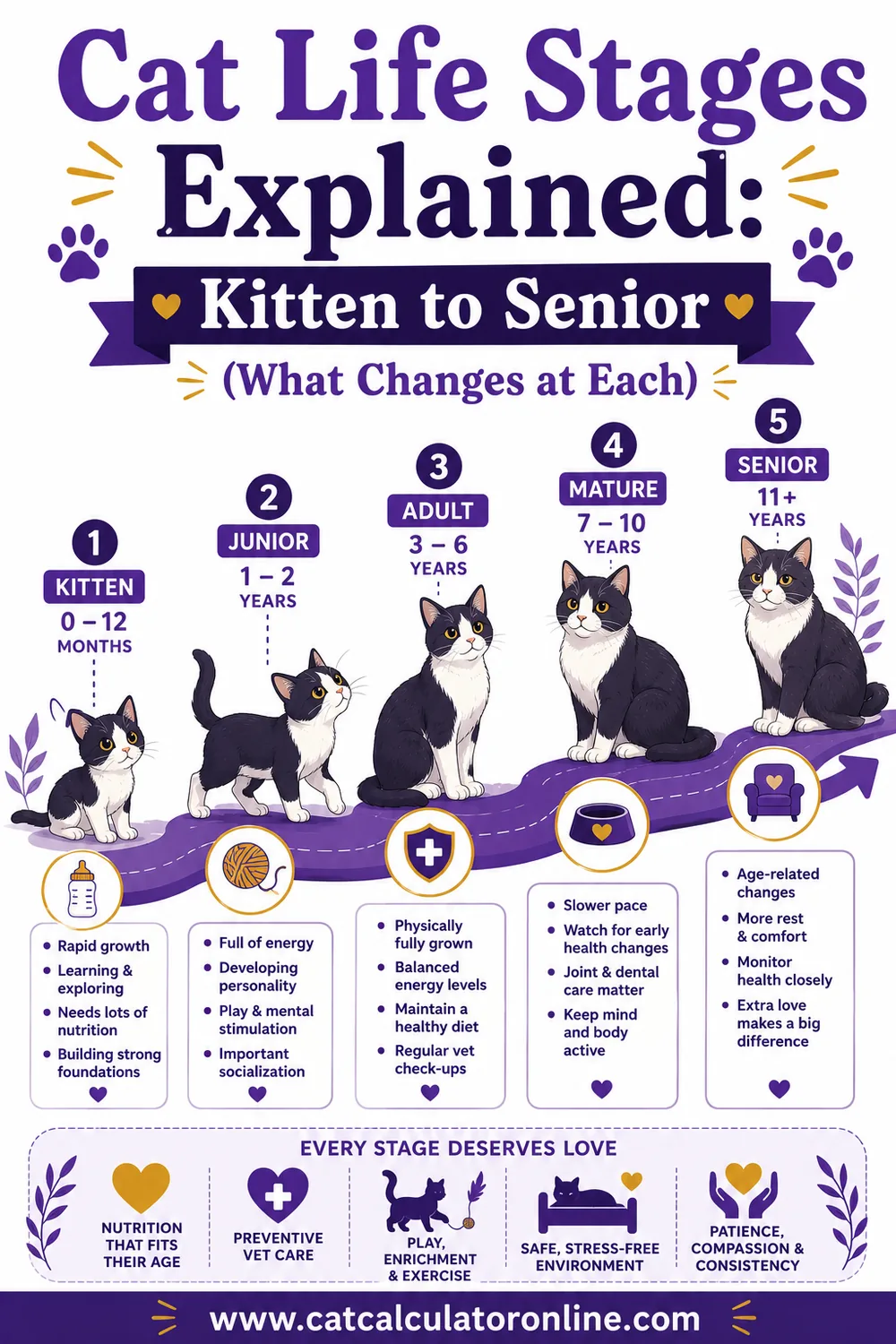
Reading the chart is more useful when you know what each zone means for day-to-day care:
- Kitten (up to 1 year, ~15 human years): Kitten-specific food, a full vaccination series, and spay/neuter.
- Young adult (1–6 years, ~24–40): The healthy prime. Annual checkups, steady weight, and dental care.
- Mature adult (7–10 years, ~44–56): Human middle age. Watch for creeping weight gain and start monitoring more closely.
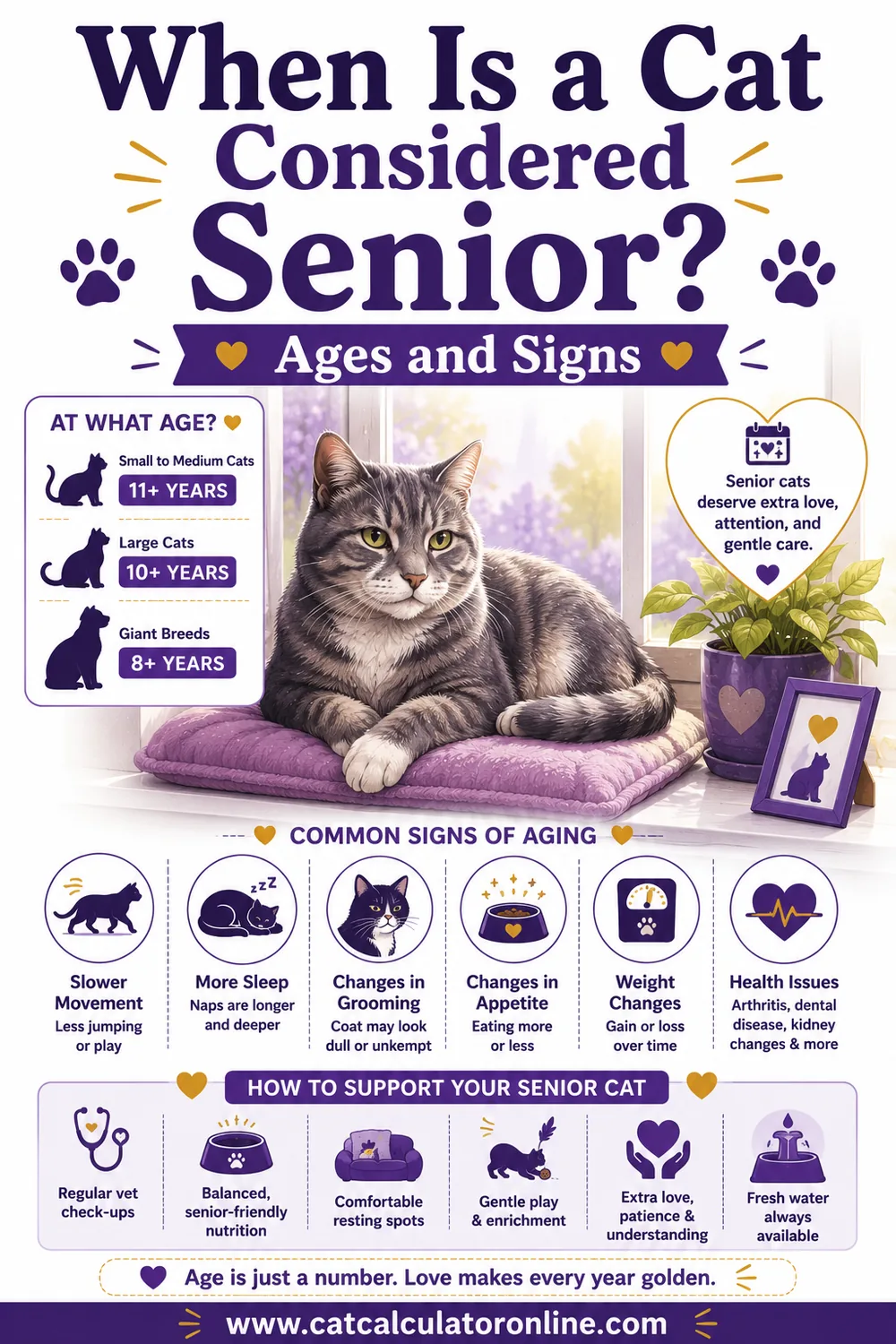
- Senior (10+ years, ~56+): Twice-yearly vet visits and bloodwork to catch kidney, thyroid, and joint issues early.
Our cat life stages explained guide covers each of these in depth, and when is a cat considered senior focuses on that important 10-year turning point.
How Far Up the Chart Can a Cat Go?
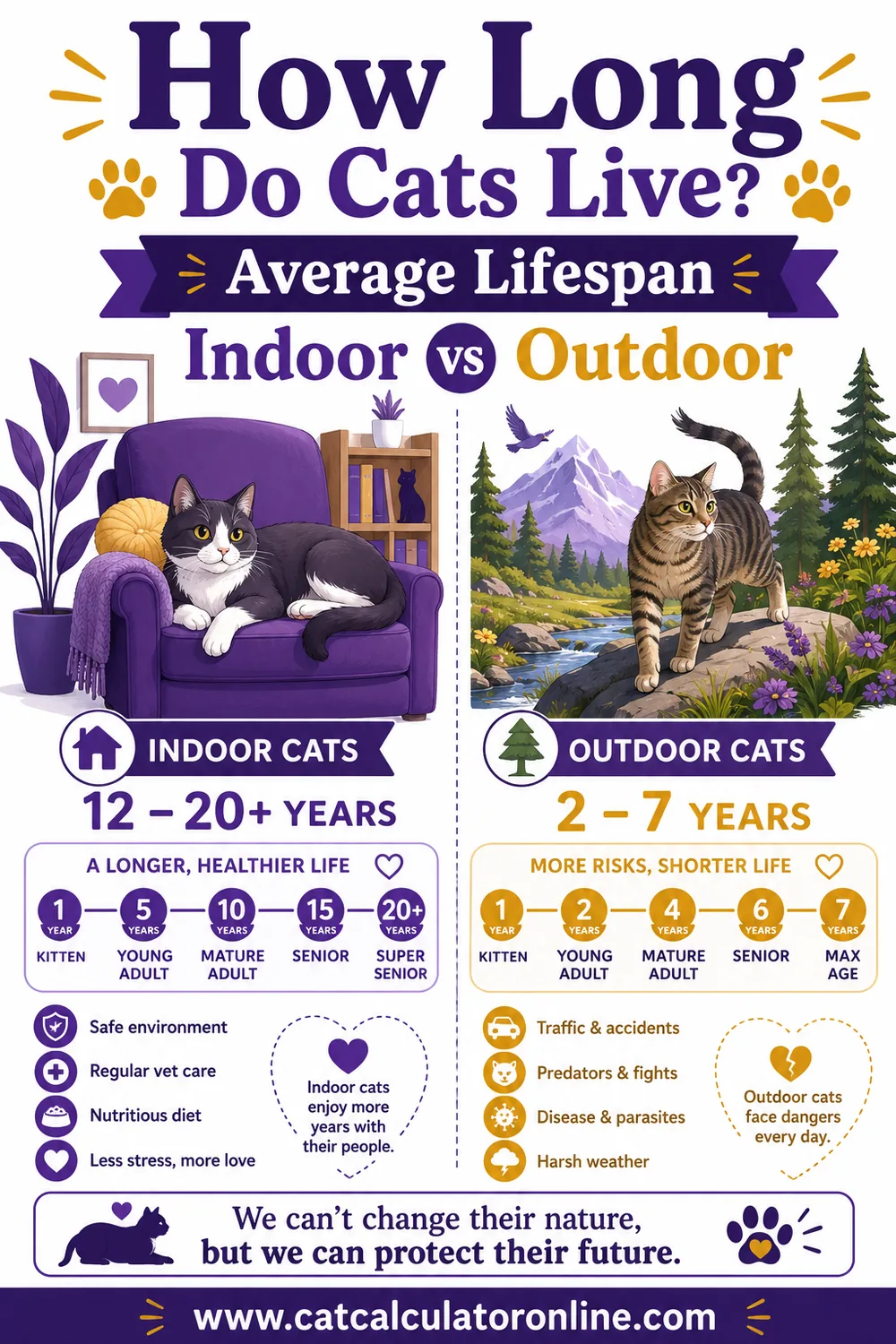
Most cats live 13 to 17 years, which puts them well into the senior rows. Many indoor cats reach 20 — that's about 96 in human years. And the verified oldest cat ever, Creme Puff, lived to an astonishing 38.
Whether your cat climbs into those upper rows depends heavily on lifestyle. Indoor cats routinely live 13 to 17 years and beyond, while outdoor cats average just 2 to 5. Our how long do cats live guide breaks down exactly why.
Cat Age Chart vs. the Old "×7" Rule
You've probably heard that one cat year equals seven human years. It's a tidy rule, and it's wrong — badly wrong at both ends of a cat's life. Lining the two up side by side makes it obvious:
| Cat's age | The old "×7" rule says | This chart says | What the myth gets wrong |
|---|---|---|---|
| 1 | 7 | 15 | A 1-year-old cat is a young adult who can have kittens — nothing like a 7-year-old child. |
| 2 | 14 | 24 | Still undershooting — a 2-year-old cat is a full adult. |
| 5 | 35 | 36 | Around here the myth accidentally gets close. |
| 10 | 70 | 56 | Now it overshoots — it's aging your cat too fast. |
| 15 | 105 | 76 | Wildly off; no cat is "105." |
| 20 | 140 | 96 | The rule falls apart completely. |
The problem is that the ×7 rule assumes a cat ages the same amount every year. Real cats don't. They race through their first two years, then settle into a slower, steady pace. That's why the chart front-loads the early years (15, then +9) and then adds a gentle +4 from there. If you only remember one thing, let it be this: the first year is worth about 15, not 7.
The Chart Is an Average — Your Cat Is an Individual
This chart tells you where your cat typically lands, but no chart can read the actual animal on your lap. Two 12-year-old cats can be in very different shape.
- Health rewrites the timeline. A lean, well-cared-for 14-year-old can act years younger than the chart suggests, while an overweight cat with dental disease can seem older than her number.
- Genetics play a role. Some lines and breeds — Siamese and Burmese among them — tend to stay spry and long-lived, while a few purebreds are prone to earlier problems.
- Lifestyle changes lifespan, not the conversion. Being indoor or outdoor doesn't change how a cat year converts to human years — a 5-year-old is about 36 either way. What it changes is how many of those years your cat is likely to get.
So use the chart to set expectations and time your care decisions — kitten food, spay/neuter, senior bloodwork — then let your vet read the real cat in front of you.
Quick-reference: the ages that matter most
- 6 months — near sexual maturity; the standard window for spay/neuter.
- 1 year (~15) — officially a young adult.
- 7 years (~44) — entering mature adulthood; start closer monitoring.
- 10 years (~56) — a senior; switch to twice-yearly vet visits and bloodwork.
- 15 years (~76) — geriatric; comfort, warmth, and gentle care become the priority.
FAQ
What age is a cat in human years?
A 1-year-old cat is about 15 in human years, a 2-year-old is about 24, and every year after adds roughly 4. So a 5-year-old is about 36, a 10-year-old about 56, and a 15-year-old about 76.
Is 7 years old middle-aged for a cat?
Yes. At 7 years — about 44 in human years — a cat is entering the mature adult stage, the feline version of middle age. It's a good time to start watching weight and monitoring health more closely.
How old is a 10-year-old cat in human years?
About 56. A 10-year-old cat is officially a senior, and vets usually recommend twice-yearly checkups and bloodwork from this age on.
Does this chart work for all breeds?
Almost entirely, yes. Cats age at nearly the same rate regardless of breed or size, unlike dogs. Large breeds like the Maine Coon take longer to reach full size, but their age still converts the same way.
How old is the oldest cat on record?
Creme Puff holds the verified record at 38 years — far beyond the top of this chart. Most cats live 13 to 17 years, with many indoor cats reaching 20.
Why isn't the "one cat year = 7 human years" rule accurate?
Because cats don't age evenly. They pack about 15 human years into their first year and 9 into their second, then slow to roughly 4 a year. A single ×7 multiplier undershoots kittens and overshoots older cats — by age 15 it would claim your cat is "105," when the real figure is about 76.
The Bottom Line
This cat age chart gives you a quick, reliable way to translate your cat's years into human ones and see her life stage at a glance. One year is about 15, two is about 24, and every year after adds roughly 4 — no size columns needed, because cats age at nearly the same rate across the board.
For your cat's exact number in one tap, use our free cat age calculator. Then dig into the cat years to human years method or find out how long cats live to see how far up the chart your cat might climb.