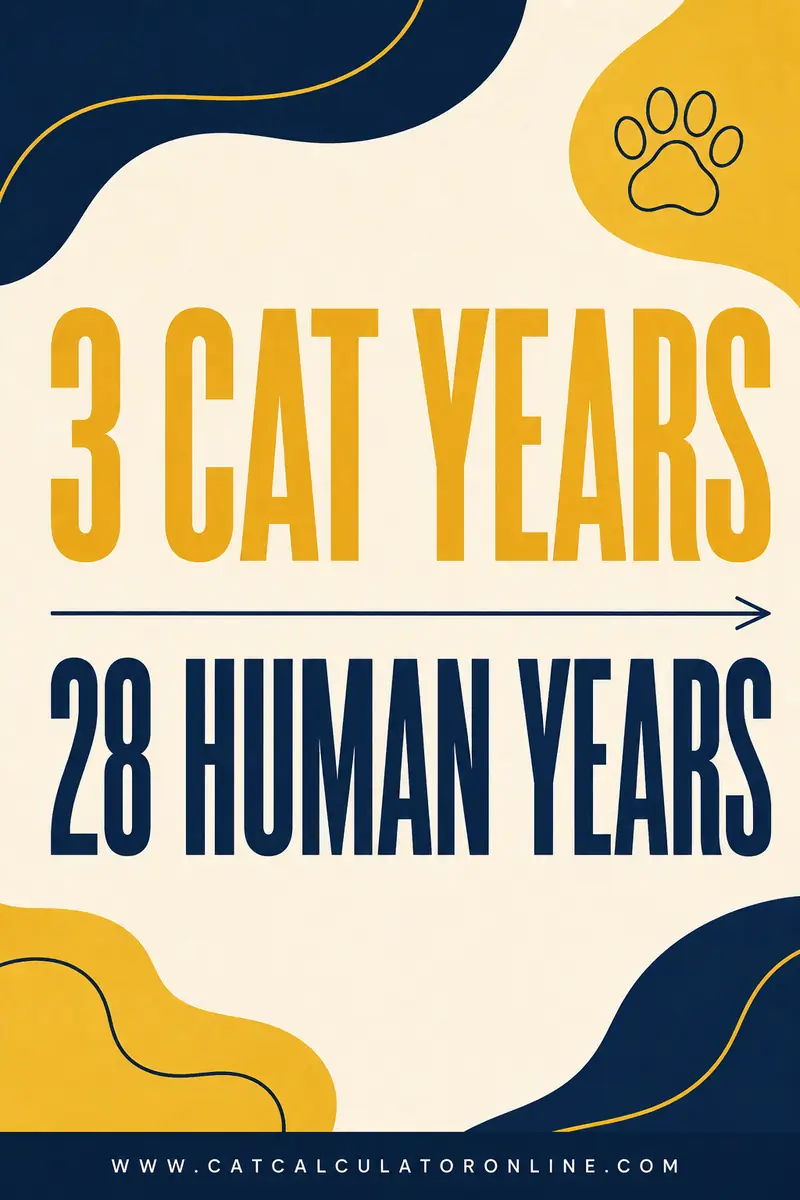
2 Cat Years in Human Years
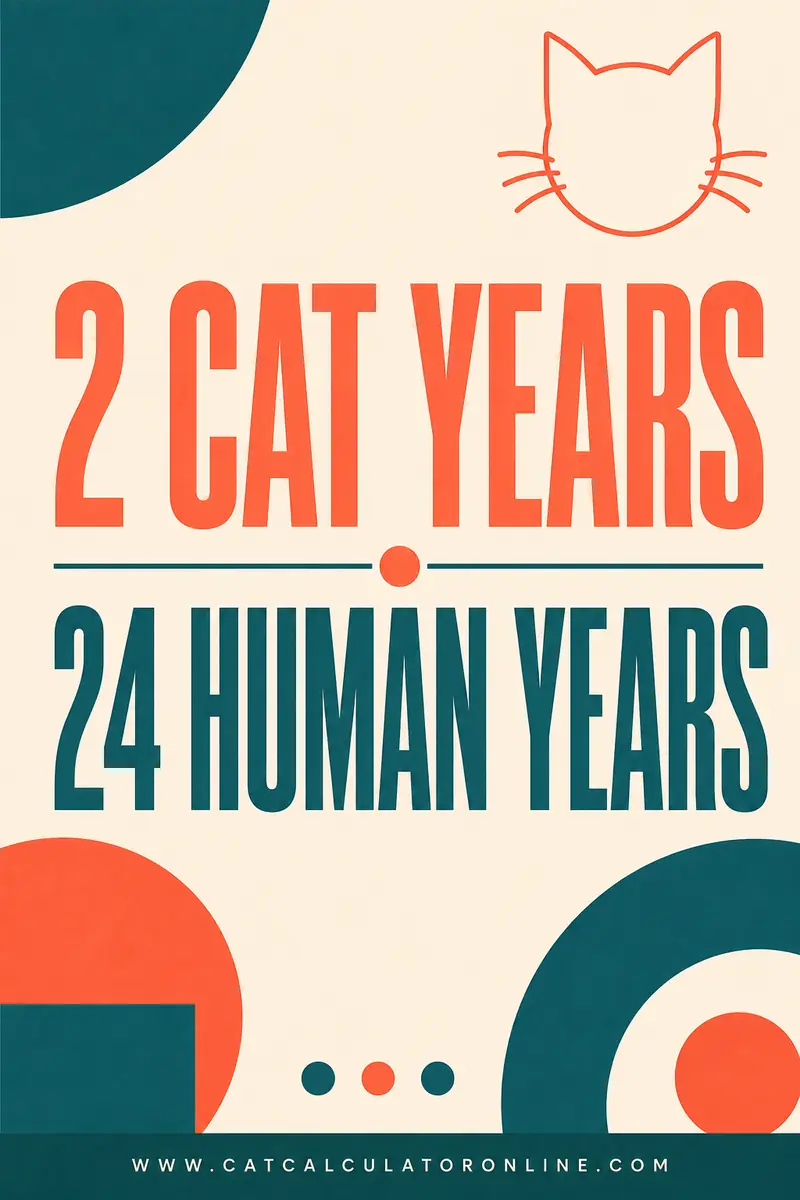
A two-year-old cat is about 24 in human years. The second year adds nine — less than the fifteen of year one, more than the four every subsequent year adds — which makes age two the hinge point of the whole conversion. Before it, a cat is racing through development; after it, ageing settles into a steady, predictable four human years per calendar year for the rest of its life. This page explains why year two is worth nine, what actually changes in a cat between its first and second birthdays, and why this is the age at which most owners finally get the calm cat they were promised. For any age, the cat age calculator gives the figure instantly.
Why Does Year Two Add Nine?
Because a cat is still finishing significant development in its second year, but far less than in its first.
Year one covers the dramatic part — birth to sexual maturity, blind newborn to full-sized adult. That's worth fifteen human years because it maps onto everything a human does between birth and the mid-teens.
Year two covers the finishing — behavioral settling, social maturity, the last of the physical filling out, and the point at which a cat's temperament becomes what it will be for the next decade. In human terms that's roughly the mid-teens to the mid-twenties: a real and meaningful stretch, but nothing like the first fifteen years.
Hence 15 + 9 = 24. A two-year-old cat is a young adult in every sense — physically complete, behaviourally settled, at the start of a long healthy plateau.
And after this, the curve flattens. From year three onwards each calendar year adds a flat four human years. There's no further developmental milestone to account for; it's simply the steady accumulation of adulthood.
What Is the Full Conversion?
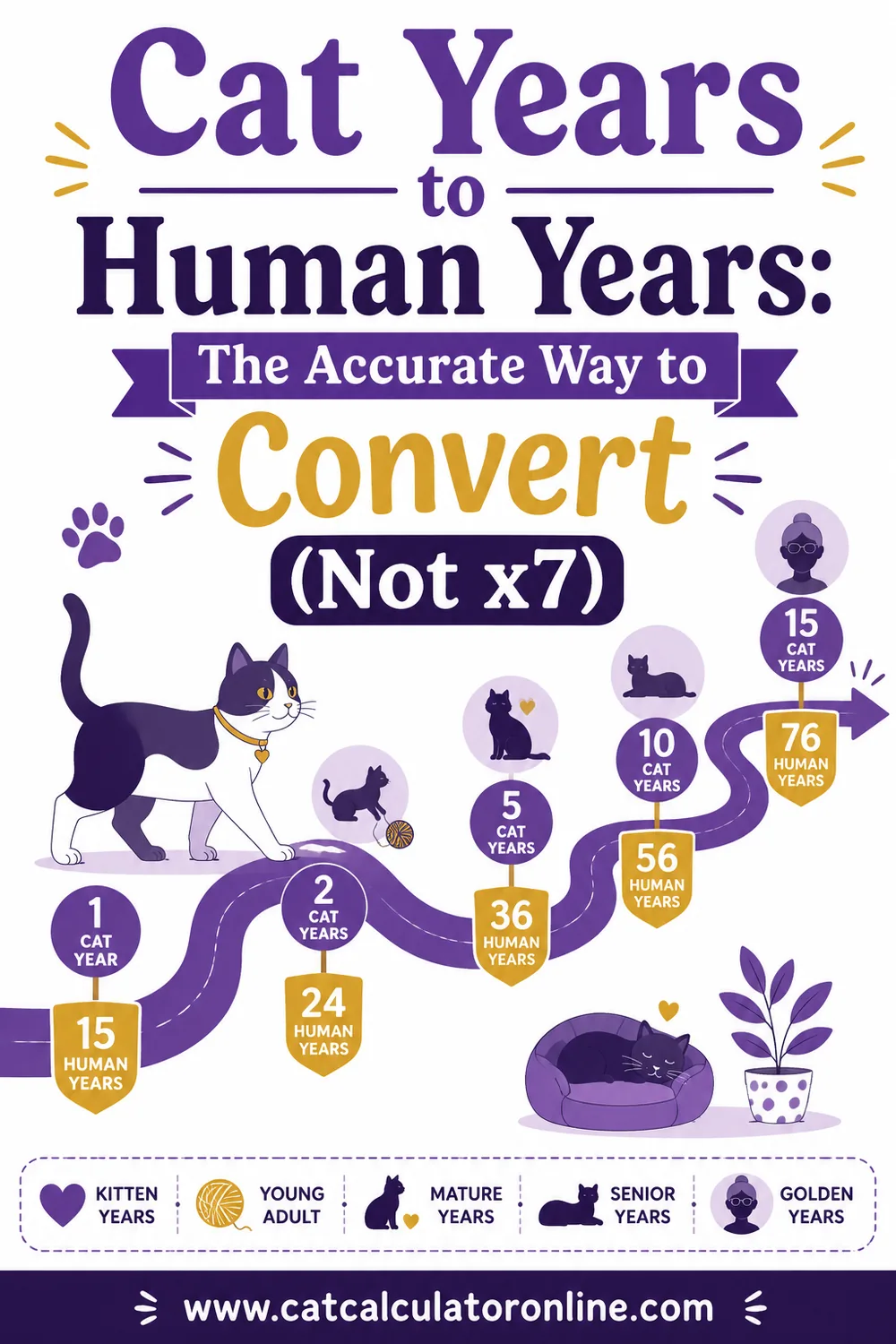
| Cat's age | Add | Human-year equivalent | Life stage |
|---|---|---|---|
| 1 year | +15 | 15 | Kitten → young adult |
| 2 years | +9 | 24 | Young adult |
| 3 years | +4 | 28 | Young adult |
| 4 years | +4 | 32 | Young adult |
| 5 years | +4 | 36 | Young adult |
| 6 years | +4 | 40 | Young adult |
| 7 years | +4 | 44 | Mature adult |
| 10 years | +4/yr | 56 | Senior |
| 15 years | +4/yr | 76 | Senior |
| 20 years | +4/yr | 96 | Senior |
Two things worth noticing. The gap between age one and age two is nine human years — larger than any later single-year gap. And from three onwards the pattern is completely regular, which is why the math becomes trivial: 24 plus four for every year past two.
That regularity is what the cat age calculator applies, and the reasoning behind the method is set out in how a cat age calculator works. The year before is covered in 1 cat year in human years.
What Actually Changes Between One and Two?
More than owners expect behaviourally, less than they expect physically.
The adolescent edge comes off. This is the change people notice most. A one-year-old cat frequently still has the frantic energy, boundary-testing and rough play of a kitten. By two, most cats have visibly settled — play becomes less manic, the 3am zoomies become occasional rather than nightly, and the cat starts choosing to sit near you rather than ambush you.
Personality locks in. Whatever a cat is like at two is broadly what it will be like at eight. Confidence, sociability, tolerance of handling and relationship with other pets are all essentially fixed by now. That's worth knowing if you're considering a second cat or a change in household — introductions are easier before this point than after.
Physical growth finishes for most breeds. A domestic shorthair is done. Large breeds are not: a Maine Coon, Ragdoll or Norwegian Forest Cat continues to fill out until three or four, so a two-year-old of those breeds may still gain noticeable muscle and frame.
Activity level drops. This is the quiet one, and it matters more than it sounds — because it's the point at which weight gain typically begins.
What doesn't change: the need for play and enrichment. A settled cat is not an unstimulated one, and two-year-olds still need daily interactive play. Cats that don't get it tend to develop the behavior problems owners then attribute to personality.
Why Is Two the Age Weight Gain Starts?
Because energy needs fall and portion sizes usually don't.
An adolescent cat burns a great deal of energy on growth and on sheer activity. Once growth finishes and the frantic phase passes, calorie requirements drop — often noticeably. If the food bowl keeps getting the same amount, the surplus goes on as fat.
The pattern is extremely common. Feline obesity is one of the most prevalent health problems in domestic cats, and the trajectory usually starts in the second or third year rather than in middle age. By the time an owner notices, the cat has often been gaining slowly for years.
What to do about it at two:
- Reassess the portion now that growth has finished, rather than continuing kitten-era amounts — how much should I feed my cat has the calculations
- Weigh monthly and write it down. Cats hide weight gain under fur, and a scale catches what your eye doesn't
- Feel for the ribs. You should be able to find them easily under a thin covering, and see a slight waist from above
- Count treats as food, because they add up faster than most people assume
- Keep interactive play daily, since a settled cat won't self-exercise the way an adolescent did
Why it matters so much: weight is the single biggest modifiable factor in feline lifespan and quality of life. An overweight cat is at materially higher risk of diabetes, arthritis, urinary problems and liver disease. Catching the trend at two is dramatically easier than reversing it at six.
What Should Happen at the Vet at Age Two?
The two-year check-up is usually straightforward, and there are specific things worth raising.
Annual examination. Weight, body condition score, teeth, coat, heart and abdomen. For a healthy young adult this is typically a fifteen-minute appointment.
Vaccination boosters according to your vet's schedule and your cat's lifestyle. Indoor-only cats and outdoor cats often have different requirements.
Dental assessment. This is the important one. Dental disease affects the majority of cats by age three, and it's largely silent — cats conceal oral pain remarkably well. Two is a good age to establish home brushing, because the mouth is still healthy and the habit is easier to build before there's discomfort involved.
Parasite prevention reviewed for the coming year based on whether the cat goes outside.
Baseline bloodwork, which some vets suggest at this age. It isn't strictly necessary for a healthy two-year-old, and having a baseline while everything is normal makes future results far easier to interpret.
Microchip details checked, which nobody thinks about until a cat goes missing and the registered address is three houses ago.
What to mention even if it seems trivial: changes in drinking, appetite, litter box habits, grooming or sociability. In a young adult cat these are rarely serious, and they're exactly the changes that matter later — establishing what's normal for your cat now makes deviations obvious in ten years' time.
Where Does Two Sit in a Cat's Whole Life?
Near the beginning of a long, stable stretch.
| Stage | Age | Human equivalent | What it's like |
|---|---|---|---|
| Kitten | 0–1 | 0–15 | Rapid development |
| Young adult | 1–6 | 15–40 | Peak health, settled behavior |
| Mature adult | 7–10 | 44–56 | Middle age; screening begins |
| Senior | 10+ | 56+ | Twice-yearly checks |
A two-year-old cat has four more years of young adulthood ahead, and those years are typically the healthiest of its life. Most cats in this window need very little beyond good food, an appropriate weight, dental care, play and an annual check.
Which is exactly why it's the right time to build habits. Brushing teeth, monthly weighing, regular play and a settled feeding routine are all much easier to establish in a healthy cat than to introduce in a sick or elderly one. The work you do at two is what makes ten and fifteen easier.
Looking forward: the next real transition is at seven, when a cat enters the mature-adult stage and screening becomes more relevant. Between now and then, very little changes structurally — which is covered age by age from 3 cat years in human years onwards, and in the overview at cat life stages explained. The complete age table is in cat years to human years.
How Does a Two-Year-Old Cat Compare With a Dog?
Worth a brief look, because owners of both frequently assume the two species track together. They don't.
A two-year-old cat is about 24 in human terms, and that figure barely moves with breed. A Siamese, a Maine Coon and a mixed-breed cat from a rescue center all land in the same place. Cats age with unusual uniformity.
Dogs are entirely different. A two-year-old small terrier and a two-year-old Great Dane are not at the same life stage at all — the giant breed is ageing considerably faster and will reach old age years earlier. Any honest dog conversion has to ask about weight; a cat conversion doesn't.
The other divergence is lifespan. Indoor cats average 13 to 17 years, with plenty reaching twenty. Dogs range from about 8 years for the largest breeds to 16 for the smallest. So a two-year-old cat has proportionally more of its life ahead than a two-year-old dog of most breeds.
One thing not to carry across: the 2019 DNA-methylation study that produced an epigenetic ageing formula was conducted on dogs. There's no validated feline equivalent, and applying the dog formula to a cat produces meaningless numbers. For cats, the AAHA life-stage guidelines and the Cornell Feline Health Center are the sources worth trusting.
Where the species do agree: in both, the first year counts for far more than any later one, weight is the biggest modifiable factor in lifespan, and dental disease is both extremely common and badly under-treated.
Frequently Asked Questions
How many human years is 2 cat years?
About 24. The first year of a cat's life counts as roughly 15 human years and the second adds another 9, giving 24 by the second birthday. Every year after that adds a steady four.
Why does the second year add nine and not fifteen?
Because year one covers the dramatic development — newborn to sexually mature adult — while year two covers behavioral settling and the last of the physical filling out. That's a real stage but a much smaller one, equivalent to roughly the mid-teens to mid-twenties in a human.
Is a 2-year-old cat fully grown?
For most breeds, yes. Domestic shorthairs reach adult size by about a year and are fully mature by two. Large breeds such as Maine Coons, Ragdolls and Norwegian Forest Cats keep filling out until three or four years old.
Do cats calm down at two years old?
Usually, yes. The frantic adolescent phase generally softens during the second year, and most owners notice a distinctly calmer cat by the second birthday. Settled doesn't mean unstimulated, though — daily interactive play is still needed.
Should I change my cat's food at two?
Portion size usually needs reviewing rather than the food itself. Energy needs fall once growth finishes and the adolescent activity level drops, so continuing the same amount is the most common cause of weight gain starting in the second or third year.
What should a 2-year-old cat's vet visit cover?
An annual examination covering weight, body condition, teeth, coat, heart and abdomen, plus vaccination boosters and a parasite review. It's also a sensible age to start home dental care and, optionally, to take baseline bloodwork while everything is normal.
Two cat years is about 24 human years — the point where the steep early climb ends and the steady four-a-year pattern begins. It's also the quiet moment to set up the habits that matter later: right portion, monthly weigh-in, teeth brushed, play every day. Check any age against the full conversion with the cat age calculator.