How to Help Your Cat Lose Weight (Safely, Without Starving Her)
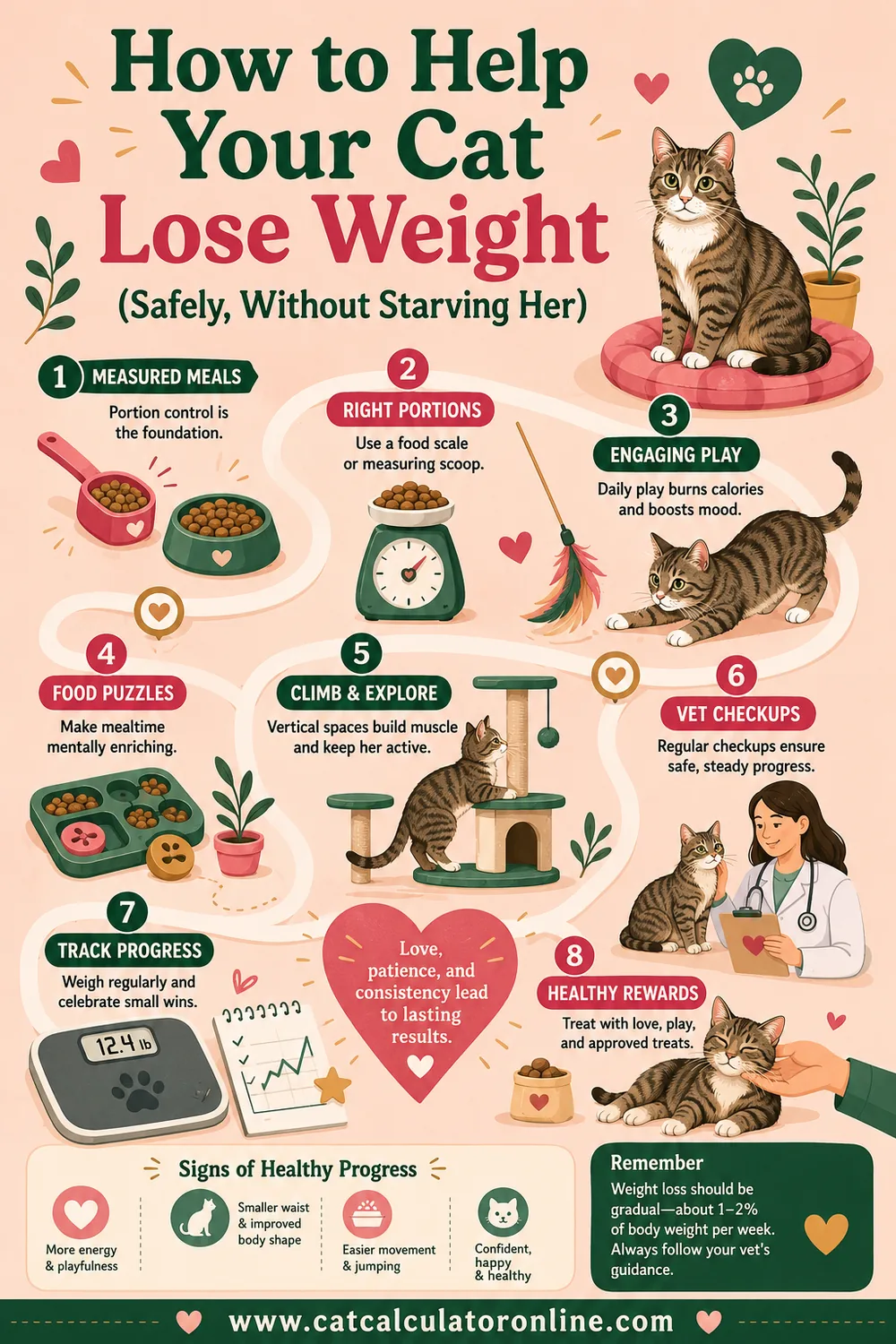
Cats should lose weight slowly — about 0.5% to 2% of their body weight per week, which works out to roughly half a pound a month for an average cat. Get there by feeding a measured calorie amount based on her target weight, not her current one, and by adding short daily play sessions. Crash dieting a cat is genuinely dangerous, so a vet should sign off on the plan before you start.
Start by finding out what your cat should actually weigh — our free cat ideal weight calculator turns her current weight and body condition score into a realistic goal. Then the cat food calculator converts that goal into a daily calorie number you can measure into a bowl. Everything below is how to make it stick.
⏱️ How long will your cat’s weight loss take?
Tap how much she needs to lose for a realistic timeline at a safe pace:
Tap an amount above. Safe loss is about ½ lb per month for an average cat.
First, Read This Warning
This is the single most important thing on the page, so it goes first rather than buried at the bottom.
Cats cannot be crash-dieted. If an overweight cat stops eating — or eats far too little — her body starts mobilizing fat faster than her liver can process it. Fat floods the liver and it stops working properly. That condition is hepatic lipidosis, or fatty liver disease, and it is life-threatening. It can develop after just a few days of significant under-eating, and overweight cats are the ones most at risk.
Practically, that means:
- Never withhold food to speed things up.
- Never cut portions dramatically overnight. Reduce gradually over one to two weeks.
- If your cat stops eating for more than 24 hours, call your vet. Don't wait it out.
- Weigh her regularly. Losing faster than about 2% of body weight per week is too fast, not a win.
Slow is the whole strategy. A cat who takes eight months to lose three pounds has done it right.
Step 1: Confirm She's Actually Overweight
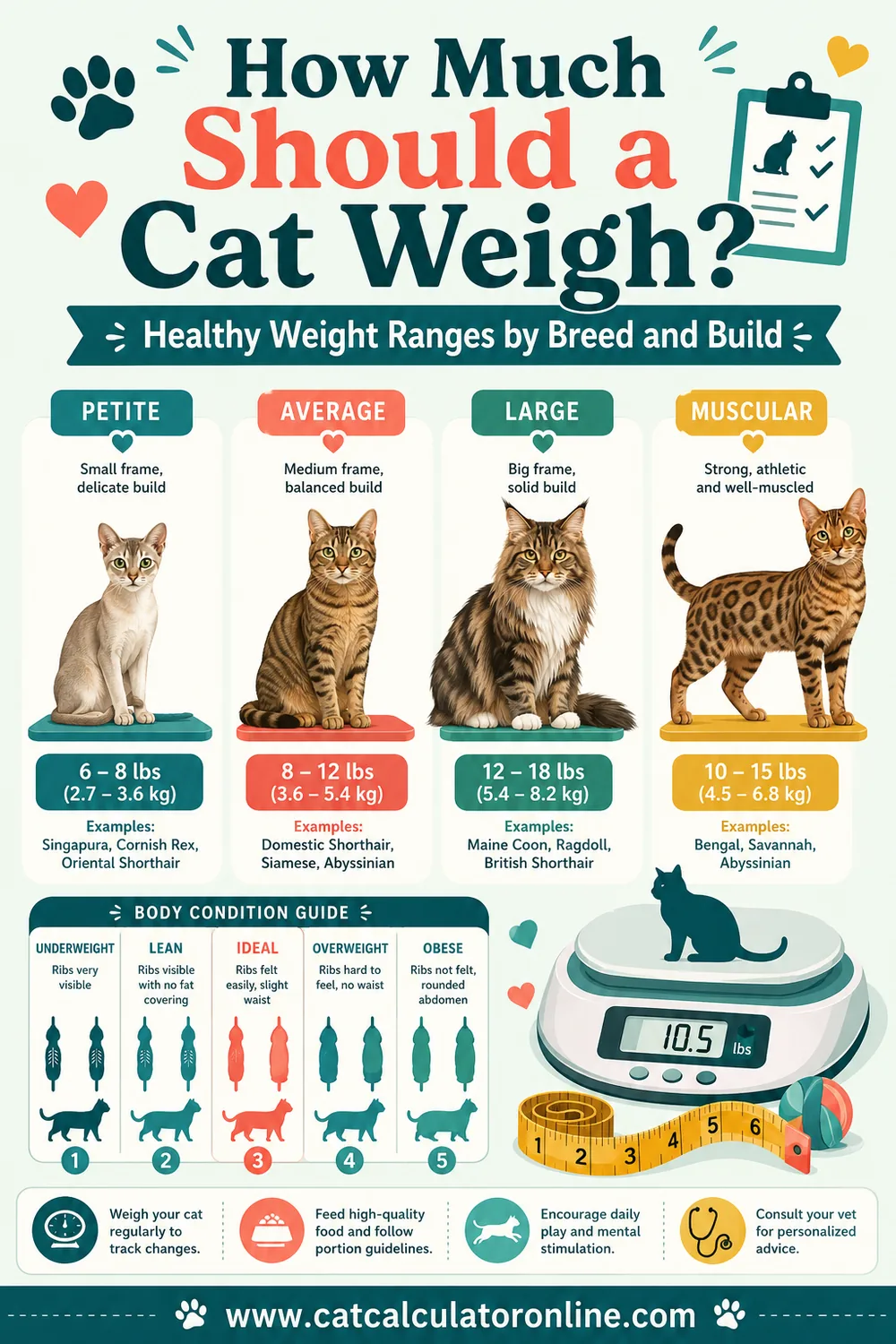
Before changing anything, check whether there's a real problem — and how big it is. The scale alone won't tell you, because healthy weight depends on frame and breed.
Vets use body condition score (BCS), a 9-point hands-on scale where 4 to 5 is ideal. Here's the quick self-check:
The rib test
Run your fingertips along her ribcage using light pressure. You should feel each rib easily, like feeling the bones on the back of your hand. If you have to press to find them, she's carrying extra.
The overhead look
Stand above her and look straight down. There should be a visible narrowing behind the ribs — a waist. If she's the same width from shoulders to hips, or wider at the middle, she's overweight.
The side view
From the side, her belly should tuck upward from ribcage to hind legs. A belly hanging level with or below the ribs means excess fat.
The pouch that isn't fat
Almost every cat has a loose, swinging flap of skin under the belly. That's the primordial pouch and it's normal anatomy — lean athletic cats have it too. Never diet a cat because of the pouch alone.
| BCS | Condition | Roughly over ideal |
|---|---|---|
| 4–5 | Ideal | — |
| 6 | Overweight | ~10% |
| 7 | Overweight | ~20% |
| 8 | Obese | ~30% |
| 9 | Obese | ~40%+ |
Step 2: Calculate Her Target Weight
Each BCS point above 5 means roughly 10% over ideal body weight. That gives you a formula:
Ideal weight = current weight ÷ (1 + 0.10 × (BCS − 5))
Examples:
- A 14 lb cat at BCS 7: 14 ÷ 1.20 = 11.7 lb target
- A 16 lb cat at BCS 8: 16 ÷ 1.30 = 12.3 lb target
- A 11 lb cat at BCS 6: 11 ÷ 1.10 = 10 lb target
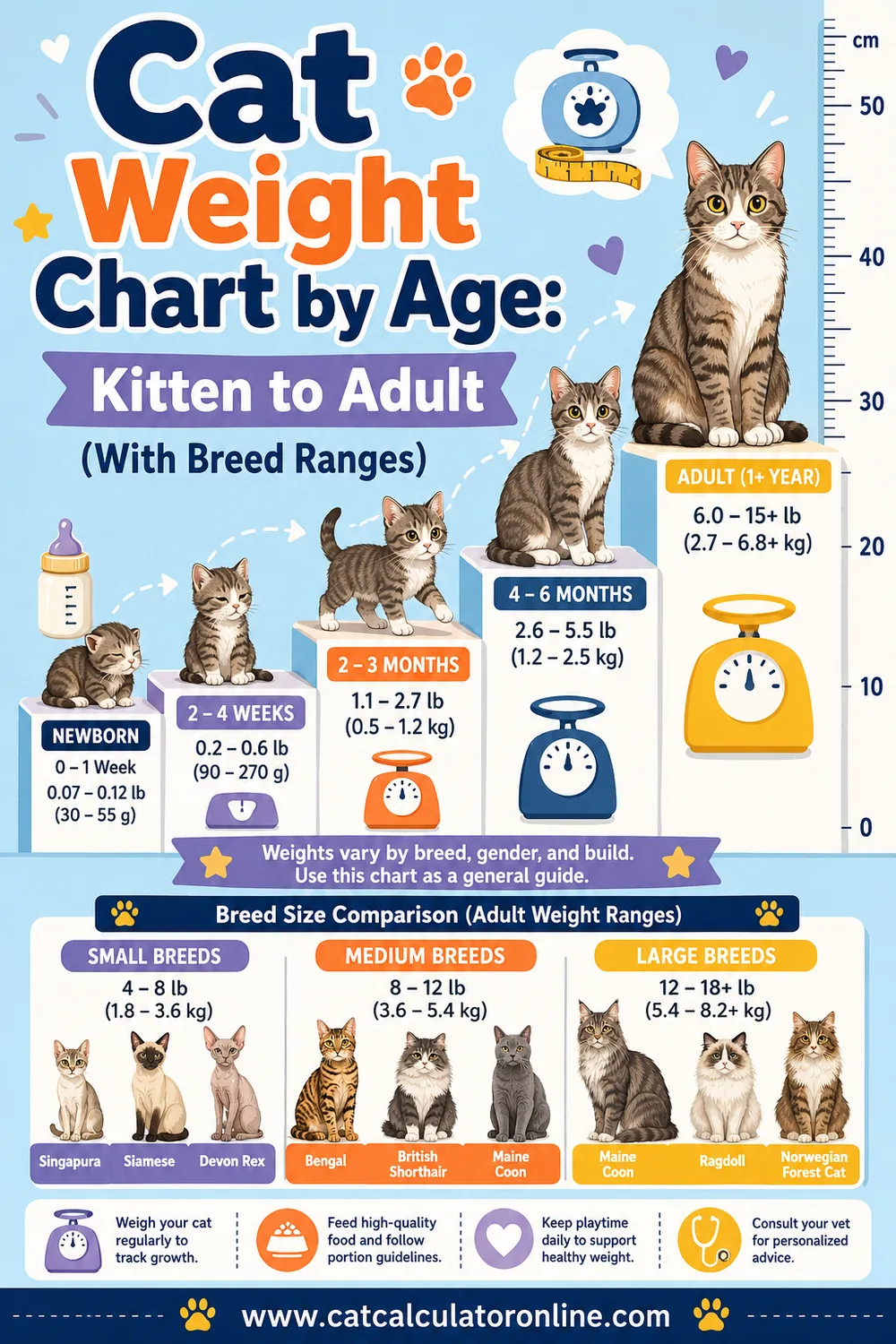
Our cat ideal weight calculator does this for you if you'd rather skip the arithmetic. And if you're unsure what's normal for her breed, how much should a cat weigh has ranges from Siamese to Maine Coon.
Set interim goals
Don't aim straight at the final number. Break it into stages — lose the first pound, then reassess. It keeps expectations sane and gives your vet natural checkpoints.
Step 3: Get the Calorie Number Right
Here's the math vets use. Resting energy requirement (RER) is:
RER = 70 × (body weight in kg)^0.75
For weight loss, apply a factor of about 0.8 to the RER of her TARGET weight — not her current weight. That's the crucial detail. Feeding for current weight just maintains the problem.
Worked example for an 11.7 lb target (5.3 kg):
- 5.3^0.75 ≈ 3.5
- RER = 70 × 3.5 ≈ 245 kcal/day at maintenance-resting
- Weight loss ≈ 245 × 0.8 ≈ 196 kcal/day
A simpler rough guide that gets you close: about 20 kcal per pound of ideal body weight per day for maintenance, less for active loss. For an 11.7 lb target, that's around 230 kcal maintenance and meaningfully less while dieting.
Our cat food calculator runs all of this and converts it into cups or cans of whatever food you're using. Treat any number — ours included — as a starting point your vet adjusts based on how she actually responds.
| Target weight | Approx. daily kcal for weight loss |
|---|---|
| 8 lb | ~145 kcal |
| 9 lb | ~160 kcal |
| 10 lb | ~175 kcal |
| 11 lb | ~185 kcal |
| 12 lb | ~200 kcal |
| 14 lb | ~225 kcal |
These are starting estimates for a typical neutered indoor cat. Your vet may set them higher or lower.
Step 4: Take Portion Control Seriously
Most cats are overweight for one unglamorous reason: nobody's measuring.
Ditch the free-feed bowl
Leaving dry food out all day is the leading cause of slow weight gain in indoor cats. Cats aren't reliable self-regulators, especially bored ones. Switch to measured meals — two to four a day works well.
Use a real measuring cup or a scale
The scoop that came in the food bag is not a measurement. A kitchen scale is even better: weighing dry food in grams removes the guesswork that cup-packing introduces.
Read the label, then ignore the feeding guide
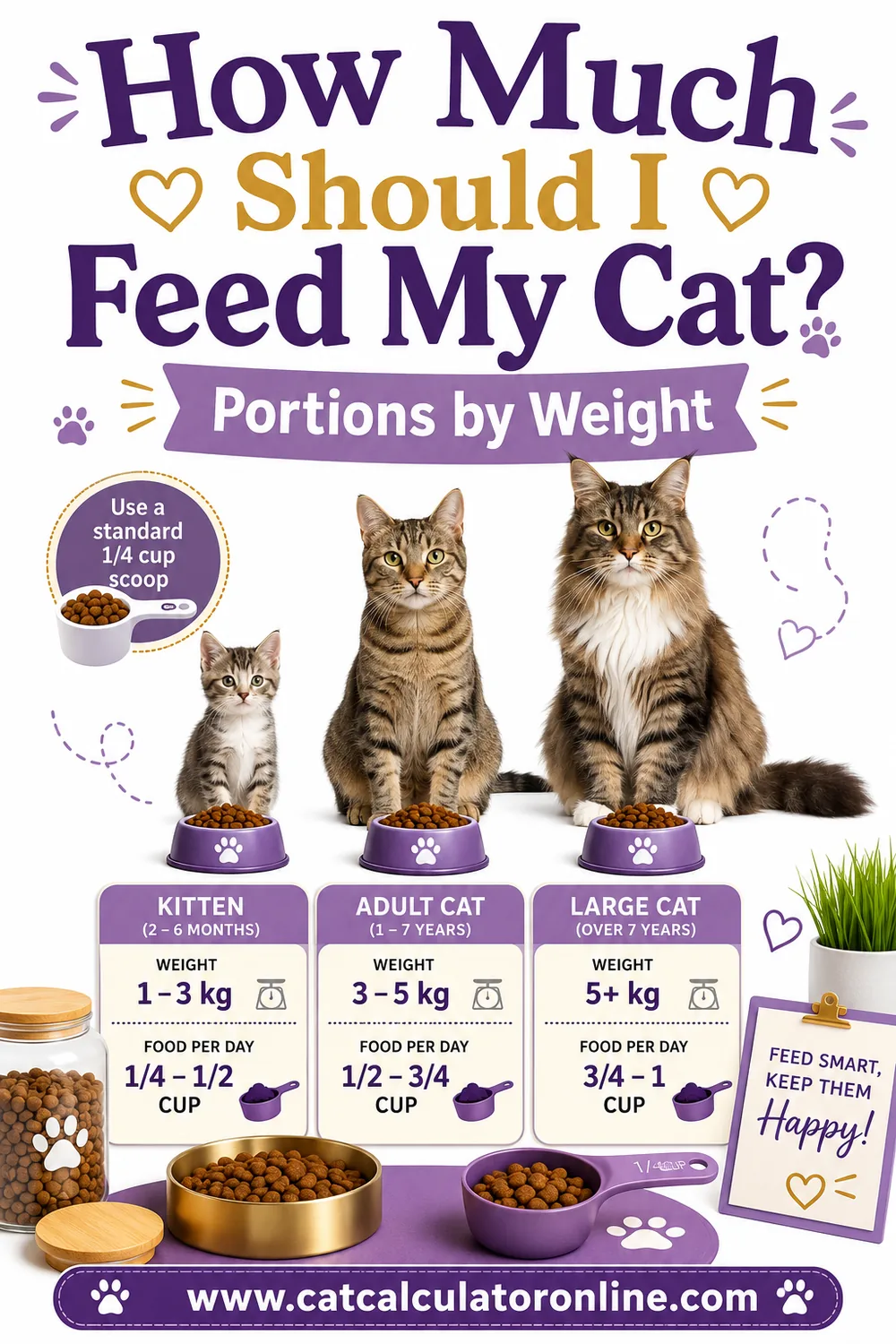
Bag guidelines are generous and written for average, often unneutered, cats. What you need from the label is the kcal per cup or per can figure. Divide your target daily calories by that, and you've got your portion.
Count the treats
Treats should stay under about 10% of daily calories. On a 200 kcal budget, that's 20 kcal — often just two or three small treats. Options that help:
- Swap treats for a few kibbles set aside from her daily ration.
- Use play or brushing as the reward instead of food.
- If multiple people live in the house, agree on who feeds and post the daily amount on the fridge.
Feed multi-cat households separately
If one cat needs to diet and another doesn't, they can't share a bowl. Feed in separate rooms, use timed feeders, or place the slim cat's food somewhere the heavier cat can't easily jump to.
Step 5: Consider Wet Food
Canned food is often a genuine advantage for weight loss, for two reasons:
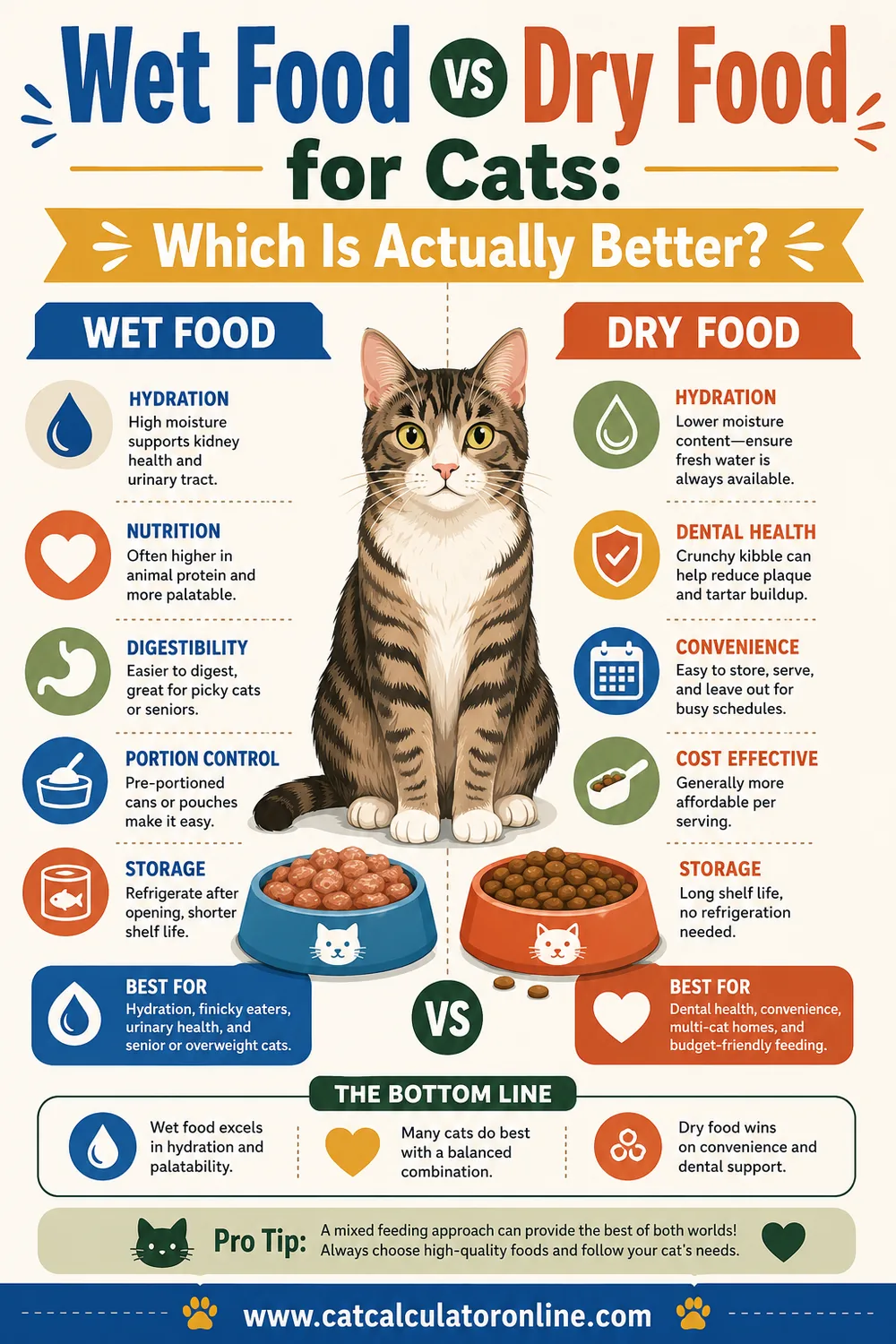
- Lower calorie density. Wet food is largely water, so a satisfying volume delivers fewer calories than the same-looking amount of kibble.
- Better hydration. Cats have a weak thirst drive, and wet food helps with overall water intake.
That doesn't make dry food wrong. A measured portion of dry food works fine, and many cats do best on a mix. The full comparison lives in wet food vs dry food for cats.
If you're switching foods, do it gradually over 7 to 10 days, mixing increasing amounts of the new food into the old. An abrupt switch can cause a hunger strike — which is exactly the scenario you're trying to avoid.
Prescription weight-management diets
Your vet may recommend a therapeutic weight-loss formula. These are engineered to keep a cat feeling full on fewer calories while protecting muscle and nutrient intake. They cost more, but for a cat with several pounds to lose they often work better than simply feeding less of a regular food.
Step 6: Get Her Moving
Diet does most of the work — you can't out-play a bowl that's too full — but activity protects muscle, helps mood, and makes the whole thing faster.
Play in short bursts
Cats are sprinters, not joggers. Two or three sessions of 5 to 10 minutes a day beats one long one. Aim for a proper "hunt": stalk, chase, pounce, catch.
Toys that actually work
- Wand toys. The gold standard. Move it like prey — away from her, in short darts, with pauses.
- Laser pointers. Fine, but always finish by landing the dot on a physical toy or treat so she gets a "catch."
- Crinkle balls and springs. Cheap, and many cats will bat them around solo.
- Cardboard boxes and paper bags. Free enrichment that most cats can't resist.
Make her work for food
- Food puzzles and treat balls slow eating and add mental work.
- Scatter feeding: toss her kibble ration across the floor so she hunts for it.
- Move the bowl. Put it upstairs, or somewhere that requires a climb.
Build vertical space
Cat trees, shelves, and window perches encourage jumping and climbing throughout the day. This matters more than any single play session, because it changes her baseline activity.
If she's very heavy, start gently
An obese cat may not want to play, and forcing it can strain joints. Start with a minute or two, keep it low to the ground, and build as the weight comes off. Mention any limping or reluctance to jump to your vet — arthritis and obesity often travel together.
Step 7: Track It — Weigh Regularly
Weight loss you don't measure is weight loss you can't manage.
How to weigh at home: step on the bathroom scale alone, note the number, pick her up, weigh again, and subtract.
How often: every one to two weeks during active weight loss. Same time of day, before a meal.
What you want to see: about 0.5% to 2% of body weight per week. On a 15-pound cat, that's roughly 1 to 4 ounces a week — small numbers, which is why a precise scale and a written log matter.
| Weekly loss | Verdict |
|---|---|
| Under 0.5% | Too slow — recheck portions and hidden treats |
| 0.5%–2% | Ideal, safe pace |
| Over 2% | Too fast — call your vet |
| No loss over 4–6 weeks | Reassess with your vet |
Keep a simple log with the date and the weight. Bring it to your vet appointments.
Why Weight Loss Is Worth the Effort
Trimming a cat down isn't about looks. Excess weight raises her risk of:
- Diabetes mellitus, which may require lifelong insulin
- Arthritis and joint pain — heavy cats stop jumping, and owners often mistake it for aging
- Reduced grooming, leading to a greasy or matted coat over the back and hindquarters
- Higher anesthetic and surgical risk
- A shorter life overall
The encouraging flip side: even a modest loss improves mobility and metabolic health, and some diabetic cats improve substantially with weight loss and dietary change. Small, sustained progress genuinely pays off.
Common Mistakes to Avoid
- Cutting food too fast. The number one danger. Ease portions down over a week or two.
- Feeding for current weight. Calorie targets should be based on target weight.
- Forgetting the treats. They're often the entire calorie surplus.
- Giving in to the 5 a.m. yowl. Hungry cats get loud. Adding a small extra meal from the same daily ration usually helps more than caving with extra food.
- Assuming weight gain is always diet. Sudden gain, or a swollen belly, deserves a vet check — it isn't always fat.
- Skipping the vet entirely. Weight-loss plans should be supervised, particularly for cats with more than a pound or two to lose.
When to Call the Vet
Book an appointment if:
- Your cat has more than a couple of pounds to lose
- She refuses food for more than 24 hours
- She's losing faster than about 2% of body weight per week
- She becomes lethargic, vomits repeatedly, or her gums or eyes look yellow-tinged
- Weight won't budge after 4 to 6 weeks of careful feeding
- She's over 10 and losing weight you didn't plan for
Nothing here replaces your veterinarian's judgment. Use it to arrive at the appointment with good questions and a real weight log.
FAQ
How fast should a cat lose weight?
About 0.5% to 2% of body weight per week — roughly half a pound a month for an average cat. Faster than that risks hepatic lipidosis, a life-threatening liver condition.
Can I just feed my cat less?
Reducing portions is the core of it, but do it gradually and base the amount on her target weight, not a guess. A sudden large cut can make a cat stop eating, which is dangerous. Our cat food calculator helps set a sensible number.
Is wet food better for cat weight loss?
Often yes, because it's less calorie-dense and adds water. But a measured amount of dry food works too — the calorie total matters more than the format.
How long will it take my cat to lose 3 pounds?
At a safe pace of about half a pound a month, roughly six months. Weight loss in cats is a long project by design.
My cat cries constantly since I cut her food. What do I do?
Split the same daily ration into more meals, use a food puzzle to stretch the eating time, and add a play session at the hour she's loudest. Don't increase the total amount — and if she genuinely stops eating, call your vet.
Should I use a prescription weight-loss food?
Ask your vet. These diets keep cats fuller on fewer calories while protecting nutrition, and they're often worth it for cats with several pounds to lose.
The Bottom Line
Safe cat weight loss is slow, measured, and vet-supervised: about half a pound a month, driven by portions calculated from her target weight, supported by short daily play and a bit of food-puzzle enrichment. Never starve a cat to speed it up — rapid loss can cause fatty liver disease.
Start with the number. Run her through the free cat ideal weight calculator to get a realistic target, then use the cat food calculator to turn that target into a daily portion. For more on everyday feeding amounts, how much should I feed my cat covers it by weight and activity level.