How a Cat Age Calculator Works
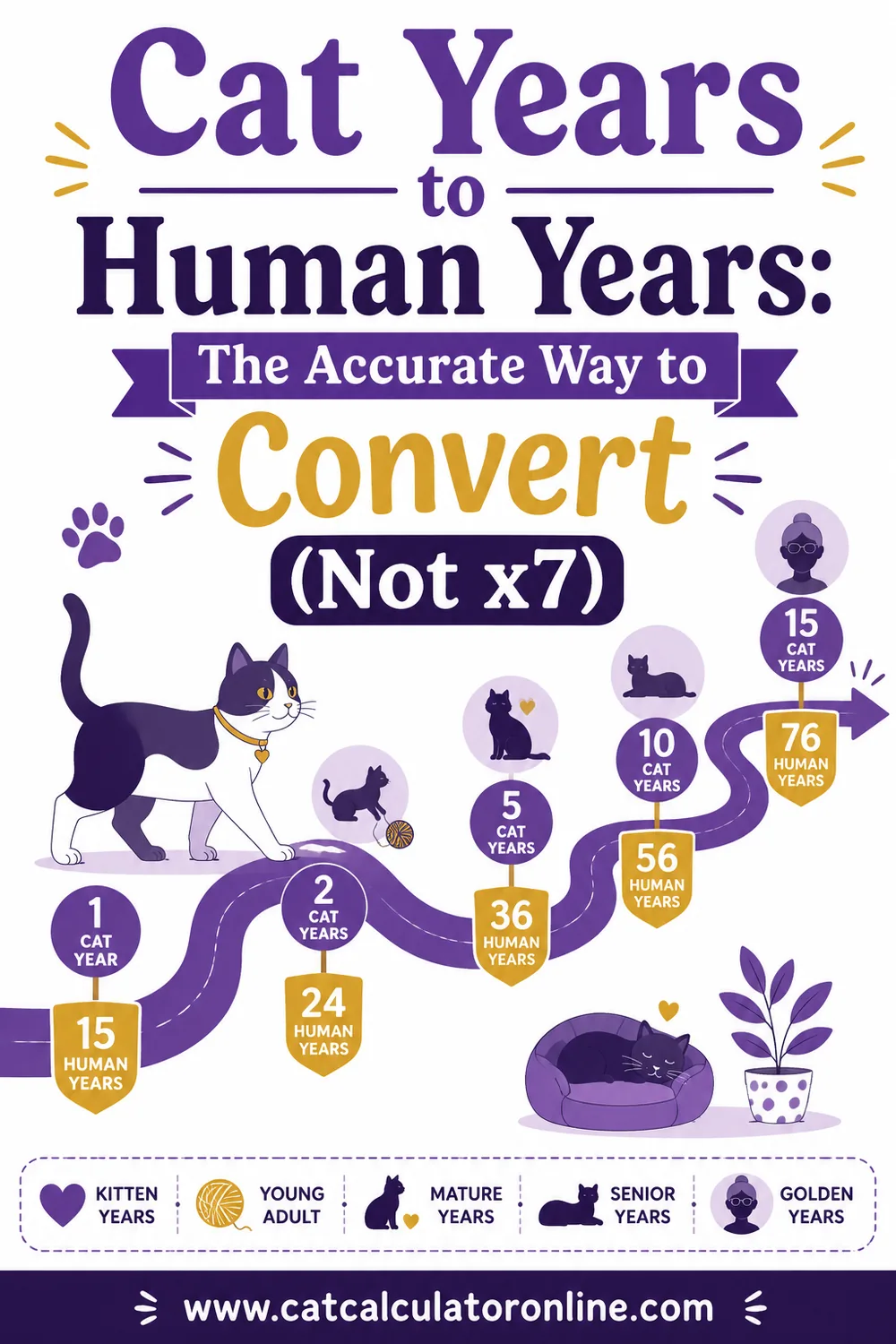
A cat age calculator runs a simple three-step formula: 15 human years for the cat's first year, 9 more for the second, and 4 for every year after that. So a two-year-old cat is 24, a five-year-old is 36, and a twelve-year-old is 64. What makes it useful isn't the arithmetic — it's why the arithmetic is shaped that way, which comes down to how much development a cat packs into its first two years and how steadily it ages afterwards. This page explains where the numbers come from, what the calculator is actually good for, and what it can't tell you. Try it on the cat age calculator.

What Formula Does a Cat Age Calculator Use?
Three steps, and every reputable calculator uses the same ones.
Step one: the first year is worth 15 human years. At twelve months a cat is fully grown, sexually mature and behaviourally adolescent.
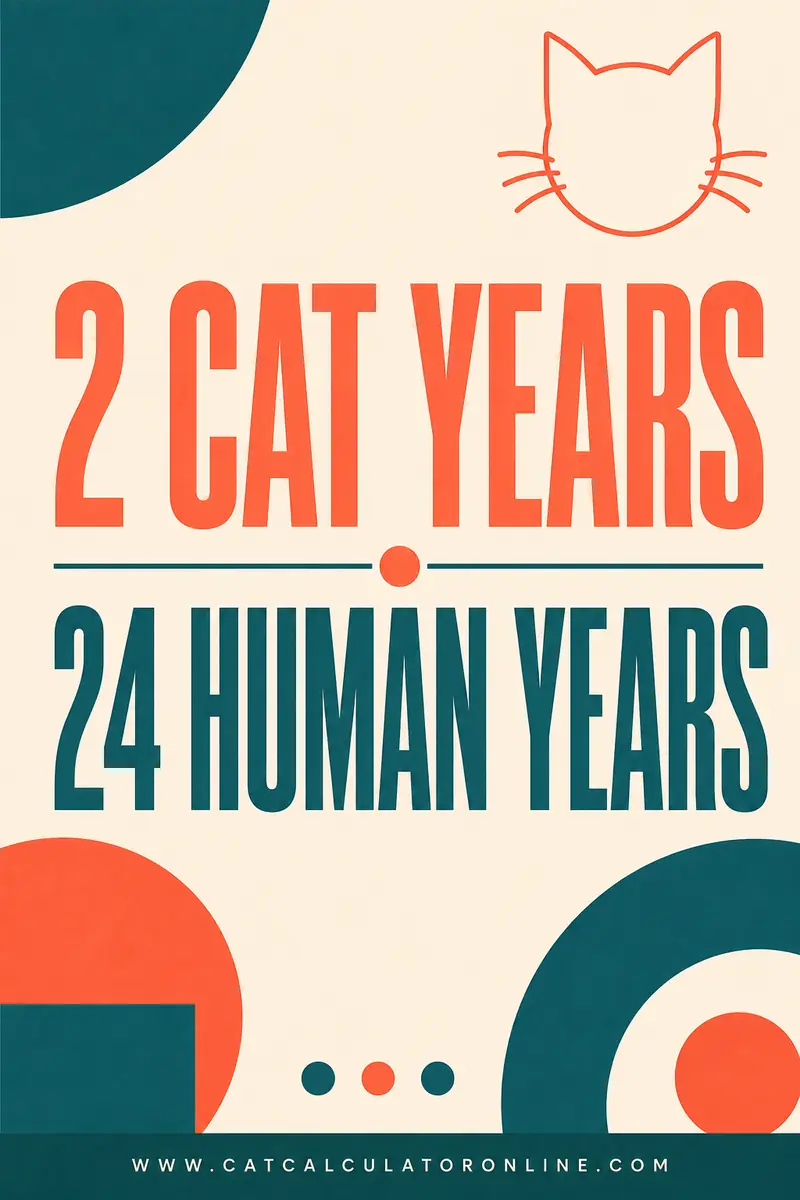
Step two: the second year adds 9, reaching 24. By two, a cat has finished maturing.
Step three: every year after adds 4. Age three is 28, age four is 32, and so on.
| Cat's age | Human years | Life stage |
|---|---|---|
| 1 | 15 | Kitten → young adult |
| 2 | 24 | Young adult |
| 3 | 28 | Young adult |
| 5 | 36 | Young adult |
| 7 | 44 | Mature adult |
| 10 | 56 | Senior |
| 12 | 64 | Senior |
| 15 | 76 | Senior |
| 18 | 88 | Senior |
| 20 | 96 | Senior |
The shortcut for anything over two: 24 + (age − 2) × 4. For a nine-year-old cat: 24 + (7 × 4) = 52.
And backwards, from a human age to a cat age: subtract 24, divide by 4, add 2. That direction is covered in human years to cat years, and the whole table in cat years to human years.
Where Do the Numbers 15, 9 and 4 Come From?
From how a cat actually develops, rather than from dividing one lifespan by another.
The 15. A kitten is born blind, deaf and weighing about 100 grams. Eyes open at roughly a week. Walking by three weeks, weaned by eight. Capable of reproducing from four to six months. Fully grown by twelve. Getting a human from newborn to independent adult takes about fifteen years — that's the comparison being drawn, and it's about development covered rather than time elapsed. More in 1 cat year in human years.
The 9. Year two isn't about growing, it's about maturing: filling out, settling down, losing the adolescent edge. In human terms that's roughly 15 to 24 — teenager to settled young adult. Adding 9 gets you there. Detail in 2 cat years in human years.
The 4. Once a cat is fully mature, ageing settles into a steady rate, and four human years per feline year fits what vets observe: cats become middle-aged around seven, senior around ten, and reach the end of a typical lifespan in their mid-to-late teens. Those landmarks land where the arithmetic puts them — 44, 56, and 68 to 84.
The life-stage backbone. The stages themselves come from the AAHA feline life stage guidelines: kitten to one year, young adult one to six, mature adult seven to ten, senior from ten onwards. That framework is what makes the conversion clinically useful rather than merely interesting, because it's the same framework vets use to decide how often to see a cat.
Why Is the "Multiply by Seven" Rule Wrong?
Because it fails at both ends of a cat's life, in opposite directions.
At the young end it undercounts badly. Seven times one is seven, but a one-year-old cat is fully grown, sexually mature, and perfectly capable of raising a litter. No seven-year-old child is any of those. Fifteen is the honest figure.
At the old end it overcounts. Seven times sixteen gives 112, implying a sixteen-year-old cat is at the extreme limit of possibility. In reality sixteen is old but ordinary, and cats reach eighteen and twenty often enough that no vet is surprised. Eighty is the better comparison.
Where it came from. It's a folk average from a period when people compared a human lifespan of about 70 years with a pet lifespan of about 10 and divided. It was never grounded in how animals develop; it persists because it's easy to remember.
Why the error matters. The seven-times rule makes a ten-year-old cat sound like a seventy-year-old — which encourages owners to write off a cat that is, in truth, at 56 and just entering the senior stage with years of good life ahead. It also makes a one-year-old sound like a child, which leads people to underestimate how much a young cat needs neutering, structure and outlet for its energy.
Does Breed or Size Change the Calculation?
Barely, and this is the biggest difference between cat and dog conversions.
Dogs need size bands. A Great Dane and a Chihuahua age at genuinely different rates, and a dog age calculator that ignores weight gives poor answers. Large breeds reach middle age and old age markedly sooner.
Cats don't. Domestic cats occupy a narrow size range — a Maine Coon and a Siamese differ far less than a Great Dane and a Chihuahua — so one formula covers essentially all of them, pedigree or mixed-breed cat.
What does vary between cats: lifespan, not ageing rate. Some pedigree lines carry heritable conditions that shorten life, and indoor cats consistently outlive outdoor cats by a wide margin. Neither changes what a given year is "worth"; both change how many years there are.
A note on the DNA-methylation research that occasionally gets cited here. The well-publicised 2019 epigenetic clock study was conducted on dogs, not cats, and its results don't transfer. There is no equivalent widely-adopted feline epigenetic clock, and any cat calculator claiming to use one is overstating what exists.
The practical answer: use the standard formula for any cat. If your cat is a breed with known health issues, that affects what to screen for and when — not the conversion itself.
What Should You Actually Use the Calculator For?
Timing decisions, mostly — it earns its keep as a scheduling tool.
Deciding how often to visit the vet. Kittens need a series of visits in the first year. Adults are generally fine annually. From ten cat years — 56 human — the recommendation becomes twice yearly, because six months of a senior cat's life is roughly two human years. That single insight is the most useful thing the conversion gives you, and it's covered in 10 cat years in human years.
Knowing when screening starts being worthwhile. Baseline bloodwork around six or seven, when a cat is 40 to 44 and still well, gives you the comparison values that make later results meaningful.
Setting realistic expectations. A two-year-old cat that is boisterous and destructive is behaving like a 24-year-old, not misbehaving. A twelve-year-old that sleeps a great deal and prefers the sofa to the wardrobe is at 64, not ill by definition.
Explaining care to children and to other members of the household. "She's about eighty" communicates far more than "she's sixteen".
And one thing it should not be used for: predicting how long a cat will live. The conversion describes where a cat is on its timeline. It says nothing about the length of that timeline, which depends on lifestyle, weight, dental care, genetics and whether problems get found early.
What Are the Limits of the Model?
Worth being clear about, because the arithmetic looks more precise than it is.
It's an approximation. No formula converts a cat's age into a genuinely equivalent human age, because the two species age differently in ways no single set of multipliers can capture. Feline kidneys, teeth and joints don't decline on a human schedule.
The decimals are false precision. The formula will happily tell you a cat of 6.5 is 42, but a cat's life doesn't run to that resolution. Whole years, and a rounded human figure, is as much accuracy as the model supports.
Individual variation swamps it. A well-cared-for indoor cat at fourteen can be in better shape than a neglected outdoor cat at nine. Weight, dental care, whether the cat is neutered, whether it goes outside, and whether problems get found early all matter far more than the number.
Conditions ignore the timetable. Hyperthyroidism, kidney disease and diabetes appear when they appear. A cat can develop any of them years earlier or later than the conversion would imply, which is why screening is scheduled by age band rather than waited for by symptom.
It says nothing about lifespan. The conversion places a cat on its timeline; it doesn't tell you how long the timeline is. A cat at 56 human-equivalent may have two years left or ten.
Where it's genuinely reliable: the life-stage boundaries. Kitten to one, young adult to six, mature adult seven to ten, senior from ten. Those brackets are clinically grounded, and everything useful the calculator does rests on them rather than on the exact human number attached to any given year.
What If You Don't Know Your Cat's Age?
Common with rescues and strays, and there are reasonable ways to estimate.
Teeth are the most useful guide. Kittens have all their baby teeth by about eight weeks and their adult set by around seven months. After that, tartar build-up, gum recession and wear give a rough bracket — some tartar suggests two to five years, noticeable tartar and gum change five to ten, and significant wear or missing teeth suggests ten or more.
Eyes. Young cats have smooth, clear irises. Older cats often show a slightly hazy lens, usually benign nuclear sclerosis, and the iris can look more textured with age.
Coat and body. Young adults have soft, even coats and firm muscle. Older cats have coarser coats, greying around the muzzle in dark-coated cats, prominent shoulder blades and less muscle over the spine.
Behavior and activity give a broad steer: constant motion suggests under two, sustained interest with steadier habits suggests three to eight, and long sleeping with reduced jumping suggests double figures.
Get a vet's estimate. A vet examining teeth, eyes, coat and body condition together will bracket a cat's age far more reliably than any single sign, and once you have a working birthday the calculator does the rest. The full method is in how to tell a cat's age.
And treat the result as a bracket, not a birthday. "Somewhere between eight and ten" is a perfectly good answer, and it's enough to decide when senior screening should start.
Frequently Asked Questions
What is the formula for a cat age calculator?
Fifteen human years for the cat's first year, nine more for the second, and four for every year after. For any cat over two: 24 + (age − 2) × 4.
How many human years is 1 cat year?
About 15. A cat's first twelve months take it from a blind newborn to a fully grown, sexually mature adult — roughly the development a human covers in fifteen years.
Is the seven-year rule accurate for cats?
No. It undercounts young cats badly and overcounts old ones. A one-year-old cat is about 15, not 7, and a sixteen-year-old is about 80, not 112.
Do cat age calculators account for breed?
They generally don't need to. Unlike dogs, where size changes the ageing rate considerably, domestic cats are all a similar size and one formula covers essentially all of them.
Is there a DNA test that gives a cat's real age?
Not a widely available or validated one. The well-known epigenetic clock study from 2019 was done on dogs and its findings don't transfer to cats. A vet's physical examination remains the practical method.
What is a cat age calculator actually useful for?
Timing care. It tells you when annual checks should become twice-yearly, when screening bloodwork starts being worthwhile, and what to expect behaviourally at a given age. It doesn't predict lifespan.
A cat age calculator adds 15 for the first year, 9 for the second and 4 for every year after — an arithmetic shape that mirrors how much development a cat packs into its first two years. Use it to time vet visits and screening rather than to predict anything, and convert any age in either direction with the cat age calculator.