Why Is My Cat Peeing Outside the Litter Box?
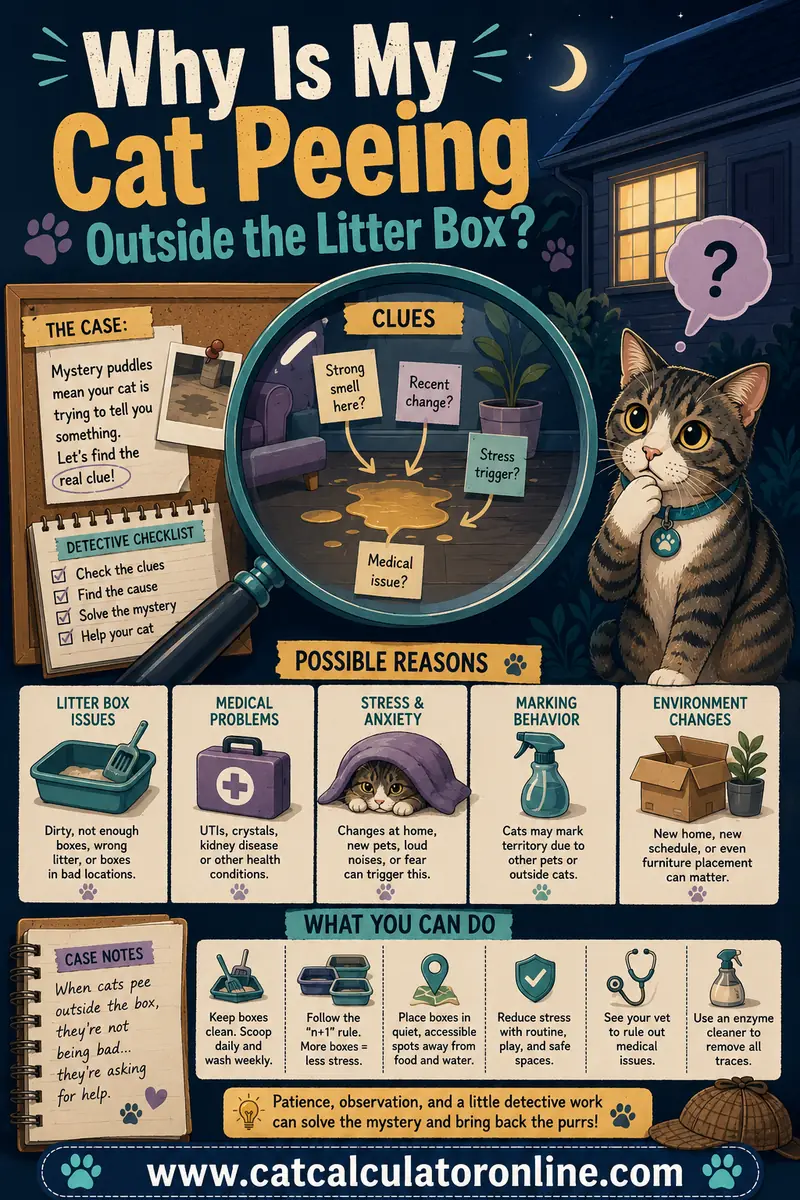
A cat peeing outside the litter box is almost always telling you something is wrong — and the first thing to rule out is medical, not behavioral. Urinary tract inflammation, crystals or stones, kidney disease, diabetes and arthritis all cause it, and a cat who associates the box with pain will start avoiding it. Book a vet appointment before you change anything else.
And one urgent exception first: a cat who is straining in the box and producing little or nothing — especially a male cat — may have a urinary blockage. That is life-threatening and can be fatal within hours. Go to a vet or emergency clinic immediately.
Once your vet has ruled out a medical cause, the behavioral side is very solvable. What follows is the whole map: the emergency signs, the medical causes, how to tell spraying from squatting, a full troubleshooting table, and how to clean up properly so it doesn't repeat. This guide is informational only — it can't diagnose your cat, and it shouldn't replace the vet visit. If you want context on her life stage before that call, our free cat age calculator gives you it in a few seconds.
🔎 What’s most likely going on?
Tap what best describes what you’re seeing:
Tap an option above to see what it can mean and how urgent it is.
🚨 Rule One: Get Medical Causes Ruled Out First
If you take one thing from this page, take this: peeing outside the box is a medical symptom until a vet says otherwise. It's on every list of feline illness warning signs for good reason.
The logic is straightforward. If urinating hurts, and it hurts every time she does it in the box, she starts to blame the box. Cats form that association fast. So she tries the bath mat, the tiles, the pile of laundry — anywhere that isn't the place she now connects with pain. From the outside it looks like a behavior problem. It isn't.
The other reason to go medical-first is that several of the underlying conditions are progressive. Kidney disease, diabetes and urinary stones all get worse and more expensive the longer they run untreated. Catching them because your cat peed on the rug is a genuinely good outcome.
The emergency: straining with nothing produced
This deserves its own paragraph because it is the one thing on this page that cannot wait.
A cat who goes in and out of the box repeatedly, squats and strains, cries out, and produces only a few drops or nothing at all may have a urinary blockage. It's most common in male cats because their urethra is narrower. A blocked cat cannot pass urine, and the condition becomes life-threatening within hours.
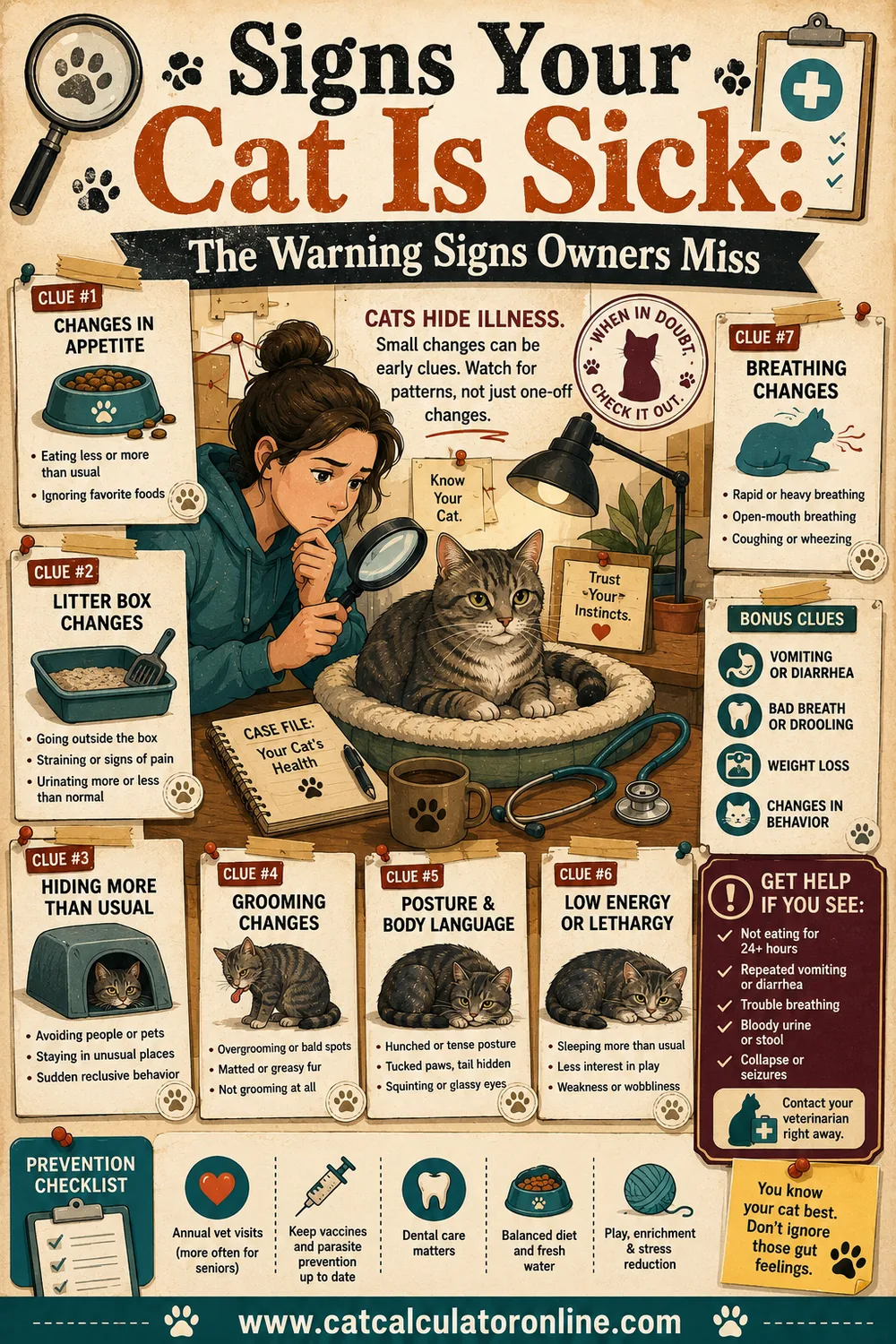
Other signs that go with it: restlessness, repeated licking at the genital area, vomiting, hiding, a hard painful belly, and lethargy that gets worse quickly. Owners often mistake the straining for constipation. Don't assume — get her seen.
If you suspect this, go to a vet or emergency clinic in the same hour. Not tomorrow. Not after you've tried a clean box. Now.
Medical causes worth testing for
Your vet will decide what's relevant, but these are the usual suspects behind a cat urinating outside the box:
- Urinary tract inflammation and infection — painful, causes frequent small urinations, urgency and sometimes blood. Extremely common.
- Crystals or bladder stones — irritate the bladder lining and can partially or fully block the urethra.
- Kidney disease — very common in older cats. Produces more urine, so she may simply not make it to the box in time.
- Diabetes — also causes increased thirst and urine volume.
- Hyperthyroidism — common in senior cats, often alongside weight loss and increased appetite.
- Arthritis and joint pain — makes climbing into a high-sided box genuinely painful. Hugely underdiagnosed in cats.
- Cognitive decline in very old cats — a cat can simply forget where the box is.
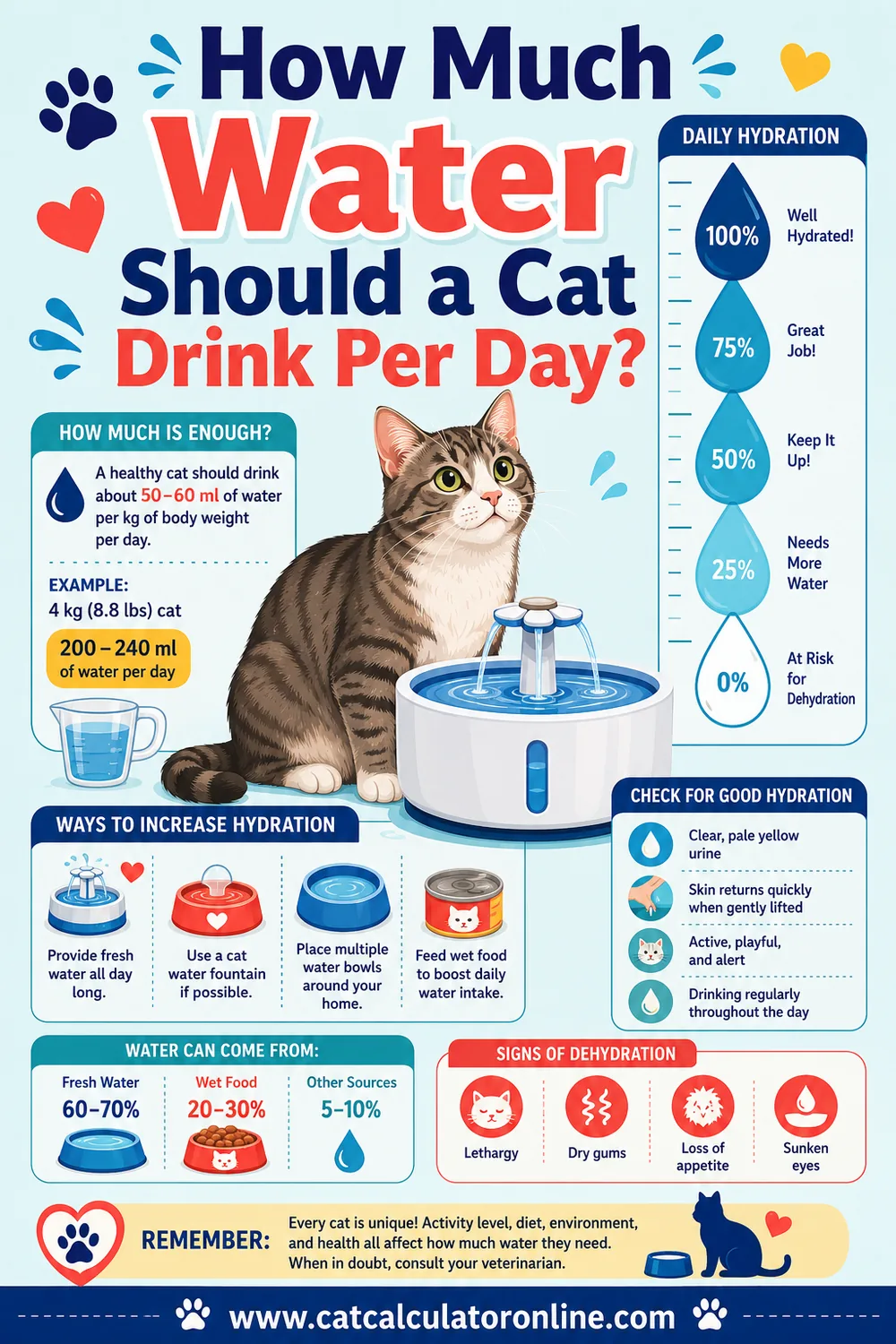
A typical workup is a physical exam plus a urinalysis, often with bloodwork and sometimes imaging. Bring specifics: when it started, where she's going, how much, how often, and whether her drinking has changed. How much water should a cat drink will help you judge whether her intake has shifted, and signs your cat is sick covers the other symptoms worth mentioning at the same appointment.
Spraying vs Peeing Outside the Box: Not the Same Problem
These two get lumped together constantly, and they have different causes and different fixes. Look at the posture and the surface.
Spraying (marking):
- Small amount of urine
- On a vertical surface — walls, door frames, furniture legs, curtains, bags
- Cat is standing up, tail held vertical and quivering, back legs sometimes treading
- Often at height, a few inches off the floor
- It's a communication behavior, not a bathroom failure
Inappropriate urination (elimination):
- Normal-sized puddle
- On a horizontal surface — rugs, beds, laundry piles, bathtubs, sofas
- Cat squats like she would in a box
- Usually means the box, her body, or her environment isn't working
Spraying is most common in unneutered males, but neutered cats of either sex spray too — usually in response to stress, a new pet, an outdoor cat visible through a window, a house move, or tension between cats already in the home. Neutering resolves a large share of spraying cases, and reducing the trigger handles many of the rest.
Squatting puddles are the ones where the medical-first rule bites hardest, and where the litter box audit below does the heavy lifting.
The Behavioral Causes (After the Vet Gives the All-Clear)
Once medical causes are off the table, work through these in order. Most cases come down to one or two of them.
The box isn't clean enough. This is the number one behavioral cause. Cats have a far sharper sense of smell than we do, and a box that seems acceptable to you can be unusable to her. Scoop every box at least once a day, every day.
There aren't enough boxes. The guideline is n + 1 — one box per cat plus a spare — and they need to be in separate locations. Two boxes side by side count as one to a cat. Two cats sharing one box is a setup that fails eventually.
The litter is wrong. Most cats prefer unscented, fine-grained clumping litter — the texture closest to sand. Heavily scented litter, large pellets and crystal litters are all common rejection triggers. A recent brand switch is a very frequent culprit; check whether the problem started around the time you changed litter.
The box has a lid. Covered boxes trap odor inside where the cat is, block her view of the room, and turn the box into a dead end she could be cornered in. Try taking the lid off.
There's a liner. Liners catch claws and bunch up when a cat digs. Plenty of cats simply refuse them.
The box is too small. A box should be at least 1.5× the length of your cat, nose to tail base. Most store-bought boxes are undersized for an average adult. A large under-bed storage tub is often a better box.
The sides are too high. Kittens and arthritic seniors need a low entry — around 1–2 inches. If your cat is over 10, assume some stiffness even without an obvious limp. When is a cat considered senior has the age brackets.
The location is wrong. Boxes next to food and water, in noisy laundry rooms, behind doors that swing shut, or in dead-end corners with no escape route all get abandoned. Quiet, but with a clear view and two ways out.
Another cat is guarding it. In multi-cat homes, one confident cat can control access without any obvious fighting — just sitting in a doorway is enough. Boxes clustered in one area make this worse. Spread them across rooms and floors.
Stress or change. New baby, new pet, new furniture, a house move, building work, a change in your schedule, a strange cat visible through the window. Cats are strongly routine-driven and urinating outside the box is a common stress response.
A learned negative association. If something startled her in the box once — a loud appliance, a dog, a child, a painful urination — she may have written that box off entirely, even after the cause is gone.
She's found a surface she prefers. Soft absorbent things (bath mats, laundry, duvets, rugs) feel good to eliminate on. Once a spot smells even faintly of urine, it invites repeats.
Full Troubleshooting Table
| Cause | What you'll notice | What to do |
|---|---|---|
| Urinary blockage | Straining, little or nothing produced, crying, restlessness — often a male cat | EMERGENCY. Vet or emergency clinic this hour. |
| Urinary inflammation or infection | Frequent small trips, blood, licking, crying while going | Vet the same day |
| Bladder stones or crystals | Blood, straining, repeat episodes | Vet — needs urinalysis/imaging |
| Kidney disease | Large puddles, drinking much more, weight loss | Vet within the week for bloodwork |
| Diabetes | More thirst, more urine, appetite changes | Vet within the week |
| Arthritis | Older cat, going right beside a high-sided box | Vet check + swap to a low-entry box |
| Cognitive decline | Very old cat, confusion, night yowling | Vet — plus extra boxes in easy reach |
| Dirty box | Going near but not in the box | Scoop daily; full change + wash on schedule |
| Too few boxes | Multi-cat home, accidents in shared areas | Use n+1, in separate locations |
| Wrong litter | Started after a brand switch; she doesn't dig or cover | Return to unscented, fine-grained clumping litter |
| Covered box | Hesitates at the entrance, uses it briefly or not at all | Remove the lid |
| Box too small | Rear end hangs over the edge; urine over the side | Bigger box — at least 1.5× her length |
| Bad location | Box near food, appliances, or in a dead end | Quiet spot, escape routes, away from bowls |
| Bullying between cats | One cat waits, hovers, or gets blocked in doorways | Spread boxes across rooms and floors; add more |
| Stress or household change | Started around a move, new pet, new person, building work | Restore routine, add hiding spots, ask your vet about a calming plan |
| Negative association | Avoids one specific box entirely | New box, new spot, new litter — start fresh |
| Surface preference | Repeats on rugs, beds, laundry | Enzymatic clean, block access, put a box on that spot temporarily |
| Spraying (marking) | Small amount, vertical surface, standing, quivering tail | Neuter if intact; reduce triggers; enzymatic clean; vet advice |
How to Clean Cat Urine Properly
Cleaning is not a side note — it decides whether the behavior repeats. Cats return to spots that still smell like a toilet, and a spot can smell like one to her long after it stops smelling like anything to you.
Use an enzymatic cleaner. Enzyme-based pet cleaners break down the actual uric acid compounds in urine rather than masking them. Nothing else does this properly. Soak the area generously — more than feels necessary, because urine spreads wider under the surface than the visible stain — and let it dwell for as long as the label says. Air dry. Don't rush it with a hairdryer.
Never use ammonia-based cleaners. Ammonia smells like urine to a cat. Cleaning a spot with it is close to putting up a sign that says "bathroom here." Avoid bleach on soiled areas too — it's harsh, and its residue doesn't remove the odor markers she's responding to.
Don't scrub with a regular carpet cleaner first. Steam and heat can set the proteins in urine, making the smell permanent. Enzymatic cleaner goes on first.
Deal with what's underneath. On carpet, urine often reaches the underlay. Treat the pad, not just the surface, or the smell keeps coming back. Cushions, mattresses and duvets may need saturating and multiple passes.
Check with a blacklight. A UV torch in a dark room will show old spots you never knew about — often exactly the ones she keeps returning to.
Block or repurpose the spot. After cleaning, either make the spot unavailable (close the door, cover it, put a plant on it) or change its meaning — feeding her there, or putting a litter box directly on it and gradually moving it a few inches a day toward where you want it.
What Not to Do
Some instinctive reactions actively make this worse, and they're worth naming.
Never punish her. Don't shout, don't rub her nose in it, don't spray her with water, don't shut her in a room with the box. Cats don't connect punishment with an act they committed earlier, and they don't urinate out of spite — that's a human explanation for a cat problem. What punishment reliably does is increase stress, and stress is one of the causes. You end up making the exact thing you're trying to fix worse, and damaging her trust in you at the same time.
Don't wait it out. "She'll grow out of it" doesn't apply here. Every repeat strengthens both the habit and the scent marker.
Don't remove the boxes she is using. Take nothing away while you're troubleshooting. Only add.
Don't change five things at once. If you swap the litter, move the box, buy a new one and add a diffuser on the same afternoon, you won't know what worked. Change one variable, give it a week, then reassess.
Don't assume it's behavioral because she "seems fine." Cats hide pain by instinct. A cat with a painful bladder will still eat, play and purr.
A Step-by-Step Plan to Fix It
Work through this in order once your vet has ruled out or treated medical causes.
- Vet visit first. Urinalysis at minimum. Treat anything found before doing anything else.
- Count your boxes. Get to n+1, in separate locations, at least one per floor.
- Audit each box. Lid off, liner out, at least 1.5× her length, low entry if she's a kitten or a senior, 2–3 inches of litter.
- Go back to basics on litter. Unscented, fine-grained, clumping. If you switched recently, switch back.
- Scoop daily, every box. Full change and wash every 2–4 weeks for clumping litter, weekly for non-clumping. Mild unscented soap only.
- Move boxes away from food, water, and noise. Quiet, visible, escapable.
- Enzymatic-clean every soiled spot, including ones you find with a UV torch.
- Reduce competition. In multi-cat homes, add boxes, spread them out, add vertical space and separate feeding stations so nobody has to negotiate for access.
- Offer a litter cafeteria. If you're stuck, put two or three boxes side by side with different litters in each and see which she picks. Her vote is the answer.
- Rebuild the association. Confine her to a smaller, calm room with a clean box for a few days so she has an easy win, then expand her space gradually.
- Address the stress. Restore routine, add hiding spots and high perches, use play to burn tension, and ask your vet about pheromone products or a calming plan if the trigger can't be removed.
- Go back to the vet if it doesn't resolve. Persistent cases often have a medical component that wasn't obvious first time round, and your vet can refer you to a veterinary behaviourist.
Most cases resolve somewhere in steps 1–6. The rest usually need patience more than they need a new product.
FAQ
Why is my cat suddenly peeing outside the litter box?
A sudden change is a medical red flag. Urinary inflammation, stones, kidney disease, diabetes and arthritis all cause it, and a cat who hurts while urinating starts avoiding the box she associates with the pain. Book a vet appointment before assuming it's behavioral.
Is my cat peeing outside the box out of spite?
No. Cats don't urinate to punish you — that's a human explanation for a feline problem. It's either a medical issue, something about the box she can't tolerate, or stress. Punishing her increases stress and makes the behavior more likely, not less.
When is peeing outside the litter box an emergency?
When your cat is straining in the box and producing little or no urine, especially if she's a male cat. That can mean a urinary blockage, which is life-threatening and can be fatal within hours. Go to a vet or emergency clinic immediately.
How do I tell spraying from peeing outside the box?
Look at the surface and the posture. Spraying is a small amount on a vertical surface, done standing with an upright quivering tail — that's territorial marking. A normal-sized puddle on a horizontal surface, done squatting, is an elimination problem tied to the box, her health, or her environment.
What cleaner should I use on cat urine?
An enzymatic pet cleaner, applied generously and left to dwell per the label. Never use ammonia-based cleaners — ammonia smells like urine to a cat and encourages her to go there again. Skip steam cleaning first, since heat can set the odor permanently.
How many litter boxes should I have?
One per cat plus one spare, in separate locations — so two cats need three boxes. Two boxes side by side count as one to a cat, and in multi-story homes you want at least one box per floor so nobody has to make a long trip.
My older cat started missing the box — why?
Two common reasons in senior cats: arthritis makes climbing over high sides painful, and kidney disease increases urine volume so she may not reach the box in time. Both need a vet visit, and both improve with low-entry boxes placed closer to where she rests.
The Bottom Line
Start at the vet. A cat peeing outside the litter box is a medical symptom far more often than owners expect, and straining with nothing produced is a same-hour emergency. Once she's been checked, the behavioral fixes are mostly unglamorous: enough boxes in separate places, a big open box with a low entry, unscented fine-grained clumping litter two to three inches deep, scooped every single day, somewhere quiet and away from her food. Clean every accident with an enzymatic cleaner, never ammonia. Never punish her.
Change one thing at a time, give each change a week, and be patient — most cats come back to the box once the reason they left it is gone.
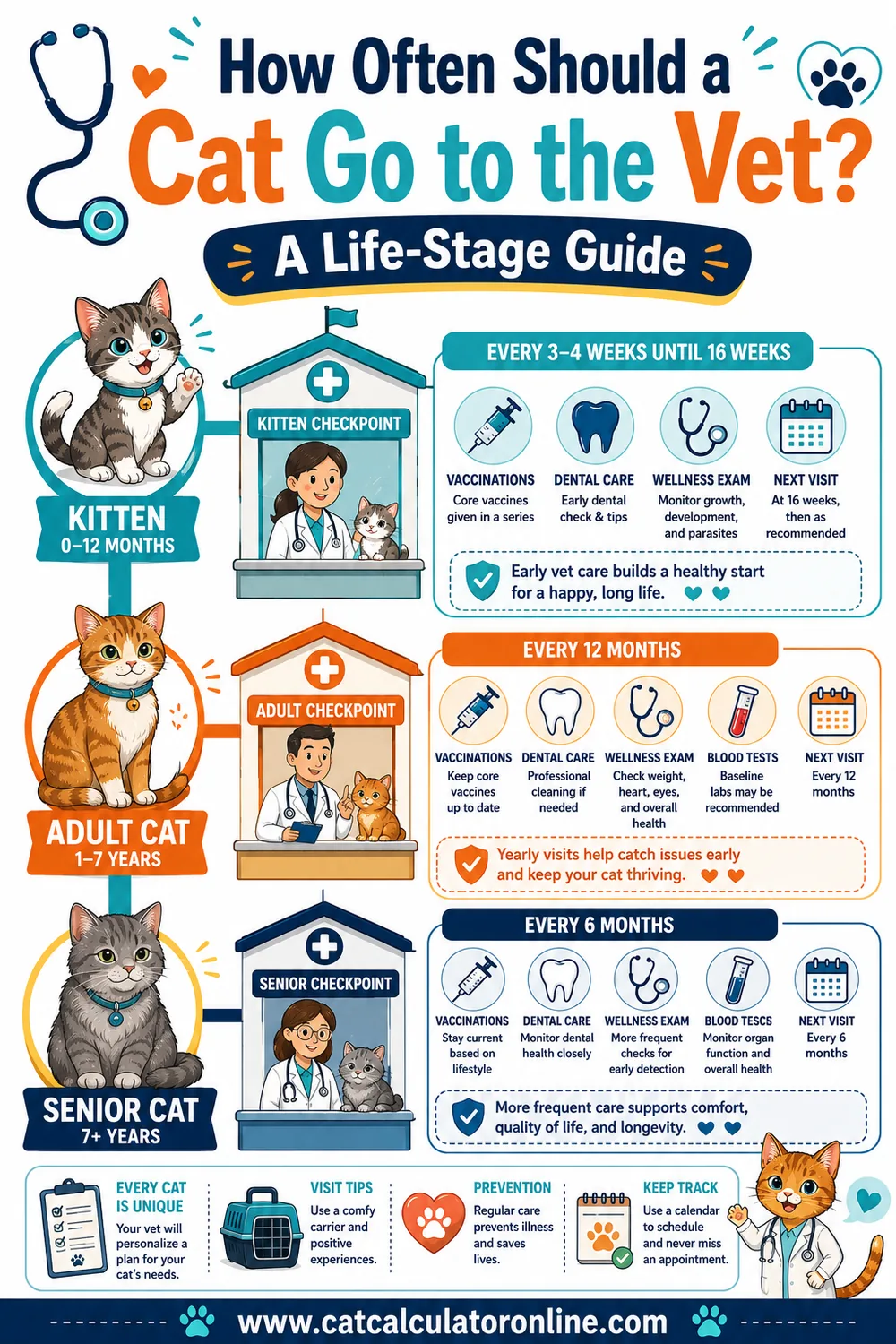
Next steps: check her life stage with our free cat age calculator, read signs your cat is sick for the other symptoms worth raising at the appointment, and see how often should a cat go to the vet for the checkup schedule that catches these conditions early.