Hyperthyroidism in Cats
Hyperthyroidism is the most common hormonal disorder in older cats, and it has one very recognizable signature: a cat that is losing weight while eating more than ever. An overactive thyroid pushes the whole body into overdrive, burning through calories faster than any appetite can keep up with. It usually appears past the age of ten, it's almost always caused by a benign growth rather than anything sinister, and — this is the genuinely good news — it is one of the few conditions in older cats that can often be cured outright. Treatment ranges from a daily tablet to a one-off curative therapy, and the cat cost calculator helps you plan for whichever route suits you.
What Is Hyperthyroidism?
The thyroid is a small gland in the neck that produces hormones controlling metabolism — essentially the body's idle speed. In hyperthyroidism, the gland produces far too much, and everything runs too fast.
In the overwhelming majority of cats, the cause is a benign, non-cancerous overgrowth of thyroid tissue. That's worth saying clearly, because "growth on the gland" sounds alarming and usually isn't. Malignant thyroid tumours in cats exist but are uncommon.
Because thyroid hormone affects nearly every system, the effects are wide-ranging. The heart beats faster and works harder, blood pressure often rises, the digestive system speeds up, and the body burns through energy stores at a rate no amount of eating can match.
It's a disease of older cats. Most diagnoses come after age ten, and it's rare in cats under seven. If you have a senior cat losing weight, this belongs near the top of the list of possibilities — alongside kidney disease and diabetes, which is why bloodwork rather than guesswork is the way forward.
What Are the Signs?
The combination is what makes it distinctive.
Weight loss with a good or increased appetite. This is the hallmark, and it's unusual enough to be a genuine clue. Most conditions that cause weight loss also suppress appetite. A cat that is visibly thinner while emptying the bowl enthusiastically — sometimes demanding food constantly — is showing something quite specific.
Restlessness and hyperactivity. Owners often describe a cat that has become oddly kittenish, or agitated and unsettled. Night-time yowling is common, and it's frequently what finally prompts the vet visit.
Alongside those:
- Increased thirst and urination
- Vomiting or loose stools, from a sped-up gut
- A scruffy, greasy or matted coat, because grooming slips
- A rapid heart rate, which your vet will pick up immediately
- Panting or breathlessness in more advanced cases
- Occasionally the opposite of hyperactivity — a smaller number of cats become quiet and withdrawn instead, which makes diagnosis harder
Some owners can feel a small lump in the neck, though this is genuinely difficult and not something to rely on. Leave that to your vet.
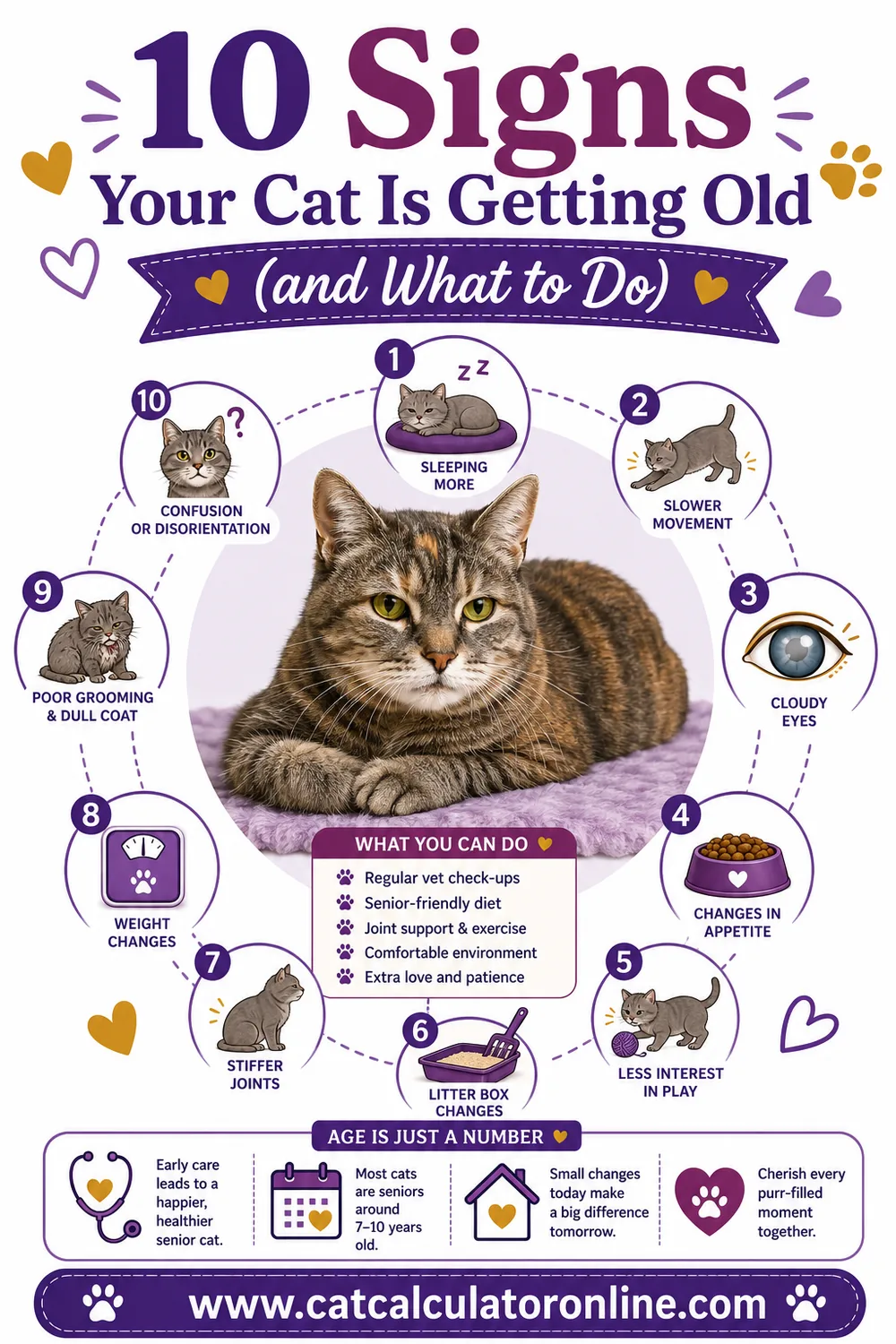
None of these signs on their own proves anything. Thirst and weight loss appear in kidney disease and diabetes too, and it's entirely possible for an older cat to have more than one condition at once. The general picture of ageing is covered in signs your cat is getting old.
How Is It Diagnosed?
Usually with a straightforward blood test, which is one of the reasons this condition is worth knowing about.
Total T4. A blood test measuring thyroid hormone. In most affected cats the level is clearly raised, and that combined with the clinical picture is enough to diagnose.
Free T4 or repeat testing, sometimes. A minority of hyperthyroid cats have a T4 in the upper-normal range, particularly early on or when another illness is masking it. If your vet strongly suspects hyperthyroidism despite a normal result, they may repeat the test or run a more sensitive one. That's thoroughness, not indecision.
A full blood panel and urine test. Essential rather than optional here, because hyperthyroidism travels with other conditions and can hide them. More on that below.
Blood pressure. Often raised in hyperthyroid cats, and high blood pressure can quietly damage the eyes, heart, brain and kidneys. Easily measured and very treatable.
Heart assessment. Your vet will listen carefully, since the raised heart rate and workload can cause changes to the heart muscle. These often improve once the thyroid is controlled.
The practical takeaway: this is one of the more findable conditions in older cats, which is a strong argument for annual or twice-yearly bloodwork from around age seven, as set out in the senior cat health checklist.
What Are the Treatment Options?
Four, and they're genuinely different in cost, commitment and outcome. This is a decision worth talking through properly with your vet.
1. Daily medication. An anti-thyroid drug, usually given as a tablet or a gel applied to the ear, once or twice daily for life. It controls the condition without curing it, and it's the most common starting point — cheap to begin, easy to stop, and it lets your vet see how the kidneys respond before committing to anything permanent. The downsides are lifelong pilling and regular blood monitoring.
2. Radioactive iodine therapy (I-131). A single injection that destroys the overactive tissue while leaving normal tissue intact. It cures the condition outright in the large majority of cats, with no ongoing medication. Your cat stays at a licensed facility for a few days afterward for safety reasons. Expensive upfront, and often the best value over a cat's remaining years. This is widely considered the gold standard.
3. Surgery. Removal of the affected thyroid tissue. Effective, but it involves general anaesthesia in an older cat, and there's a risk to the nearby parathyroid glands. Less commonly chosen now that radioactive iodine is more widely available.
4. Prescription iodine-restricted diet. A therapeutic food that limits the iodine the thyroid needs to make hormone. It can work well, but only if your cat eats nothing else at all — no treats, no other cat's food, no hunting. That makes it difficult in multi-cat or indoor-outdoor households, though it can be a good option for a cat that can't tolerate medication.
Which is right depends on your cat's age, kidney function, other health conditions, your budget and how practical daily medication is in your household. There's no universally correct answer, and it's a fair thing to ask your vet to walk through with you.
What Does Treatment Cost?
| Option | Typical cost | Ongoing? |
|---|---|---|
| Diagnosis (T4, full panel, BP) | $150–$400 | One-off |
| Daily medication | $20–$50 a month | Lifelong |
| Monitoring bloodwork | $100–$250, 2–4× a year | Ongoing |
| Radioactive iodine (I-131) | $1,200–$2,500 | Usually one-off |
| Surgery | $800–$2,000 | Usually one-off |
| Prescription diet | $50–$90 a month | Lifelong |
The arithmetic here is worth doing properly, because the cheapest option upfront isn't always cheapest overall.
Medication at, say, $35 a month plus three monitoring panels a year comes to roughly $800–$1,000 annually. Over four or five years that's $3,000–$5,000 — more than radioactive iodine, which is usually a single payment.
So for a cat with several good years ahead and otherwise sound health, I-131 often works out better on both cost and quality of life. For a cat that is older, has kidney disease, or has other conditions complicating the picture, medication's flexibility is a genuine advantage.
Insurance covers hyperthyroidism if the policy was in place before any signs appeared. Once diagnosed, it's excluded from any new policy — universally, across insurers. Typical veterinary pricing is set out in cat vet costs explained.
Why Does It Matter for the Kidneys?
This is the single most important thing to understand about hyperthyroidism, and it surprises most owners.
An overactive thyroid increases blood flow through the kidneys. That extra flow can make kidney function look better on paper than it really is — effectively masking underlying chronic kidney disease.
When the thyroid is treated and everything returns to normal speed, that artificial boost goes away. Sometimes kidney disease that was hiding underneath becomes visible for the first time, and it can look as though the treatment caused it. It didn't — it revealed it.
This is exactly why vets:
- Run full kidney bloodwork before treating, not just a thyroid test
- Often start with medication rather than a permanent cure, since medication can be stopped or reduced if the kidneys struggle
- Recheck kidney values after the thyroid is under control
None of this means hyperthyroidism shouldn't be treated. Left alone it causes heart damage, dangerous blood pressure, and progressive wasting — it is genuinely harmful. It just means the two conditions have to be managed together, carefully, which is why the monitoring matters. Kidney disease is covered in full in chronic kidney disease in cats.
What Happens If It Isn't Treated?
It progresses, and the consequences reach well beyond weight loss.
Heart problems. A permanently raised heart rate thickens the heart muscle over time and can lead to heart failure. Encouragingly, these changes often improve substantially once the thyroid is controlled.
High blood pressure. Can damage the eyes — sometimes causing sudden blindness from retinal detachment — as well as the brain, heart and kidneys.
Severe weight and muscle loss. Cats become genuinely frail, losing muscle as well as fat, which affects mobility and quality of life.
A thyroid storm, rarely — an acute crisis with dangerous heart rhythm changes.
The reason to be direct about this is that hyperthyroidism sometimes seems mild early on. A cat that's eating well and seems energetic doesn't look ill, and it's tempting to wait. But the damage accumulates quietly, and the condition responds so well to treatment that waiting has little to recommend it.
How Quickly Does Treatment Work?
Faster than most owners expect, which is one of the more satisfying things about this condition.
Medication typically brings hormone levels down within two to four weeks. Your vet will usually recheck bloodwork at around three weeks to see where things have landed and adjust the dose. Many owners notice the behavioral changes first — the restlessness settles, the night-time yowling eases — before the weight starts coming back.
Radioactive iodine works over one to three months. There's no immediate switch; the treated tissue gradually stops overproducing. Most cats are back to normal thyroid levels within three months, and the majority need nothing further.
Weight recovery lags behind hormone levels, and this trips people up. Your cat's blood results can be perfectly normal while they still look thin, because rebuilding lost muscle and fat takes time. Expect weight to return over two to four months, not two to four weeks. Steady monthly gain is what you're looking for rather than a dramatic change.
A few things to expect along the way:
- Appetite often drops back to normal, which can feel worrying after months of a ravenous cat. It's usually a good sign.
- Some cats become noticeably calmer, and owners occasionally worry the treatment has gone too far. Your vet will check.
- Kidney values need rechecking once the thyroid is controlled, for the reasons above.
If your cat seems sluggish, is putting on weight rapidly, or seems generally flat a few weeks into treatment, mention it. Levels swinging too far the other way is straightforward to correct with a dose adjustment.
What Can You Do at Home?
Once treatment starts, most of the work is your vet's. But a few things genuinely help.
Weigh monthly and write it down. Weight is the clearest measure of whether treatment is working. A cat regaining lost weight steadily is a good sign, and a record beats memory every time.
Give medication consistently if that's the route you take. Missed doses let hormone levels swing. If pilling is a struggle, say so — the ear gel formulation exists precisely for cats who won't take tablets, and it's a common switch rather than an admission of defeat.
Keep every monitoring appointment. The bloodwork is how the dose gets adjusted and how the kidneys get watched. Skipping it is the main way treatment goes wrong.
Feed generously during recovery. A cat that has lost condition needs to rebuild it. Your vet may suggest a higher-calorie or more palatable food for a period.
Keep things calm. A hyperthyroid cat is often restless and unsettled. Quiet spaces, predictable routine and easy resting spots all help while the treatment takes effect.
Watch for changes and report them. Increased thirst, poor appetite, weakness, or a cat that becomes sluggish after starting treatment all warrant a call — sometimes the dose simply needs adjusting. Broader senior guidance is in how to care for a senior cat.
Frequently Asked Questions
What are the first signs of hyperthyroidism in cats?
Weight loss despite a good or increased appetite is the hallmark, and it's unusual enough to be a real clue. Restlessness, night-time yowling, increased thirst, vomiting or loose stools, and a scruffy coat commonly appear alongside it. Most cats are over ten at diagnosis.
Can hyperthyroidism in cats be cured?
Yes, often. Radioactive iodine therapy resolves it permanently in the large majority of treated cats, and surgery can too. Daily medication and prescription diets control the condition without curing it. Which suits your cat depends on age, kidney function and other health factors.
How much does it cost to treat hyperthyroidism in a cat?
Medication runs $20–$50 a month plus $100–$250 for monitoring bloodwork a few times a year — roughly $800–$1,000 annually. Radioactive iodine is usually $1,200–$2,500 as a one-off, which often works out cheaper over several years.
Why did my cat's kidney disease appear after thyroid treatment?
An overactive thyroid increases blood flow through the kidneys, which can mask existing kidney disease. Treating the thyroid removes that artificial boost and reveals what was already there. The treatment didn't cause it — which is why vets check kidney values before and after.
Is hyperthyroidism in cats cancer?
Almost always no. In the overwhelming majority of cats it's caused by a benign, non-cancerous overgrowth of thyroid tissue. Malignant thyroid tumours do occur in cats but they're uncommon, and your vet will discuss it if there's any suggestion of one.
Can I treat my cat's thyroid with diet alone?
A prescription iodine-restricted diet can control hyperthyroidism, but only if your cat eats absolutely nothing else — no treats, no other pets' food, no hunting. That makes it impractical in many households, though it's a useful option for cats who can't tolerate medication.
Hyperthyroidism is, oddly, one of the better diagnoses to get in an older cat. It's common, it's easy to test for, and unlike most conditions of the senior years it can often be cured outright rather than merely managed. The main thing worth acting on is not waiting — a cat losing weight while eating well should have a blood test rather than a watchful few months. If your cat is over seven, annual bloodwork will find this early, and you can plan the costs with the cat cost calculator.