What Does Cat Insurance Actually Cover?
A standard accident-and-illness policy covers the unexpected medical costs of treating a cat that gets hurt or sick — the diagnostics, surgery, hospitalisation and medication that follow an accident or a new diagnosis. That includes the big feline categories owners actually face: urinary blockage, kidney disease, hyperthyroidism, diabetes, cancer, and dental disease. What it does not cover is anything routine, anything cosmetic, and anything your cat already had before you signed up. Once you know how the line is drawn, most policy documents become readable — and the cat cost calculator helps you see what the uncovered half of the picture costs each year.
What Does a Standard Cat Insurance Policy Include?
Nearly every accident-and-illness policy is built from the same set of building blocks. The wording varies; the categories rarely do.
| Category | Typically covered? | Examples |
|---|---|---|
| Accidents and injuries | Yes | Fractures, wounds, swallowed string, falls, toxin ingestion |
| Illnesses | Yes | Urinary disease, kidney disease, hyperthyroidism, diabetes, infections |
| Cancer | Yes | Diagnosis, surgery, chemotherapy, follow-up scans |
| Diagnostics | Yes | Bloodwork, X-rays, ultrasound, MRI, biopsies, lab fees |
| Surgery and hospitalisation | Yes | Theater time, anaesthesia, overnight care, nursing |
| Prescription medication | Yes | Drugs prescribed to treat a covered condition |
| Hereditary and congenital conditions | Usually, if not pre-existing | Heart disease in Maine Coons, polycystic kidney disease in Persians |
| Dental disease | Usually | Extractions, treatment for diagnosed disease |
| Behavioral treatment | Sometimes | Vet-led treatment for spraying, over-grooming |
| Alternative therapy | Sometimes | Acupuncture, hydrotherapy, physiotherapy |
| Routine and preventive care | No | Vaccines, checkups, flea treatment, dental cleaning |
| Elective procedures | No | Neutering, declawing, cosmetic surgery |
| Pre-existing conditions | No | Anything showing signs before cover began |
The mental model that makes this stick: insurance pays for the things you couldn't have planned for. If you could put it in a calendar — a vaccination, a neuter, a dental cleaning — it's yours. If it arrived without warning, it's probably covered.
What Accidents Does Cat Insurance Cover?
Accidents are the simplest category and the least disputed. A policy covers the treatment of sudden physical injury: road traffic accidents, falls from height, fractures, lacerations, bite wounds from fights, burns, eye injuries, and foreign bodies.
Foreign bodies deserve their own mention, because cats are unusually good at creating them. String, tinsel, hair ties, dental floss and ribbon are the classic culprits, and a linear foreign body caught in the intestine is a surgical emergency that commonly runs $2,000–$4,000. Toxin ingestion sits here too — lilies, antifreeze, human medication and certain essential oils are all genuine feline emergencies.
Accident cover typically starts fast. Where illness cover usually waits 14–30 days, accident cover often begins within a few days of the policy start, and occasionally the next day.
An important nuance: it's the treatment that's covered, not the event. If your cat is hit by a car, the policy pays for the X-rays, the surgery, the hospitalisation and the pain relief. It doesn't pay for damage to anyone's property, and third-party liability for cats is generally not offered at all — unlike dog policies, where it's common. Cats are legally treated differently in most jurisdictions, and insurers follow suit.
What Illnesses Are Covered?
This is where the money is, and where a policy earns its keep. A standard plan covers new illnesses diagnosed after the waiting period ends, including the conditions that dominate feline medicine:
- Urinary tract disease, including feline lower urinary tract disease (FLUTD) and the blocked-bladder emergency that's disproportionately common in male cats.
- Chronic kidney disease, the single most common serious diagnosis in older cats — covering bloodwork, fluids, prescription diet in some policies, and ongoing monitoring.
- Hyperthyroidism, very common past ten, treatable with medication, surgery or radioactive iodine therapy.
- Diabetes, including insulin, monitoring equipment and the frequent rechecks that go with stabilizing a diabetic cat.
- Cancer in all its forms — lymphoma is the most common feline cancer — including diagnostics, surgery, chemotherapy and palliative care.
- Infections and viruses, including respiratory infections, abscesses, and conditions arising from FIV or FeLV where the cat wasn't already positive at enrollment.
- Gastrointestinal disease, including inflammatory bowel disease and pancreatitis.
- Heart disease, notably hypertrophic cardiomyopathy, the most common feline heart condition.
The pattern is worth noticing. Many of these are chronic — they don't resolve, they get managed for years. That makes two policy details far more important than they first appear: whether the annual limit is high enough to absorb years of ongoing management, and whether the policy renews cover for a condition into the following policy year. Policies that reset and then exclude last year's diagnosis as "pre-existing" exist, and they are the single biggest trap in the market.
Does Cat Insurance Cover Dental Treatment?
Usually, with a clear split. Dental disease is generally covered; dental maintenance generally isn't.
If your vet diagnoses periodontal disease, tooth resorption — extremely common in cats — a fractured tooth, or stomatitis, the treatment is typically eligible. That matters, because feline dental work is expensive: extractions under general anaesthesia routinely cost $800–$2,000, and full-mouth extraction for severe stomatitis can go higher.
What's excluded is the routine scale and polish, which is preventive care and lands in the same bucket as vaccines.
There's a condition attached that catches people out. Many insurers require evidence of routine dental care — usually an annual check, sometimes a documented cleaning — before they'll pay a dental claim. Skip the checkups for three years and the insurer may argue the disease was preventable and long-developing. Keep the appointments in the record, and the claim is straightforward.
Are Hereditary and Congenital Conditions Covered?
Most good policies cover them, provided the condition wasn't diagnosed or showing signs before your cover started. This matters more for pedigree cats than for the average domestic shorthair.
Real, documented examples: hypertrophic cardiomyopathy in Maine Coons and Ragdolls, polycystic kidney disease in Persians, and progressive retinal atrophy in Abyssinians. These are known breed risks, which is precisely why some insurers price pedigree cats higher.
Two traps to check before buying. First, some cheaper policies exclude hereditary conditions outright — read that section specifically, because it's the difference between real cover and decorative cover for a pedigree cat. Second, a condition your cat is predisposed to isn't excluded just for being a breed risk; it's only excluded if there were already signs before enrollment. Buying young, before anything shows up, is what keeps these conditions coverable. The mechanics are set out in our guide to pre-existing conditions.
What Does "Covered" Actually Mean on a Claim?
Covered doesn't mean free, and this is the most common source of disappointment. Three things sit between an eligible bill and the money that lands in your account.
The deductible. You pay the first slice each policy year — commonly $100 to $1,000. A $700 claim against a $500 deductible only puts $200 into the reimbursable pot. How these work, and the annual-versus-per-condition distinction, is covered in cat insurance deductibles explained.
The reimbursement percentage. After the deductible, the insurer pays its stated share — usually 70%, 80% or 90% — and you pay the rest.
The annual limit. The ceiling on total payouts in a policy year. A $5,000 limit sounds generous until a cancer diagnosis produces $9,000 of treatment across eight months.
Worked example. Your cat blocks and needs emergency treatment costing $2,800. You have a $500 deductible, 80% reimbursement and a $10,000 annual limit. You pay $500, then 20% of the remaining $2,300 ($460). The insurer reimburses $1,840 and your out-of-pocket is $960, plus whatever you've paid in premiums that year.
One more practical point: nearly all pet insurance works by reimbursement. You pay the clinic in full and claim it back afterward, typically within a couple of weeks. Being insured doesn't remove the need to access the money on the day.
What Do the Covered Conditions Actually Cost?
Cover only means something in proportion to the bills behind it. These are typical US ranges for conditions a standard policy would treat as eligible — wide, because geography and severity move them enormously, but enough to show the shape of the risk.
| Condition | Typical treatment cost | Notes |
|---|---|---|
| Urinary blockage (male cat) | $1,500–$3,000 | Emergency; may recur, sometimes leading to surgery |
| Foreign body / linear obstruction | $2,000–$4,000 | Surgical; string and tinsel are classic feline causes |
| Dental extractions under anaesthesia | $800–$2,000 | Higher for full-mouth extraction in stomatitis |
| Chronic kidney disease (annual management) | $1,000–$3,000/yr | Ongoing: bloodwork, fluids, diet, medication |
| Hyperthyroidism | $500–$2,500 | Medication is cheapest; radioactive iodine is curative and costlier |
| Diabetes (annual management) | $1,000–$2,500/yr | Insulin, monitoring, frequent rechecks |
| Cancer (lymphoma, full course) | $4,000–$10,000+ | Diagnostics, chemotherapy, follow-up imaging |
| Hypertrophic cardiomyopathy | $500–$2,000/yr | Lifelong monitoring and medication |
| Fracture repair | $1,500–$4,000 | Depends on the bone and the fixation method |
Two patterns matter here. The emergencies are single large bills — the kind savings can absorb if you've built them, and can't if you haven't. The chronic conditions are recurring annual costs that continue for years, and those are where annual limits and renewal terms decide whether a policy actually holds up.
That second group is disproportionately feline. Dogs skew toward one-off surgical events; cats skew toward long-running internal medicine. It's the strongest practical argument for reading the renewal terms carefully rather than the headline premium.
Does Cat Insurance Cover Chronic Conditions for Life?
It depends entirely on the policy structure, and this is the single most consequential distinction in the market.
Lifetime-style policies cover a condition for as long as the policy stays continuously in force. Your cat is diagnosed with kidney disease at eleven, and the policy keeps paying toward its management at twelve, thirteen and fourteen — subject to the annual limit resetting each year. This is what most owners assume they're buying.
Annual or time-limited policies cover a condition only within the policy year it appeared, or for a fixed window such as twelve months. At renewal, the condition is reclassified as pre-existing and excluded from then on. The premium looks similar. The product is fundamentally different.
For a cat, this distinction is close to decisive. The most common serious feline diagnoses — chronic kidney disease, hyperthyroidism, diabetes, heart disease, inflammatory bowel disease — are all conditions your cat will have for the rest of its life. A policy that stops covering them after twelve months protects you against the diagnosis and abandons you for the decade of management that follows.
Three questions that settle it before you buy:
- Does cover for a condition continue at renewal, indefinitely, while the policy remains in force?
- Is the annual limit per year (resetting each renewal) or a lifetime cap per condition?
- Is there any circumstance in which the insurer can add an exclusion to my existing policy at renewal?
A good insurer answers all three plainly. Vague answers to the first or third are informative in themselves.
How Do You Check What a Policy Covers Before You Buy?
Read four sections and you'll know more than most buyers.
- The exclusions list. Skip the marketing and go straight here — it's the shortest and most honest part of any policy. Our companion guide walks through the standard ones in what cat insurance does not cover.
- The waiting periods. Check accident, illness, and any special waits. Some policies impose a longer wait — six months or more — on specific conditions.
- How the limit is structured. Annual, per-condition, or lifetime per-condition? Per-condition lifetime caps are the ones that quietly fail a cat with chronic kidney disease.
- Whether cover continues year to year. Look for language confirming that a condition diagnosed this year remains covered at renewal. This is the difference between a lifetime policy and an annual one, and for a chronic feline illness it's the whole ballgame.
Two quick questions worth asking directly: is the consultation or exam fee covered, and are prescription diets covered for conditions like kidney or urinary disease? Both are common feline costs and both vary by insurer.
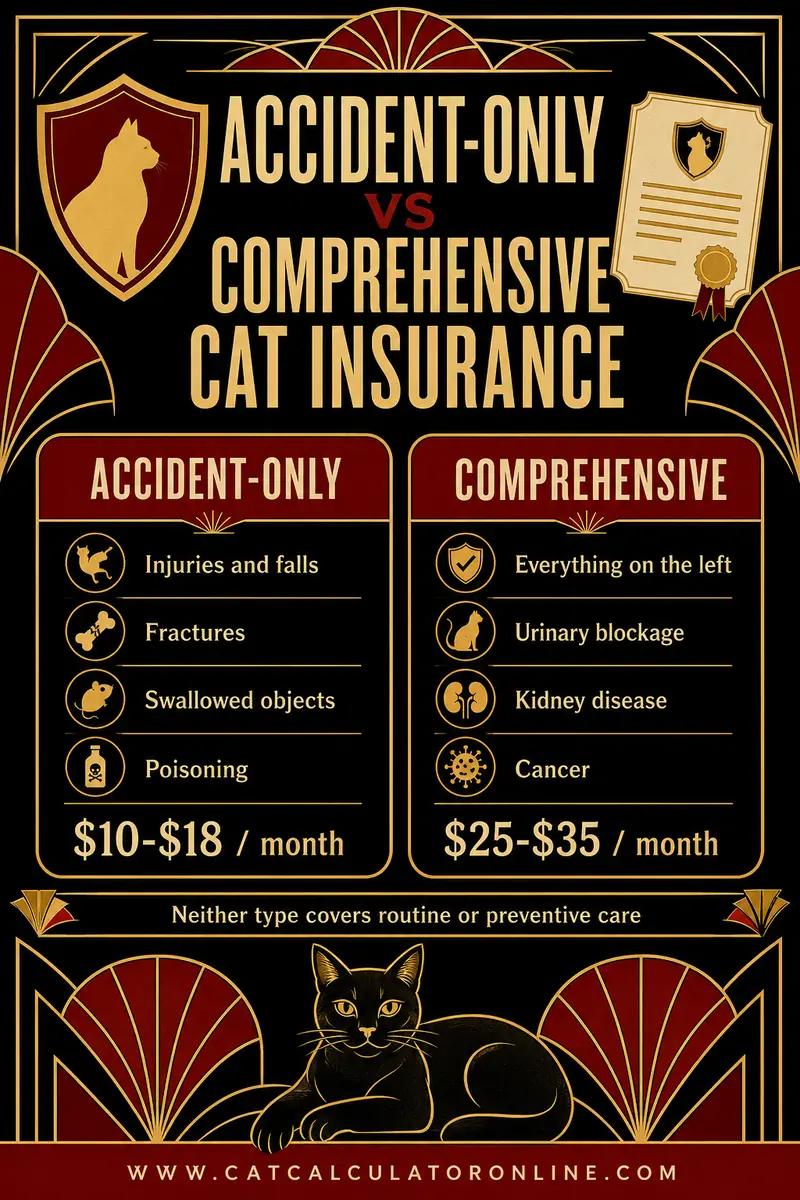
If you're still weighing whether any of this is worth the premium, we work through the case honestly in is cat insurance worth it, and compare the two main policy structures in accident-only vs comprehensive cover.
Is Emergency and Out-of-Hours Treatment Covered?
Yes, and it's often where a policy proves its worth. Eligible treatment is eligible regardless of which clinic provides it or what time it happens, so an emergency hospital at 2am on a Sunday is covered on the same terms as your regular vet on a Tuesday morning.
That matters because out-of-hours pricing is steep. An emergency consultation alone commonly runs $100–$200 before anything is done, and the overnight hospitalisation that follows a urinary blockage or a suspected obstruction can double a bill relative to daytime care at a general practice.
A few practicalities worth knowing in advance rather than at 2am:
- You still pay up front. Emergency clinics almost always require payment at discharge, and reimbursement follows weeks later. Being insured doesn't remove the need for available credit on the night.
- Referral rules are usually relaxed for genuine emergencies, but some policies expect a referral for specialist treatment. Check whether your insurer requires one for non-emergency specialist care.
- Keep every document. Emergency visits generate itemised invoices and discharge notes, and claims move faster when you submit both together.
Most insurers let you claim for treatment anywhere licensed within your country, which also means a cat treated while you're traveling domestically is generally covered. International travel is a different question and usually needs specific cover.
Frequently Asked Questions
Does cat insurance cover vet visits?
It covers visits related to a covered accident or illness — the diagnostics and treatment that follow. Routine annual checkups aren't covered by a standard policy. Note that some insurers exclude the consultation fee itself, paying only for the treatment, so check that detail specifically.
Does cat insurance cover neutering or spaying?
No. Neutering is an elective, plannable procedure and sits outside every standard accident-and-illness policy. Some wellness add-ons contribute toward it, but that's a budgeting product rather than insurance. Low-cost neutering clinics are widely available.
Does cat insurance cover kidney disease?
Yes, provided there were no signs before your cover started and the waiting period has passed. That includes bloodwork, fluid therapy, medication and ongoing monitoring. Since kidney disease is chronic and lifelong, check that your policy continues covering it at each renewal rather than reclassifying it as pre-existing.
Are prescription foods covered?
Sometimes. Therapeutic diets for conditions like kidney or urinary disease are covered by some insurers and excluded by others, and it's rarely prominent in the marketing. Given how commonly cats end up on prescription diets, it's worth asking before you buy.
Does cat insurance cover an indoor cat's illnesses?
Yes — lifestyle doesn't change what illnesses are eligible. Indoor cats claim less for accidents but are somewhat more prone to obesity-linked conditions such as diabetes. Always describe your cat's lifestyle accurately on the application, since a misstatement can jeopardise a claim.
What is the most common cat insurance claim?
Urinary tract problems, gastrointestinal upset and skin conditions sit near the top by frequency, while cancer, kidney disease and urinary blockage dominate by cost. This mix is exactly why illness cover, rather than accident-only, is where most feline value sits.
The short version: cat insurance covers the unexpected, not the routine, and everything your cat already had is off the table permanently. If you read only one part of a policy before buying, make it the exclusions list — it tells you more in two pages than the brochure does in twenty. When you've picked a plan, add the premium to the cat cost calculator alongside the routine costs the policy won't touch, so the yearly picture is honest from the start.