How to Use a Cat Pregnancy Calculator
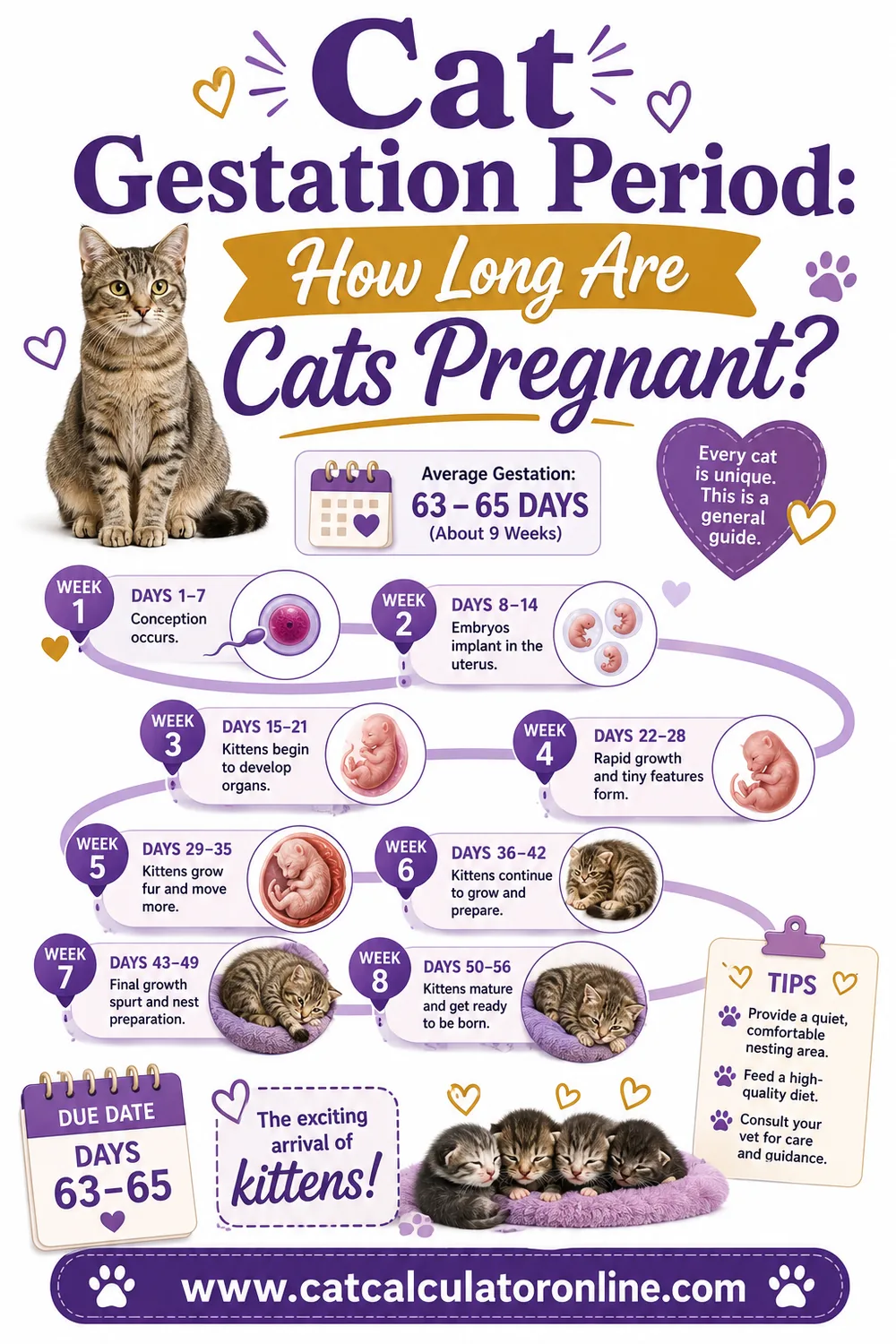
A cat pregnancy calculator takes the date your cat mated and adds the gestation period — around 63 to 67 days — to give an estimated due date and show which week she's currently in. That's all it does, and it does it reliably provided the mating date is right. The complication is that many owners don't have one, because cats mate discreetly and often more than once. When the date is unknown, a vet's estimate from ultrasound or X-ray is far more useful than any calculation. Used with a good date, the cat pregnancy calculator tells you when to prepare the nesting box and when to start watching for labor.
What Does the Calculator Actually Do?
Simple arithmetic with a well-established constant.
You enter the mating date, and it adds the feline gestation period — commonly modeled as 63 to 67 days, with 64 to 65 as the midpoint — to produce an estimated due date. Most calculators also show which week of pregnancy your cat is currently in, which is the more useful output day to day.
That's the whole mechanism. There's no clever modeling and no hidden data, which is worth knowing because it tells you exactly where the accuracy comes from: entirely from the date you enter.
What you get back:
- An estimated due date, best treated as the middle of a window
- The current week, which tells you what to expect and what to prepare
- Days remaining, useful for timing the nesting box and the switch to kitten food
What you don't get: confirmation that your cat is actually pregnant, how many kittens there are, or whether anything is wrong. Those all need a vet.
What Date Should You Enter?
The date your cat mated, not the date you noticed she was pregnant.
Two complications make this less straightforward than it sounds.
Cats often mate repeatedly. Cats are induced ovulators — mating triggers ovulation rather than following a cycle — and a queen in heat will typically mate several times over a few days, sometimes with more than one male. A single litter can genuinely have multiple fathers.
So the "date" is often a span. If you know mating happened over, say, three days, enter the first date. That gives you the earliest plausible due date, which is the safer end to prepare against.
If you saw a single mating and nothing else, that date is your best input. If your queen was outdoors and unsupervised during a heat, you may have nothing better than "sometime that week", in which case use the middle of the heat.
A useful secondary marker: the date heat behavior stopped. A queen that had been calling and rolling suddenly going quiet often indicates a successful mating within a day or two, and it's frequently easier to pinpoint than the mating itself. The heat cycle is explained in cat in heat.
How Accurate Is the Due Date?
Accurate to within a few days, which is enough to be genuinely useful.
Feline gestation runs 63 to 67 days, with anything from 61 to 70 considered normal. So even with a perfect mating date, the honest output is a window of roughly a week rather than a specific day.
| Source of imprecision | Effect on the estimate |
|---|---|
| Natural variation in gestation | ±3 days either side |
| Mating spread over several days | ±2–3 days |
| Uncertain mating date | Anything up to ±1 week |
| Large or small litter | Larger litters sometimes arrive slightly earlier |
Add those together and the practical guidance is: prepare a week before the estimated date, and don't be concerned until several days after it.
This is one of the more reliable pet calculators, because the underlying constant is well established and doesn't vary by breed the way, say, adult weight does. A Siamese and a Maine Coon carry for the same length of time. The full detail on gestation is in the cat gestation period.
What If You Don't Know the Mating Date?
Very common, and the calculator can't help — but your vet can.
Ultrasound, from around day 15–21. Confirms pregnancy and gives a rough gestational age from fetal measurements. Earliest usable option, and it detects heartbeats, though it's poor at counting kittens.
Palpation, around day 17–25. A vet can feel the kittens as distinct swellings in a narrow window. Quick and cheap, but it dates the pregnancy only roughly. Never attempt this at home — pressing on a pregnant abdomen risks real harm.
X-ray, from day 40–45. Once the kittens' skeletons have mineralised they're clearly visible. This is the only reliable way to count them, and skeletal development gives a reasonable age estimate too.
If you have no date at all, the sensible sequence is an early ultrasound to confirm and roughly date the pregnancy, then an X-ray around week six for the count. Knowing how many kittens to expect is genuinely valuable at the birth, because it tells you when she's finished.
You can also work backward from physical signs. Pinking up around days 15–18, an obviously rounded belly from week five, and visible fetal movement from week seven each place her roughly on the timeline. Those markers are set out in signs your cat is pregnant. They're less precise than a scan, but for a cat found already pregnant they're often the only starting point available, and they narrow things down enough to be worth using.
What Should You Do With the Result?
The due date matters less than the week number, because that's what tells you what to do now.
Weeks 1–3 — confirm. Book a vet appointment. Ultrasound from day 15–21 confirms the pregnancy, and it's the right moment to review any medication or parasite treatment, since some aren't suitable during pregnancy.
Week 4 — change the food. Switch to kitten food. A pregnant queen needs more energy and protein than adult maintenance food supplies, and intake should rise from here rather than being restricted.
Week 6 — consider an X-ray if you want a kitten count, and move to smaller, more frequent meals as abdominal space gets tight.
Week 7 — set up the nesting box. A plain cardboard box with a low entry, lined with soft washable bedding, somewhere quiet, warm and dark. Put it out early so it stops being novel.
Week 8 — keep her indoors. This prevents her giving birth somewhere inaccessible and reduces injury risk while she's heavy and slow.
Week 9 — watch and wait. Have your vet's out-of-hours number written down, keep clean towels handy, and otherwise stay out of the way. What each week involves is covered in cat pregnancy week by week.
The single most useful habit: work to a date a week earlier than the estimate. Being ready early costs nothing; being caught out costs a great deal.
It also helps to write the milestone dates down rather than recalculating each time. Five dates on a calendar — vet visit, food change, X-ray, nesting box, indoors — turn an abstract due date into a set of appointments you'll actually keep. Most of the things that go wrong in a cat pregnancy at home aren't medical; they're a nesting box that went up two days before labor, or a food change made abruptly in week eight because nobody had thought about it earlier.
What Does a Worked Example Look Like?
Two scenarios, showing how the same tool behaves with good and poor information.
Scenario one: a known mating date. Your queen was in heat and you witnessed mating on 1 March. Adding 63 to 67 days gives a due window of roughly 3 to 7 May, with 5 May as the midpoint.
From that you can build a plan straight away:
| Date | Week | What to do |
|---|---|---|
| 15–21 March | 3 | Vet visit; ultrasound to confirm |
| 22 March | 4 | Switch to kitten food |
| 10 April | 6 | Optional X-ray for a kitten count |
| 17 April | 7 | Set up the nesting box |
| 24 April | 8 | Keep her indoors |
| 28 April onward | 9 | Watch for nesting, appetite drop, restlessness |
Note that the preparation date sits a full week before the earliest plausible birth. That's deliberate.
Scenario two: no mating date. Your outdoor queen simply stopped calling sometime in early March, and by early April her belly is obviously rounded. Here the calculator has nothing useful to work with.
The better route: a vet appointment now. An ultrasound will confirm the pregnancy and estimate gestational age, which effectively gives you a start date to work backward from. If she's estimated at five weeks in mid-April, that places mating around mid-March and birth in mid-May — and from there the same planning table applies, just with wider margins.
The lesson from both: the calculator is only as good as its input, and a vet can supply the input when you can't.
What Are the Common Mistakes?
Five, and most involve trusting the number more than it deserves.
Treating the due date as fixed. It's the midpoint of a window. Kittens arriving three days either side is entirely normal.
Entering the wrong date. The date you noticed the pregnancy, or the date of the vet visit, produces a due date that's wrong by weeks. Only the mating date works.
Assuming a single mating. If she was in heat and outdoors, mating may have happened over several days. Use the earliest known date.
Using it to confirm pregnancy. A calculator can't tell you whether your cat is pregnant. False pregnancy is possible, and abdominal swelling can indicate illness — including pyometra, a uterine infection that is a genuine emergency in unspayed cats.
Waiting past the window. If your cat reaches day 70 with no sign of labor, that needs a vet rather than more patience.
One further point worth making: the calculator is a planning tool, not a monitoring one. It tells you roughly when to be ready. It cannot tell you whether the pregnancy is progressing normally, and it will happily produce a confident-looking date for a cat that isn't pregnant at all.
Should You Use It for an Unplanned Pregnancy?
Yes — it's arguably more useful there than in a planned mating, because unplanned pregnancies are usually discovered late and the timeline matters more.
Cats reach sexual maturity remarkably early, often between four and six months, so a cat that still looks like a kitten can be pregnant. They're also seasonally polyestrous, cycling every two to three weeks through the breeding season until they mate. An unspayed queen with any outdoor access is genuinely likely to become pregnant, and the first two weeks show nothing at all.
If you've only just realized, the sequence is:
- See a vet promptly. They'll confirm it, estimate how far along she is, and discuss the options available at that stage — which is a conversation for a professional rather than something to decide from an article.
- Use the vet's estimate as your start date, then work forward with the calculator.
- Compress the preparation. If she's already at week six, the nesting box and the food change need doing now rather than next month.
Two practical realities worth planning for early. Litters average around four kittens but range from one to eight or more, and kittens shouldn't leave their mother before eight weeks — ten to twelve is better. So the commitment runs roughly three months past the birth, not to the birth.
For the future, spaying prevents unplanned litters entirely and also removes the risk of pyometra, a serious uterine infection in unspayed females. Timing is worth discussing at the same appointment.
When Should You Stop Using It and Call the Vet?
Some situations need a professional immediately, regardless of what week the calculator says.
Call urgently if:
- Straining hard for more than 20–30 minutes without producing a kitten
- More than two hours between kittens while she's still clearly straining
- Green, dark, foul-smelling or heavily bloody discharge before the first kitten
- The queen becomes lethargic, feverish, or refuses food for more than a day
- Muscle tremors, twitching, stiffness or collapse — possible eclampsia, which can occur late in pregnancy or while nursing and is a genuine emergency
- Pregnancy running past day 70
- A kitten visibly stuck for more than a few minutes
- She ignores the kittens entirely after birth
Two nuances worth knowing. A queen can pause labor for a few hours between kittens and resume normally — that's not automatically an emergency if she's calm and not straining. And count the placentas, one per kitten; a retained placenta can cause infection, so mention any discrepancy.
The broader principle: cats manage pregnancy and birth well on their own, and most need no help at all. But when things go wrong they tend to escalate quickly, so knowing which signs justify a call is the useful preparation. Litter sizes and what to expect at birth are covered in how many kittens are in a litter.
Frequently Asked Questions
How does a cat pregnancy calculator work?
It adds the feline gestation period — around 63 to 67 days — to the date your cat mated, producing an estimated due date and showing which week of pregnancy she's currently in. The accuracy depends entirely on the mating date being correct.
How long are cats pregnant?
Roughly 63 to 67 days, with 64 to 65 typical and anything from 61 to 70 considered normal. That's about nine weeks. Gestation doesn't vary meaningfully by breed, so the same window applies to a Siamese and a Maine Coon.
What if I don't know when my cat mated?
Your vet can date the pregnancy instead. Ultrasound from around day 15–21 confirms it and estimates gestational age, and an X-ray from day 40–45 gives both an age estimate and a reliable kitten count.
How accurate is a cat due date?
Within a few days, and best treated as a window rather than a fixed date. Natural variation accounts for about three days either side, and an uncertain mating date can widen that to a week. Prepare a week early.
Can a pregnancy calculator tell me how many kittens my cat will have?
No. Only an X-ray from around day 40–45 gives a reliable count. Litters typically number about four, ranging from one to eight or more, and first litters are often smaller.
What happens if my cat goes past her due date?
A few days past is normal, given the natural variation in gestation. If she reaches day 70 with no sign of labor, contact your vet — a pregnancy running well past the window should be checked rather than waited out.
A cat pregnancy calculator is a straightforward tool that does one job well: it converts a mating date into a timeline you can plan around. Enter the earliest known mating date, treat the result as a window rather than a deadline, and use the week number to drive the practical steps — vet visit, kitten food, nesting box, indoors. If you don't have a date, your vet's estimate beats any calculation. Start with the cat pregnancy calculator, then follow what each stage brings in cat pregnancy week by week.