Cat Water Fountains: Are They Worth It?
The honest answer: a fountain is worth it if your cat drinks more from it — and some cats clearly do — but the evidence that fountains raise water intake across all cats is modest, and switching some meals to wet food does far more, far more reliably. The reason any of this matters is that cats evolved in dry places, hunting prey that was roughly 70% water. They never developed a strong thirst drive, because they never needed one. A cat on dry food is running a low-grade water deficit that her instincts do not push her to correct. Portions and moisture content are in the cat food calculator.
Why Are Cats Such Poor Drinkers?
Because they were never designed to drink much in the first place.
The domestic cat descends from a small desert-edge predator. Its water came almost entirely from prey. A mouse is roughly 70–75% water, and a cat eating eight to ten mice a day takes in most of what she needs without ever finding a puddle.
The thirst drive that evolved alongside that is weak. Dogs and humans get thirsty well before they are meaningfully dehydrated. Cats tend not to compensate fully — they undershoot, and stay slightly under-hydrated rather than seeking water out.
Dry food turns that into a real gap. Kibble is about 8–10% moisture, against roughly 75% for canned food. A cat on dry food alone has to drink substantially more to reach the same total, and typically does not quite manage it.
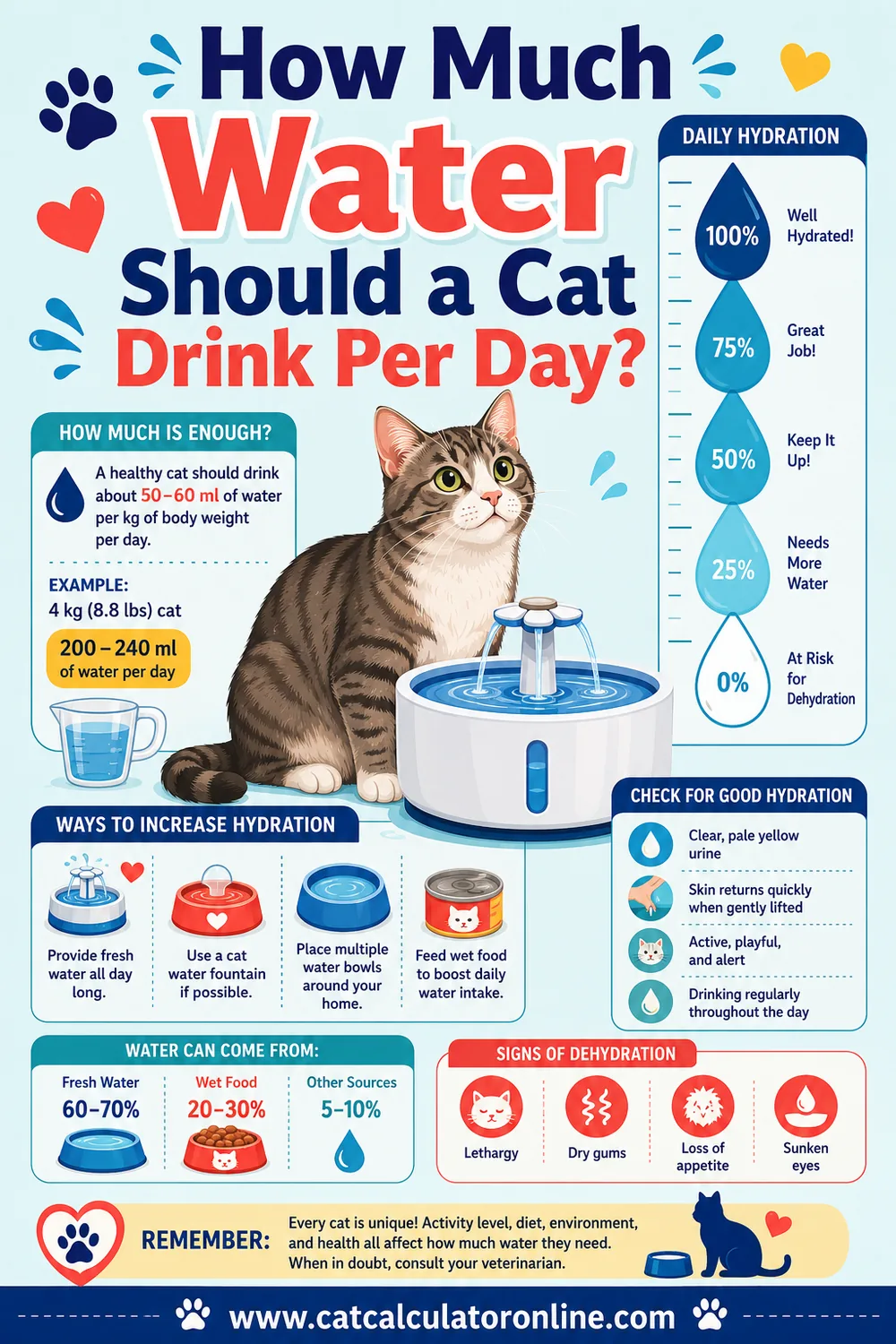
A rough figure to work from: an adult cat needs somewhere near 45–60 ml of water per kg of body weight per day from all sources combined. For a 10 lb (4.5 kg) cat, that is roughly 200–270 ml a day, food included. On an all-wet diet she may barely drink at all and still be fine; on all-dry she needs to find most of that at the bowl. The detail is in how much water should a cat drink.
Chronic mild under-hydration is not neutral. It concentrates the urine, which is a plausible contributor to the crystal and stone problems that cause urinary disease, and it makes life harder for kidneys that are already aging.
Cats are also fussy about where they drink. Many will not drink beside the food bowl, near a litter box, or from a bowl deep enough to press on their whiskers. Some of the biggest wins here cost nothing at all.
Does a Fountain Actually Make Cats Drink More?
Some cats, clearly yes. As a general rule across all cats, the evidence is thinner than the marketing suggests.
What is well established: cats have individual, strong and stable preferences about water, and a proportion of them prefer moving water. Owners of those cats see an unmistakable change — a cat who ignored a bowl for years sits at a fountain several times a day.
What is not well established: that fountains raise measured water intake in the average cat. The studies that exist are small, short, and mixed. Some show a modest increase, some show no significant difference, and some show individual cats increasing sharply while others decrease. Anyone quoting a confident percentage is inventing it.
The likely explanation for the split is preference, not physiology. Cats that like flow drink more; cats that do not, do not. Which yours is cannot be predicted from breed, age or anything else useful.
Freshness may matter as much as movement. A circulating, filtered fountain keeps water cooler, better oxygenated and free of dust and hair. Part of what people attribute to flow may simply be that a fountain is never a stale bowl that has sat since yesterday morning.
The running-tap effect is real and slightly different. Plenty of cats will drink from a tap and ignore a fountain, and that is often about novelty, attention and cold water rather than movement.
Treat it as an experiment. Buy it, run it, and watch. If she uses it within two weeks, it was a good purchase. If she has ignored it for a month, it is not going to start working, and the money is better spent on wet food.
Which Cats Benefit Most From a Fountain?
The trial is worth running for almost anyone, but for these cats it is worth pushing hard.
Cats on dry food only. The gap between what she takes in and what she needs is largest here, so any increase counts for more. The trade-offs are set out in wet food vs dry food for cats.
Cats with chronic kidney disease. Damaged kidneys cannot concentrate urine properly, so these cats lose more water and need more in. Hydration is one of the few things owners can genuinely influence — see chronic kidney disease in cats.
Cats with a history of cystitis, crystals or blockage. More dilute urine is one of the standard aims of managing feline lower urinary tract disease. For male cats especially, this matters — the risk picture is in urinary blockage in cats.
Cats with a history of constipation, where hydration is part of the routine management.
Senior cats, who tend to drink less, feel thirst less reliably, and often have early kidney changes nobody has spotted yet.
Cats in centrally heated homes in winter, where the air is dry and water evaporates from bowls faster than people expect.
One important caution: if a cat that never drank much suddenly starts drinking a lot, that is not a success story. A genuine, sustained increase in thirst is a classic sign of kidney disease, diabetes or hyperthyroidism, and it needs a vet appointment rather than a bigger fountain.
What Does Wet Food Do That a Fountain Cannot?
If you only change one thing, change this one. It is not close.
Canned food is roughly 75–80% water. A 3 oz (85 g) pouch delivers around 60–70 ml of water without your cat choosing to drink anything.
Two wet meals a day can supply most of a cat's daily water requirement on their own. No fountain achieves that.
It is reliable. Fountains depend on a preference your cat may not have. Food goes in regardless.
Even one wet meal a day helps meaningfully, which is a realistic option for households that prefer dry food for cost, dental habit or convenience. Portion guidance is in how much wet food to feed a cat.
Adding water to food works too. A tablespoon or two of warm water stirred into wet food, or a little water over kibble, is accepted by many cats. Warm slightly — it lifts the smell, which is what drives feline appetite.
Never withhold food to force a cat to drink or to accept a change. Cats that stop eating can develop hepatic lipidosis, a serious liver condition, within a few days. Any food transition should keep her eating something at every stage.
How Often Does a Fountain Need Cleaning?
More often than most people do it, and this is the point where a fountain can become worse than a bowl.
Full strip and scrub once a week. Pump apart, impeller out, every channel brushed. Warm soapy water, rinsed thoroughly.
A biofilm builds up fast. That slippery film inside the reservoir is bacteria, and it develops within days in warm rooms. Cats can smell it long before you can see it, and a slimy fountain is a fountain your cat will start avoiding.
The pump is the part people miss. The impeller sits in a small housing that traps hair and slime, and it needs to come apart. A cheap set of small brushes makes this a two-minute job.
Change the filter on schedule, usually every two to four weeks. A clogged filter reduces flow, and reduced flow makes the pump run hot and die early.
Top up daily, change fully every two to three days. Topping up alone lets the older water sit indefinitely.
Watch for pump noise. A fountain that has started buzzing is usually low on water or has a fouled impeller. Cats dislike the noise, and running dry destroys pumps.
If you know you will not clean it weekly, buy bowls instead. Several fresh, wide, shallow bowls changed daily beat a neglected fountain comfortably.
What Should You Look For in a Fountain?
| Feature | What to choose | Why |
|---|---|---|
| Material | Ceramic or stainless steel | Non-porous, easier to keep clean, no plastic taint |
| Capacity | 1.5–3 liters for one or two cats | Fewer refills; pumps hate running dry |
| Pump access | Fully removable, tool-free | The single biggest factor in whether you clean it |
| Flow type | Adjustable, quiet stream or dome | Loud splashing puts many cats off |
| Noise | Under about 40 dB | It usually lives in a kitchen or hallway |
| Cord length | Long enough to avoid an extension | Fountains rarely sit near a socket |
| Filter cost | $1–$3 each, widely available | Proprietary filters get expensive fast |
| Drinking level | Raised, wide, shallow surface | No whisker contact, no crouching |
Plastic is the cheapest and the worst. It scratches, and scratches harbor bacteria. Plastic bowls have also been linked anecdotally with feline chin acne, so if your cat has spots on her chin, swap materials first.
A quiet dome or gentle stream suits more cats than a dramatic waterfall. The splashing display is for the human.
Expect to pay $25–$70 for a decent fountain in the US, plus roughly $20–$50 a year in filters. Pumps last two to four years and are usually replaceable for $10–$15.
Where you put it matters as much as which one you buy. A fountain humming beside a washing machine, or tucked in next to the litter box, gets used far less than one in a quiet corner of a hallway. Keep it well away from the food bowl, stand it on a washable surface because splashing is inevitable, and put it somewhere you walk past every day — a fountain you see is a fountain you remember to clean.
What Cheaper Things Should You Try First?
Every one of these is free or nearly free, and several work better than a fountain.
Move the water away from the food. Cats in the wild do not drink where they eat, and many house cats hold to that. A water bowl in a different room is a genuinely common fix.
Add more water stations. Three or four bowls around the house, on different floors, catch the cat where she happens to be. Cats drink opportunistically.
Use wide, shallow bowls filled to the brim. Whisker contact with the sides of a deep bowl is unpleasant enough that some cats will paw at the water instead of drinking, or drink less than they want to.
Change the water at least daily, and rinse the bowl rather than just topping it up.
Try different vessels. Glass, ceramic, stainless steel, a tumbler on a windowsill. Some cats have strong and very specific opinions.
Keep bowls away from litter boxes and noisy appliances. A bowl beside the washing machine gets used far less than one in a quiet corner.
Try a tiny amount of tuna water or unsalted broth stirred into the bowl, if she needs encouragement. Use it as a nudge rather than a permanent fixture.
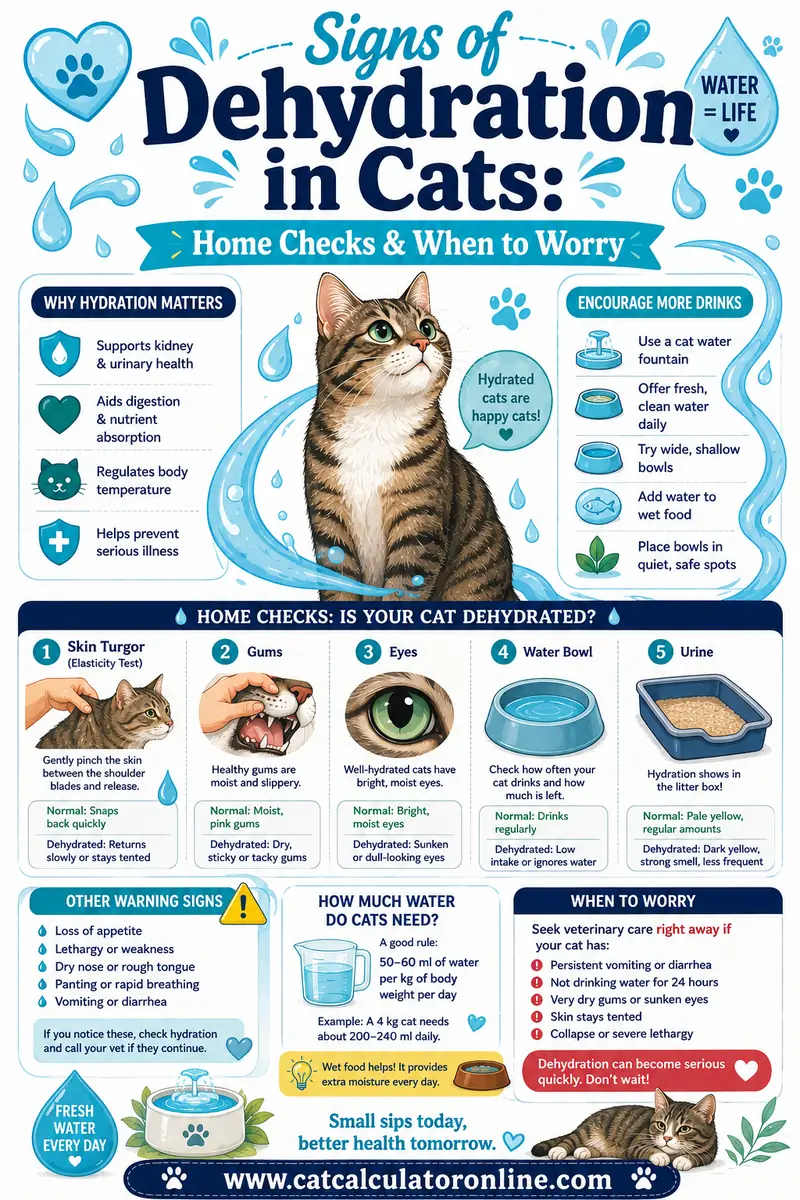
Know when this stops being a lifestyle question. If your cat has not drunk anything for 24 hours, is lethargic, or her skin stays tented when you lift it gently at the shoulders, call your vet — the warning signs are set out in signs of dehydration in cats, and the timescales in how long can a cat go without water. Dehydration in cats moves faster than most owners expect.
Frequently Asked Questions
Do cat water fountains really make cats drink more?
Some cats drink noticeably more from moving water, but studies are small and mixed, and there is no strong evidence that fountains raise intake in every cat. Treat one as a two-week experiment. Switching some meals to wet food raises water intake far more reliably.
How often should I clean a cat water fountain?
Strip and scrub it completely once a week, including taking the pump apart and brushing the impeller housing. Change the filter every two to four weeks and refresh the water every two or three days. A fountain with biofilm in it is worse than a clean bowl.
Which cats benefit most from a water fountain?
Cats fed dry food only, cats with chronic kidney disease, cats with a history of cystitis, crystals or urinary blockage, cats prone to constipation, and senior cats. For these, every extra milliliter of water intake is worth pursuing.
Are ceramic or plastic cat fountains better?
Ceramic and stainless steel are better. They are non-porous, easier to keep genuinely clean, and do not scratch the way plastic does — scratches harbor bacteria. Plastic bowls are also linked anecdotally with chin acne in some cats.
How much water should a cat drink each day?
Roughly 45–60 ml per kg of body weight per day from all sources, so about 200–270 ml daily for a 10 lb (4.5 kg) adult. A cat on wet food gets most of that from her meals and may barely drink from a bowl at all.
My cat suddenly started drinking much more — is that good?
No, that needs a vet appointment. A genuine, sustained increase in thirst is a common early sign of chronic kidney disease, diabetes or hyperthyroidism in cats, particularly over the age of seven. Note how much she is drinking and book a check-up.
A fair way to think about the money: $40 on a fountain is a reasonable bet on a preference your cat might have, while the same $40 spent on wet food buys a hydration improvement that does not depend on her opinion at all. If the budget only stretches to one, buy the food.
If you do buy a fountain, buy ceramic or steel, buy one with a pump you can dismantle without tools, put it well away from the food bowl and the litter box, and commit to the weekly clean. Then watch her for a two weeks — a cat who uses it will make that obvious. And keep the ordinary bowls in place regardless, because the goal was never the appliance. To keep her food and moisture balance in view alongside all of this, use the cat food calculator.