How Soon Can a Cat Get Pregnant Again?
Far sooner than almost anyone expects. A queen can come back into heat within two to four weeks of giving birth, and can conceive a second litter while she is still feeding the first one. Nursing does not reliably suppress cycling in cats the way it does in some other species, so the widespread belief that a nursing mother is safe is simply wrong. Combined with the fact that cats ovulate in response to mating rather than on a fixed schedule, this is why a single free-roaming female can produce two or three litters in one year. Work out dates for a suspected second pregnancy with the cat pregnancy calculator.
The Short Answer, With Real Numbers
The window is narrower than the folklore suggests.
Two to four weeks after giving birth is the earliest realistic return to estrus, and it is not rare. Some queens are calling again before their kittens have opened their eyes.
Four to six weeks is the more typical timing, and by the time the litter is weaned at seven or eight weeks a large proportion of queens have cycled at least once.
Conception can follow immediately. There is no fertility lag. A queen in a genuine heat is fertile in that heat, whether or not she has a litter attached to her.
The pregnancy that results runs its normal course of roughly 63 to 65 days, the same as any other, which is covered in cat gestation period.
So the arithmetic works out at three litters a year in a queen with year-round access to a tom, and that is the observed figure in free-roaming populations rather than a theoretical maximum.
The practical version: treat any unspayed queen as capable of conceiving from about two weeks after the birth, and plan around that rather than around what feels reasonable.
Why Nursing Does Not Stop It
This is the single most misunderstood point, and it costs a lot of kittens their homes.
Lactation suppresses ovulation unreliably in cats. In humans and some other mammals, frequent suckling suppresses the hormonal signals that start a new cycle. In queens that suppression is weak, partial and short-lived.
The suppression fades as the kittens feed less. Once kittens start taking solid food at three to four weeks, suckling frequency drops, and the brake weakens further at exactly the point the queen is still visibly a nursing mother.
Some queens never get the brake at all. Returning to heat at two weeks post-partum, with a full litter nursing, is documented and not considered abnormal.
Body condition matters more than nursing does. A well-fed queen in good condition cycles sooner; a thin, depleted one may not cycle for longer. That is a poor contraceptive to rely on and a bad thing to wish for.
Season matters too. Cats are seasonally polyoestrous, cycling most strongly in long daylight, so a spring litter is much more likely to be followed by a summer pregnancy than an autumn litter is by a winter one — although indoor lighting blurs this considerably.
The detail behind all of this is in can cats get pregnant while nursing, which is worth reading if you are relying on nursing as any part of your plan.
Induced Ovulation: Why Nothing Is Wasted
The other half of the explanation is that cats do not ovulate on a timer.
Queens are induced ovulators. Eggs are released in response to the physical act of mating, not on a fixed day of the cycle. Copulation triggers a hormonal surge that releases the eggs roughly a day or two later.
One mating may not be enough, which is why a queen usually mates repeatedly over a heat, often with more than one tom.
That is also why kittens in a litter can have different fathers. Multiple eggs released after multiple matings can be fertilised by different males, a phenomenon called superfecundation. It shows up as a litter with wildly different coat patterns, discussed further in how many kittens in a litter.
Induced ovulation makes cats extraordinarily efficient breeders. There is no fertile window to miss. If a tom reaches her while she is in heat, ovulation follows.
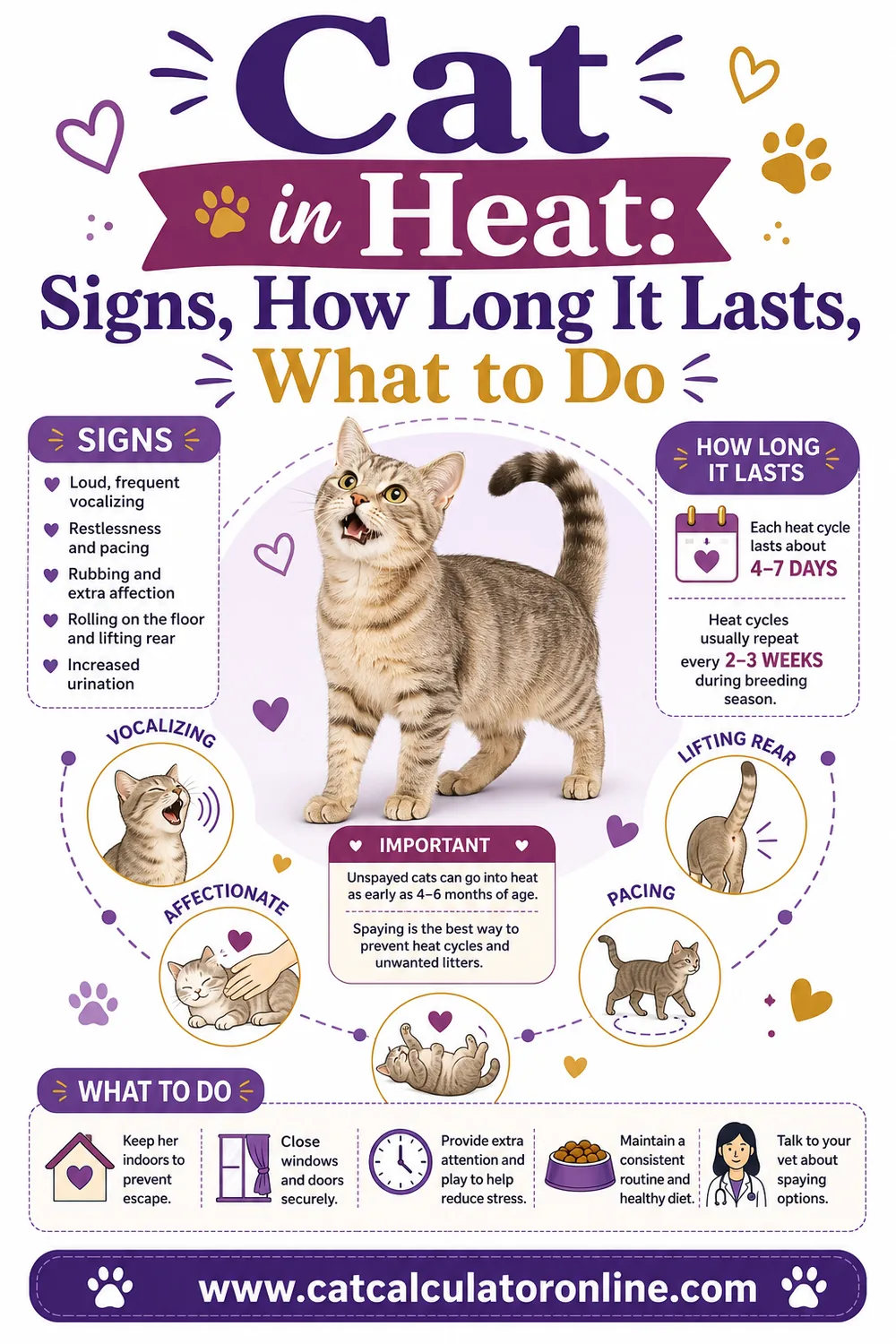
And if she is not mated, she simply cycles again. Unmated queens come back into estrus every two to three weeks through the breeding season, which is why an unspayed indoor cat seems to be permanently in heat — the pattern is set out in how often do cats go into heat.
Put the two mechanisms together — an early post-partum heat and ovulation on demand — and the three-litters-a-year figure stops looking surprising.
The Realistic Timeline After a Birth
A rough map of what happens when, assuming a normal delivery and a healthy litter.
| Time since birth | What is happening | Pregnancy risk |
|---|---|---|
| Days 1–7 | Settled nursing, queen recovering | Very low |
| Weeks 2–4 | Earliest return to heat possible | Real, often missed |
| Weeks 3–4 | Kittens start solid food, suckling drops | Rising |
| Weeks 4–6 | Common return to estrus | High if she has access |
| Weeks 6–8 | Weaning completes | High |
| From 8 weeks | Normal cycling resumed | High until spayed |
The risk column assumes an entire tom can reach her. For a strictly indoor queen in a single-cat household the practical risk is nil, however early she cycles.
Signs of a returning heat are the usual ones — loud persistent calling, rolling, treading with the hindquarters, rubbing everything, and determined attempts to reach a door. In a queen with kittens these can be mistaken for distress about the litter. The full picture is in cat in heat.
A queen in heat may become restless with her kittens, leaving them for longer stretches or seeming less settled. That is hormonal rather than a sign she is rejecting them.
Do not assume silence means she is not cycling. Silent heats happen, particularly in first-time queens, and she can conceive during one.
Is a Back-to-Back Pregnancy Harmful?
The honest answer is that it is demanding, and how demanding depends on where she starts.
Pregnancy and lactation overlap badly. A queen nursing a six-week-old litter while carrying a new one is meeting two peak energy demands at once, and it is very difficult to feed her enough to cover both.
Weight loss is the usual visible sign. A queen who ends one litter thinner than she began it and then conceives again tends to compound the deficit with each cycle.
Litter outcomes suffer at the margins. Smaller kittens at birth, lower survival in the first week and earlier weaning of the older litter are the commonly reported consequences of stacked pregnancies in poor-condition queens.
A single back-to-back pregnancy in a well-fed, healthy cat is usually tolerated. It is repetition without recovery, year after year, that grinds a queen down — which is what happens to unowned cats.
She should not be starved of food at any point. A pregnant, nursing queen needs free access to kitten food or a high-energy complete diet, eaten little and often, and restricting her is never the answer to anything.
If she is losing weight, has pale gums, seems exhausted or is not producing enough milk, that is a vet conversation rather than something to manage at home.
Spaying: When It Can Actually Be Done
This is where most people get stuck, and the answer is more permissive than they expect.
Many clinics will spay a lactating queen. Lactation is not a barrier to the surgery. The mammary tissue is enlarged and more vascular, which makes the operation a little more delicate, but experienced vets do it routinely — shelter and trap-neuter-return programs rely on it.
Spaying at or before weaning is the widely recommended point, typically around the time kittens are taking most of their food as solids at five to seven weeks.
Waiting until she is fully dry is the alternative your vet may prefer, usually about two weeks after the kittens finish weaning. That is a perfectly reasonable plan provided she is kept in until the date.
She can be spayed while pregnant. If a second pregnancy has already happened, terminating it during a spay is an option many vets will discuss, particularly in shelter settings. It is a decision to have with your vet, not to agonise over alone.
The gap between weaning and surgery is the dangerous stretch. This is when queens are cycling, kittens no longer need them constantly, and doors get left open. Keep her strictly indoors from the birth until the operation.
Timing, cost and recovery are covered in when to neuter a cat, including the kittens themselves, who can be neutered far earlier than most people assume.
Preventing the Second Litter
Practical measures, in the order they actually work.
Keep her indoors, without exception, from the day she gives birth. This is the whole of the answer. Everything else is a supplement.
Assume two weeks, not eight. Anyone planning to "let her out again once the kittens are weaned" has already left a five-week window open.
Secure the obvious routes. A queen in heat is highly motivated and will push through a partly open window, a cat flap or a door held on the latch. Lock the flap.
Neuter the household toms. A related male in the same house will mate her, and littermate matings are common in unmanaged colonies. Male kittens from a previous litter can be fertile from around four to five months — well before anyone expects it.
Do not rely on hormonal suppression. Progestogen treatments to delay heat exist but carry real risks in cats, including diabetes and uterine disease, and are not a general substitute for spaying.
Book the spay before you need it. Clinic waiting lists are the commonest reason a queen is still entire three months after a birth. Get the appointment in the diary while the kittens are still small.
What If She Is Already Pregnant Again?
It happens, often, and it is manageable.
Confirming it is a vet job. Abdominal palpation is possible from around three to four weeks and ultrasound from about three weeks, though a nursing queen's abdomen is harder to read. Behavior is not proof.
Feed her more, not less. Overlapping pregnancy and lactation is a large energy demand, and she should be on kitten food or a complete growth diet with free access and several meals a day.
Wean the older litter on schedule rather than abruptly. A gradual transition from around four weeks reduces her load without upsetting the kittens, and the method is in how to wean kittens.
Do not let her lose condition unnoticed. Weigh her weekly on kitchen scales, and treat a downward trend as a reason to call.
Discuss the options honestly with your vet, including spaying during the pregnancy. Vets have this conversation constantly and will not judge you for it.
Then set the date for after this litter, and keep her in until it arrives. The cycle only breaks when the surgery happens.
Frequently Asked Questions
Can a cat get pregnant while still nursing kittens?
Yes. Lactation does not reliably suppress cycling in cats, so a queen can come into heat and conceive while feeding a litter. It can happen as early as two weeks after the birth, before the kittens have opened their eyes.
How soon after giving birth can a cat go into heat?
As early as two to four weeks, with four to six weeks being more typical. By the time a litter is weaned at seven or eight weeks, most queens have cycled at least once and are fertile again.
How many litters can a cat have in one year?
Realistically two or three. With a gestation of around 63 days and a return to heat within a month of giving birth, a free-roaming queen with year-round access to a tom manages three litters in a good year.
Can my vet spay my cat while she is still nursing?
Usually yes. Lactation makes the surgery slightly more delicate but does not prevent it, and many clinics spay queens at or before weaning. Some vets prefer to wait about two weeks after the kittens are fully weaned.
Is it harmful for a cat to have back-to-back litters?
For a healthy, well-fed queen a single overlapping pregnancy is usually tolerated. Repeated stacking without recovery causes weight loss, smaller litters and poorer kitten survival, which is why unowned queens deteriorate so quickly.
Do I need to keep my cat indoors after she gives birth?
Yes, until she is spayed. One unsupervised hour outside during a returning heat is enough for another pregnancy, and the risky window opens far earlier than most owners assume.
The short version worth remembering is that a queen is not protected by nursing and is not protected by having just given birth: she can be in heat within two to four weeks and pregnant again immediately after, because cats ovulate in response to mating rather than on a schedule. Keep her strictly indoors from the day of the birth, book the spay while the kittens are still small, and take the appointment at or shortly after weaning rather than waiting for a convenient moment that never comes. If you think a second pregnancy has already started, put the dates into the free cat pregnancy calculator and call your vet.