Human Years to Cat Years
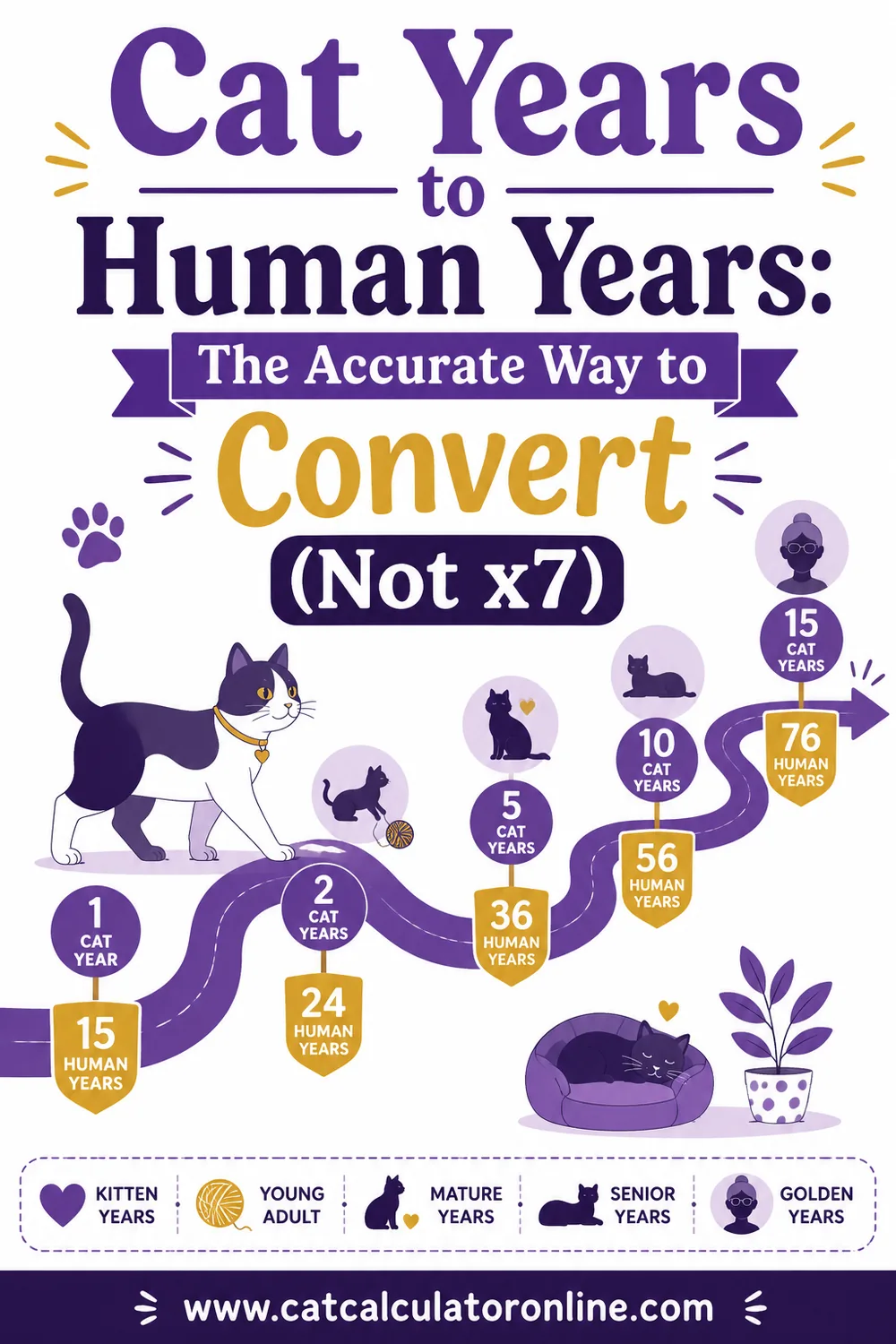
Converting human years to cat years means running the usual conversion backwards: instead of asking what a cat's age is worth in human terms, you're asking what a human age looks like on a cat's timeline. The short version is that human years compress dramatically — 15 human years is 1 cat year, 24 human years is 2, and after that every 4 human years adds a single cat year. So a 40-year-old person is about 6 in cat years, and an 80-year-old is about 16. This page gives the full table, the formula, and the places the comparison stops being useful. Both directions run on the cat age calculator.
What Is the Formula for Human Years to Cat Years?
It's the standard conversion turned around, and it comes in three parts because the standard conversion does.
The forward version, which most people know: a cat's first year is worth about 15 human years, the second adds about 9 more to reach 24, and every year after that adds about 4.
The reverse version, for turning a human age into a cat age:
- Under 15 human years: divide by 15. So 7 human years is roughly 0.5 cat years, or about six months old.
- 15 to 24 human years: subtract 15, divide by 9, add 1. So 20 human years is about 1.6 cat years.
- Over 24 human years: subtract 24, divide by 4, add 2. So 44 human years is (44 − 24) ÷ 4 + 2 = 7 cat years.
A worked example. For a 60-year-old person: 60 − 24 = 36. 36 ÷ 4 = 9. 9 + 2 = 11 cat years. A person of sixty is about the same point in life as an eleven-year-old cat.
Why three parts? Because cats don't age at a constant rate. The first year covers everything from newborn to sexually mature adolescent, the second covers the rest of growing up, and everything afterwards settles into a steady four-to-one. A single multiplier can't describe that, which is exactly why the "multiply by seven" rule fails so badly.
What Is My Age in Cat Years?
The full table, rounded to something sensible.
| Human years | Cat years | What that means for a cat |
|---|---|---|
| 15 | 1 | Kitten becomes young adult |
| 20 | 1.6 | Late adolescence |
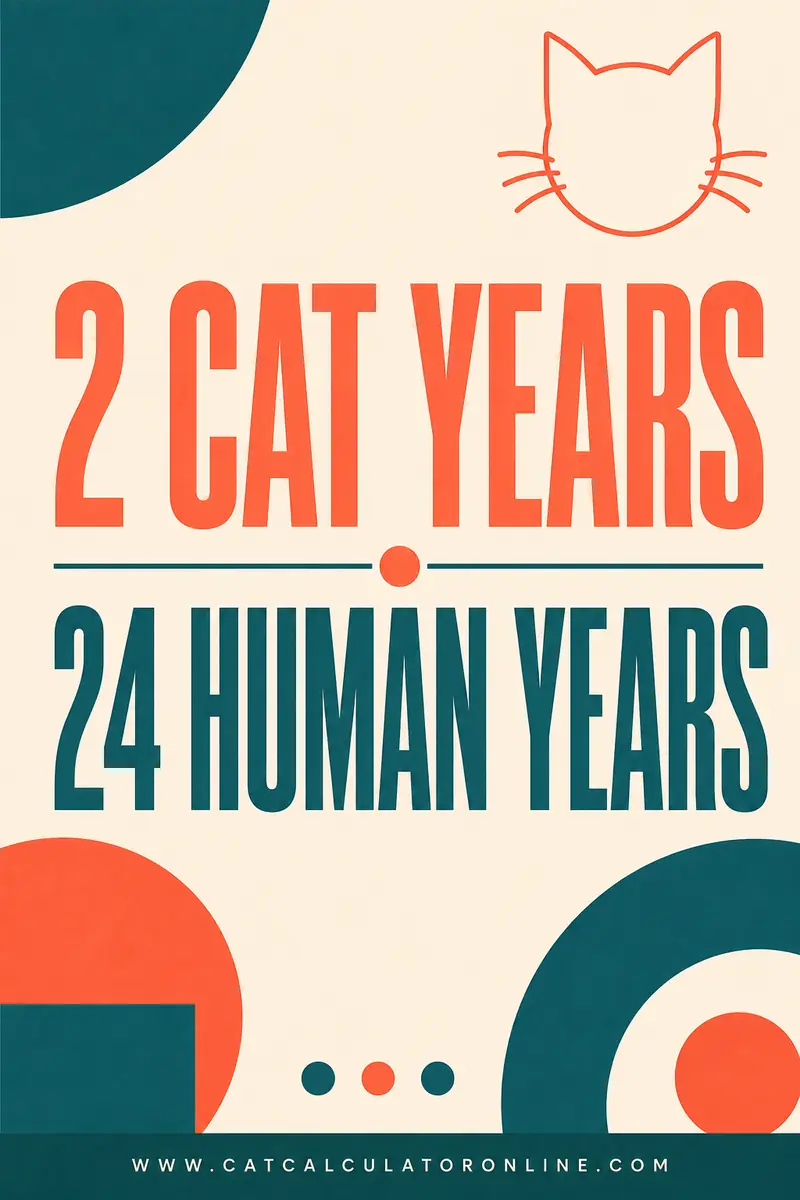
| 24 | 2 | Young adult, personality settled |
| 28 | 3 | Physical peak |
| 32 | 4 | Steady adult years |
| 36 | 5 | Roughly a third of life done |
| 40 | 6 | Last year of young adulthood |
| 44 | 7 | Mature adult begins |
| 48 | 8 | Solidly middle-aged |
| 52 | 9 | Last year before senior |
| 56 | 10 | Officially senior |
| 60 | 11 | Early senior |
| 64 | 12 | Screening year |
| 68 | 13 | Genuinely old |
| 72 | 14 | Well into old age |
| 76 | 15 | Old, often still well |
| 80 | 16 | Past average lifespan |
| 84 | 17 | Exceptional age |
| 88 | 18 | Remarkable longevity |
| 96 | 20 | Rare but real |
A quick shortcut for adults: subtract 24 from your age, divide by 4, add 2. It works for anything over 24 and takes a few seconds in your head.
The reverse direction — cat age into human years — is laid out in cat years to human years, and the method behind both in how a cat age calculator works.
Why Does the First Cat Year Cover 15 Human Years?
Because a kitten's first twelve months compress an extraordinary amount of development.
What happens in that year. A kitten is born blind and deaf, weighing around 100 grams. Its eyes open in about a week. It's walking within three weeks and weaned by eight. It can reproduce as early as four to six months, and by twelve months it is physically and sexually a full adult.
The human comparison. Getting from newborn to a person capable of independent adult life takes fifteen years or so. That's the parallel — not the calendar time, but the amount of development covered. This is why a one-year-old cat is often described as a fifteen-year-old teenager, and why the description fits so well behaviourally: they're grown, confident, boisterous and not entirely sensible. Detail in 1 cat year in human years.
Why year two adds only 9. By twelve months the growing is largely finished, and year two is about maturing rather than developing — filling out, settling down, losing the adolescent edge. Nine human years covers that reasonably: 15 to 24 is roughly the span from teenager to settled young adult. The detail is in 2 cat years in human years.
And why 4 a year afterwards. Once a cat is fully mature, ageing settles into a steady rate. Four human years for each feline year fits the observable pattern — when cats become middle-aged, when age-related disease starts appearing, and when they reach the end of a typical lifespan.
Where Do the Life Stages Line Up?
The conversion is at its most useful when you map it onto how vets actually think about a cat's life.
Kitten (0 to 1 cat year) — birth to about 15 human years. Growth, vaccination, socialization, neutering.
Young adult (1 to 6 cat years) — roughly 15 to 40 human years. Physically prime, annual check-ups, and the stage where habits get set: weight, dental care, and a baseline set of bloodwork.
Mature adult (7 to 10 cat years) — roughly 44 to 56 human years. Middle age. Screening bloodwork becomes genuinely worthwhile, and weight and dental problems tend to show up.
Senior (10 cat years and over) — 56 human years and up. Twice-yearly vet visits, screening for kidney disease, hyperthyroidism and hypertension, and adapting the house for stiffer joints. The threshold itself is covered in 10 cat years in human years.
Those stages come from the AAHA feline life stage guidelines, which is why they're worth using — they're the framework vets themselves apply, not a rule of thumb.
And note the shape. Half a cat's human-equivalent life happens by about six cat years, and the senior stage begins at ten — which is why a cat's middle age arrives sooner than most owners expect.
Why Does Multiplying by Seven Not Work?
Because it fails at both ends, and in opposite directions.
At the young end it badly undercounts. Seven times one is seven — but a one-year-old cat is not a seven-year-old child. It is fully grown, sexually mature and capable of raising a litter. No seven-year-old human is any of those things. The real figure is around fifteen.
At the old end it overcounts. Seven times sixteen is 112, which suggests a sixteen-year-old cat is at the extreme edge of possibility. In practice sixteen is old but not extraordinary, and cats reach eighteen and twenty regularly enough that no vet blinks. Eighty is the better comparison.
Where the rule came from. It's a rough folk average from a time when people compared a typical human lifespan of about 70 years to a typical cat or dog lifespan of about 10 and divided. It was never based on how animals actually develop, and it survives because it's easy to remember.
Why it matters practically. The seven-times rule tells you a five-year-old cat is 35 and a ten-year-old is 70 — which makes ten sound ancient and makes owners give up on it too early. The real figures, 36 and 56, describe a cat in its prime and a cat just entering the senior stage. Those are very different conclusions about how to care for an animal.
One important difference from dogs: cats age uniformly. Dog conversions vary a great deal by size, because a Great Dane and a Chihuahua age at genuinely different rates. Domestic cats are all much the same size, so one formula covers essentially all of them, pedigree or mixed-breed cat.
What Do People Usually Want This For?
Three questions, mostly, and the conversion answers each of them differently.
"How old is my cat compared to me?" The most common reason, and the one the table answers directly. Owners are frequently surprised to find their eight-year-old cat is at 48 — comfortably middle-aged rather than young — or that a fifteen-year-old is at 76 rather than the 105 the seven-times rule would suggest.
"Am I older or younger than my cat in cat terms?" A fun comparison, and the reason the reverse direction gets searched at all. A 30-year-old person is about 3.5 in cat years; a 70-year-old is about 13.5. Children are often delighted to discover they are, in cat terms, still kittens — under 15 human years works out at less than one cat year.
"When does my cat need what?" The genuinely practical use. Because the conversion tracks life stages rather than just numbers, it tells you when to change what you do: annual check-ups through the young adult years, baseline bloodwork around 44 human equivalent, screening in the mature adult years, and twice-yearly visits from 56 onwards.
A worked household example. A family with a 40-year-old parent and a 6-year-old cat are, in these terms, at almost exactly the same life stage — both adults in their prime, both at the point where a baseline health check is a sensible investment rather than an urgent one. That's a more useful framing than any single number.
And a caution about precision. Rounding to whole cat years is fine. The formula produces decimals — 50 human years is 8.5 cat years — but a cat's life doesn't run to that resolution, and treating 8.5 as meaningfully different from 8 or 9 reads more into the model than it can support.
Where Does This Comparison Stop Being Useful?
It's a good mental model, and like every model it has edges.
It's an approximation, not a measurement. No conversion turns a cat's age into a precise human equivalent, because the two species age differently in ways no single formula captures. The number is a way of thinking, not a clinical figure.
Individual variation is real. A well-cared-for indoor cat at fourteen can be in better shape than a neglected outdoor cat at nine. Lifestyle, weight, dental care, whether the cat is neutered, and whether problems get found early all matter more than the arithmetic. The range is discussed in how long do cats live.
Some conditions ignore the timetable entirely. Hyperthyroidism, kidney disease and diabetes appear when they appear, and a cat can develop them earlier or much later than the conversion would suggest.
Where it is genuinely useful: deciding how often to see a vet, knowing when screening starts being worthwhile, understanding why six months in a senior cat's life is a long time, and setting realistic expectations about behavior and energy at a given age. Those are the questions the conversion answers well.
And the practical upshot: use the number to calibrate care intervals rather than to predict anything. A cat at ten needs twice-yearly checks because ten is 56, not because the number itself means anything on its own.
Frequently Asked Questions
How do you convert human years to cat years?
For any age over 24: subtract 24, divide by 4, then add 2. For 15 to 24, subtract 15, divide by 9 and add 1. Under 15, simply divide by 15.
What is 40 human years in cat years?
About 6 cat years. Working it through: 40 − 24 = 16, 16 ÷ 4 = 4, 4 + 2 = 6. A six-year-old cat is a young adult in its last year before the mature adult stage.
How many human years is 1 cat year?
About 15. A cat's first twelve months take it from a blind newborn to a fully grown, sexually mature adult, which is roughly the amount of development a human covers in fifteen years.
Why isn't one cat year seven human years?
Because cats don't age at a constant rate. The first year is worth about 15 human years and the second about 9 more, after which it settles to roughly 4 a year. The seven-times rule undercounts kittens badly and overcounts old cats.
Do cats age differently depending on breed or size?
Not meaningfully. Unlike dogs, where size changes the ageing rate substantially, domestic cats are all a similar size and one formula covers essentially all of them.
At what human age is a cat considered senior?
A cat reaches the senior stage at 10 cat years, which is about 56 in human terms. That's the point where twice-yearly vet visits and routine screening bloodwork become the standard recommendation.
Converting human years to cat years means running the math backwards: divide by 15 up to a cat year, then subtract 24 and divide by 4 for anything above. Fifteen human years is one cat year, 56 is ten, and 80 is sixteen. Use it to calibrate care rather than to predict anything, and convert in either direction with the cat age calculator.