Can Cats Eat Grapes?
No — and the honest reason is more useful than a flat warning. Grapes and raisins cause sudden kidney failure in dogs, nobody has ever established a safe dose, and the evidence in cats is thin rather than reassuring. That is a genuinely important distinction. There is no body of research showing cats are fine; there is simply far less data, because cats rarely choose to eat grapes. Since the mechanism is not fully understood in either species and the possible outcome is kidney injury, every veterinary poison service treats grapes, raisins, golden raisins and currants as unsafe for cats. If your cat has eaten one, call your vet rather than waiting for symptoms. For everything else in her diet, the free cat food calculator sets the daily target.

The Straight Answer
Before the nuance, the practical position, because that is what most people need at 9pm on a Tuesday.
Do not feed grapes or raisins to a cat, in any amount. Not as a treat, not as a game, not one seedless grape rolled across the floor.
If your cat has already eaten one, call your vet or a pet poison line now. Do not wait to see whether she gets ill. Treatment is far more effective before anything absorbs, and the advice costs you a phone call.
Never try to make her vomit at home. There is no safe way to induce vomiting in a cat outside a veterinary setting. Salt water causes dangerous sodium levels, and hydrogen peroxide — which is sometimes used in dogs — causes severe stomach inflammation in cats and has killed them. This applies to every poisoning question, not just this one.
All the dried forms count: raisins, golden raisins, currants, and grapes in every color, seeded or seedless, peeled or not.
Grape juice, grape jelly and wine are the same ingredient, and wine adds alcohol, which is separately dangerous to a cat's small body.
One eaten grape is not a reason to panic, but it is a reason to make the call. Cats are small, and the difference between "probably nothing" and "worth intervening" is a judgement your vet is much better placed to make than a search result.
What the Evidence Actually Shows
This is where most articles overstate the case in one direction or the other. Here is the real state of it.
In dogs, the link is firmly established. Grapes and raisins cause acute kidney injury — sudden failure of the kidneys — in some dogs. It has been documented in large numbers of cases across decades, and it can occur after quantities that seem trivially small.
The dose response makes no sense, and that is the frightening part. Some dogs eat a whole box of raisins and are unaffected. Others develop kidney failure after a handful of grapes. No reliable toxic dose has ever been established, which is exactly why poison services default to treating any ingestion.
In cats, the reports are far fewer. There are documented cases of cats developing kidney injury after eating grapes or raisins, but they are rare, and the number is small enough that no dose or clear pattern can be drawn from them.
Rare reports are not evidence of safety. Cats lack functional sweet taste receptors — they physically cannot taste sweetness the way we do — so they rarely choose to eat grapes at all. When far fewer cats eat a thing, far fewer cases appear, and the absence of a large case series tells you about feline preferences as much as feline biology.
The mechanism is not understood in either species. The leading current hypothesis, raised in 2021, is that tartaric acid and its salt potassium bitartrate are the toxic principle, based on the observation that grapes are unusually high in both and that similar poisoning follows cream of tartar and tamarind. It fits the evidence well but it is a hypothesis, not a settled fact, and it has not been tested in cats.
So the correct position is caution, stated honestly. Not "grapes are proven deadly to cats", which overstates it. Not "there is no evidence so it is fine", which understates it. The right sentence is: the mechanism is unknown, the outcome in the affected animals is severe, so grapes are treated as unsafe for cats.
Why Kidney Injury Is the Specific Worry
Understanding what would actually happen makes the caution feel less arbitrary.
The kidneys filter waste out of the blood. In grape toxicity in dogs, the filtering structures themselves are damaged, and urine production can fall or stop.
Cats have small kidneys with limited spare capacity. Kidney disease is already one of the commonest serious illnesses in older cats, which is a good reason not to add an avoidable insult.
A cat who already has kidney disease has less reserve. If your cat is on a renal diet or has raised kidney values on bloodwork, the margin for anything nephrotoxic is much thinner. The background is in chronic kidney disease in cats.
Acute kidney injury can be reversible if caught early. Fluids, monitoring and supportive care in the first day or two make an enormous difference. Once urine production has stopped, the outlook is much worse.
That is the entire argument for phoning early. The window where treatment is cheap, simple and highly effective is the first few hours, and it closes.
Signs and the Timeline
If a cat has eaten grapes and you are watching at home while awaiting advice, this is the sequence reported in affected animals.
| When | What you might see | What it means |
|---|---|---|
| 0–6 hours | Vomiting, sometimes with pieces of grape or raisin | The commonest first sign; not proof of poisoning by itself |
| 6–12 hours | Loss of appetite, unusual quietness, diarrhea | Worth reporting to the vet promptly |
| 12–24 hours | Drinking more or less than usual, drooling, weakness | Warrants same-day veterinary assessment |
| 24–72 hours | Little or no urine, foul breath, mouth ulcers, wobbliness | Signs of established kidney injury — emergency |
| Beyond 72 hours | Ongoing poor appetite and weight loss | Requires bloodwork to assess kidney function |
Vomiting is not a diagnosis. Cats vomit for dozens of reasons, and why is my cat throwing up covers the ordinary ones. What matters here is vomiting in the context of a known ingestion.
Reduced urination is the sign to escalate on immediately. Fewer wet clumps in the tray than usual, or none at all, after a known grape ingestion is an emergency call rather than a morning-surgery call.
A cat who seems completely normal is still worth a call. Kidney injury shows up on blood tests before it shows up in behavior.
Where Cats Actually Meet Grapes
Almost never as fruit. Almost always in something with fat and salt in it, which is what makes it appealing.
Raisin bread, hot cross buns and fruit loaf left on a worktop. The butter and the bread are the attraction; the raisins come along with them.
Fruit cake, mince pies and Christmas pudding, which is why the festive two weeks generates so many of these calls.
Granola bars, cereal, trail mix and flapjacks, especially the ones with a sticky, buttery binding.
Toddler snacks. Raisin boxes get carried around, dropped and abandoned at exactly cat height.
Grape jelly and grape juice spills, which a cat may lick simply because they are there.
Wine, sangria and mulled wine. Alcohol is separately and seriously toxic to cats, and a spilled glass at floor level is a realistic route.
The fix is the same as for every kitchen hazard: a lidded bin, a habit of putting baked goods away rather than leaving them out, and the assumption that a worktop is reachable. How to cat proof your home covers the rest of the room.
What Your Vet Will Actually Do
Knowing what to expect makes the call easier to make, and it is usually less dramatic than people fear.
They will ask three questions: what was eaten, roughly how much, and when. Bring the packet if there is one, and take a photo of the wrapper before you bin it.
They may induce vomiting if the ingestion was recent. In cats this is done with an injectable drug in the clinic, not with anything from your cabinet. It is only useful within a few hours of eating.
Activated charcoal may be given to bind whatever is still in the gut.
Intravenous fluids are the core of it. Running fluids for 24 to 48 hours supports the kidneys and helps flush the system while the risk period passes.
Blood tests check kidney values, usually on arrival and again a day or two later. Urine output is monitored because it is the most sensitive early sign.
Cost is a fair thing to ask about upfront, and most practices will talk you through options. A phone consultation may cost nothing; a couple of days of hospitalised fluids is a real expense. Ask, rather than delaying the call because you are worried about it.
What Cats Can Have Instead
If the grape came up because you were sharing fruit, here is the sensible version.
Most cats do not want fruit at all. Without functional sweet taste receptors, the appeal simply is not there. A cat licking ice cream is after the fat, not the sugar.
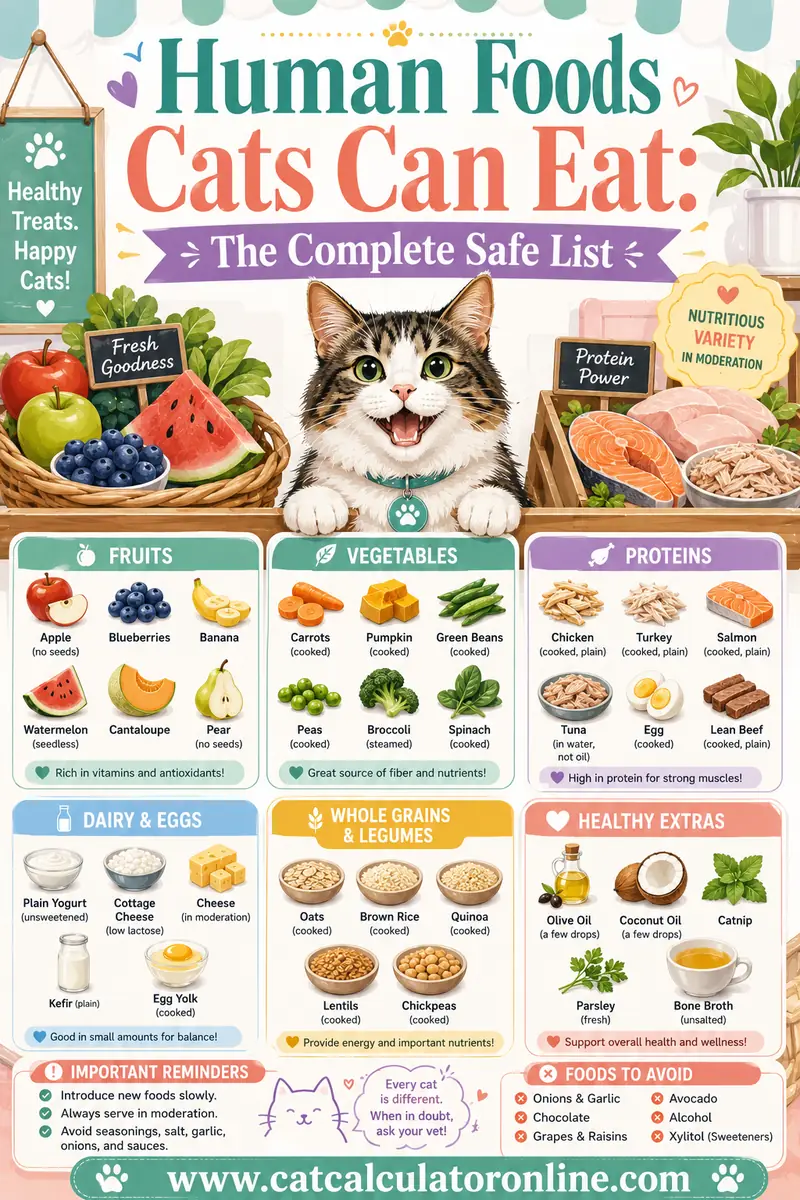
Safe in tiny amounts, if she is interested: small pieces of melon, banana, blueberry, strawberry or peeled apple with no core or pips.
Never: grapes, raisins, golden raisins, currants, and anything containing them. Citrus peel and oils are irritating and generally refused anyway. Cherry stones, peach and plum pits and apple pips contain cyanogenic compounds and are also a choking risk.
Fruit has no nutritional role for an obligate carnivore. Cats need taurine, arachidonic acid and preformed vitamin A from animal tissue, and fruit supplies none of them.
Keep all treats inside 10% of daily calories, which for a typical 9 lb (4 kg) adult cat eating around 200–250 kcal a day is roughly 20–25 kcal in total.
The full picture across every category is in human foods cats can eat, and the fruit-specific detail is in can cats eat fruit.
Reading the Risk Sensibly
A last word on proportion, because fear is not the same as caution and the two lead to different decisions.
One grape is not usually a catastrophe. Most cats who eat one grape are fine. That is a reason to stay calm on the phone, not a reason to skip the phone call.
Do not spend the evening searching for reassurance. Search results will give you both extremes. A vet with your cat's history in front of them will give you an actual answer in five minutes.
Write the numbers down before you need them. Your own vet, the nearest out-of-hours emergency practice, and a pet poison helpline. Put them in your phone tonight.
Take a photo of what was eaten, including the ingredients list, before it goes in the bin. It saves a lot of guessing.
Do not withhold food from a cat while you wait, unless your vet specifically tells you to. Cats who stop eating for more than about a day risk a serious liver condition, so starving her "to be safe" is its own hazard.
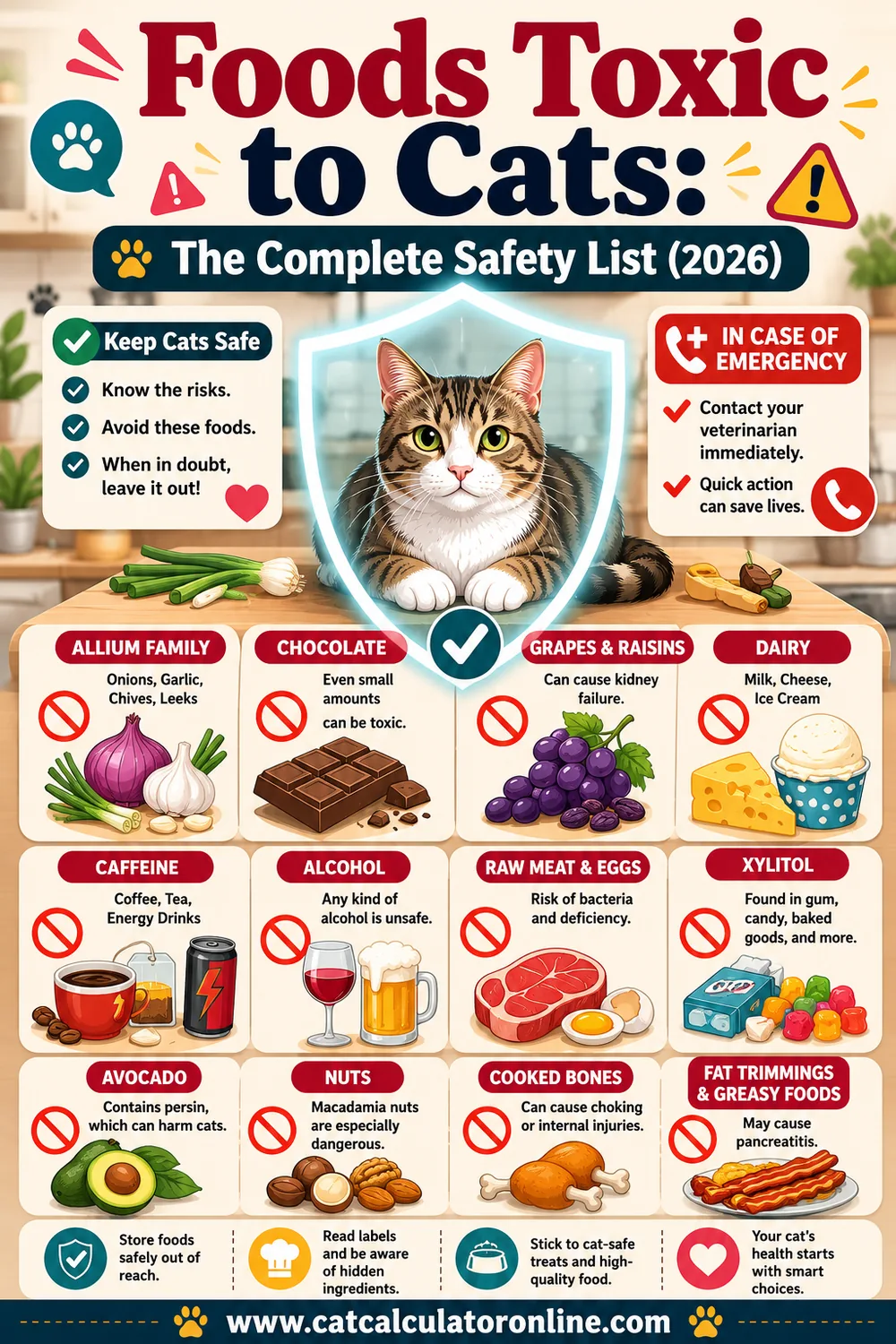
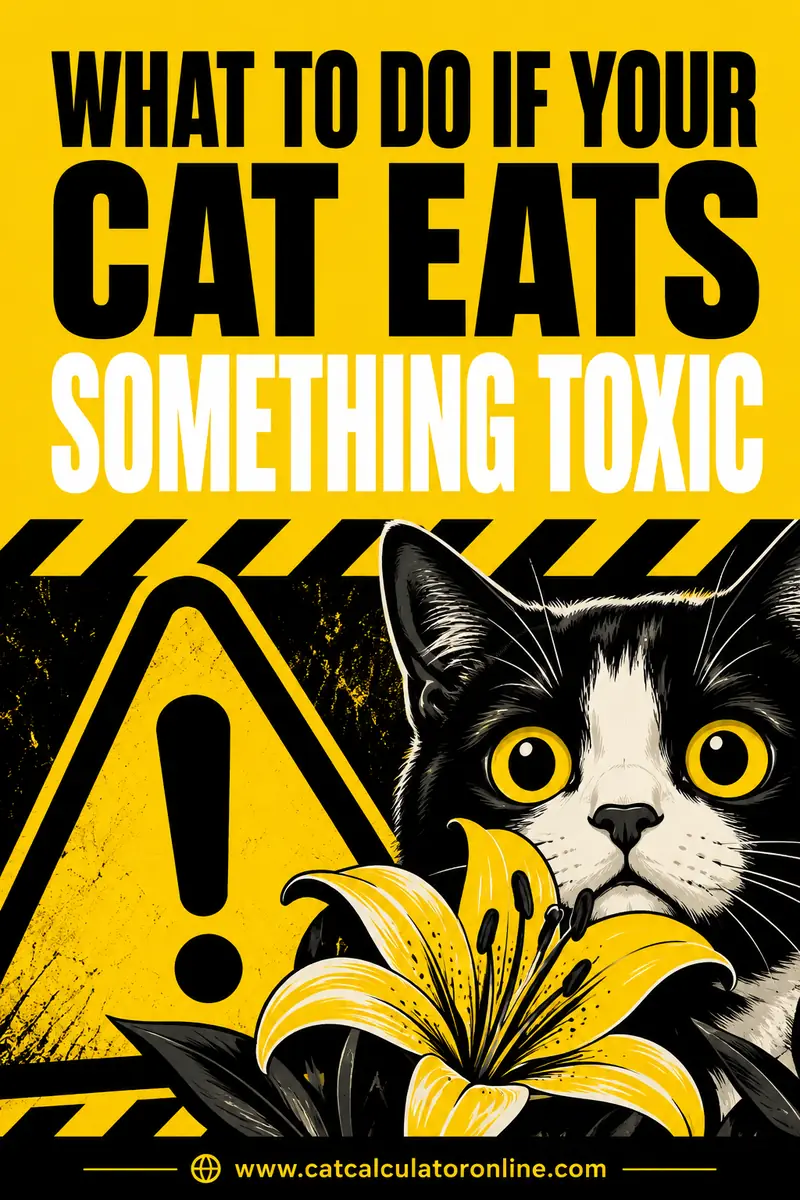
And do not induce vomiting. It is the single most common well-meaning mistake in feline poisoning, and it makes things worse. The whole first-hour sequence is set out in what to do if your cat eats something toxic, with the wider list in foods toxic to cats.
Frequently Asked Questions
Are grapes toxic to cats?
They are treated as unsafe. Grapes and raisins cause sudden kidney failure in dogs with no established safe dose, the mechanism is not understood in either species, and reported feline cases exist but are rare. Because the possible outcome is kidney injury, veterinary poison services advise avoiding them entirely in cats.
What happens if my cat eats one grape?
Most cats who eat a single grape are fine, but call your vet anyway rather than waiting for symptoms, because treatment works best before anything absorbs. Watch for vomiting, loss of appetite, unusual quietness and any drop in urine output over the following 72 hours.
Are raisins worse than grapes for cats?
Gram for gram, yes. Drying removes the water, so a raisin concentrates whatever causes the harm into a much smaller piece. Raisins, golden raisins and currants are also easier for a cat to swallow whole and turn up in bread, cakes, cereal bars and trail mix.
Should I make my cat vomit if she eats a grape?
No, never at home. There is no safe way to induce vomiting in a cat outside a clinic. Salt water causes dangerous sodium levels and hydrogen peroxide causes severe stomach inflammation in cats. Call your vet, who can give an injectable drug safely if it is appropriate.
How long after eating grapes would a cat get ill?
Vomiting, where it happens, usually appears within six hours. Loss of appetite and lethargy tend to follow in the first 12 to 24 hours, and signs of kidney injury such as reduced urination typically emerge between 24 and 72 hours. Blood tests detect the problem before behavior does.
Can cats have grape juice or raisin bread?
No. Grape juice, grape jelly, wine and anything baked with raisins, golden raisins or currants all contain the same fruit, and the fatty, salty carriers make them far more tempting to a cat than a plain grape. Wine adds alcohol, which is separately dangerous in small bodies.
Grapes and raisins belong on the never list for cats, and the reason is worth stating plainly: they cause sudden kidney failure in dogs at unpredictable doses, the mechanism is still unknown, and the feline evidence is thin rather than reassuring. If your cat has eaten one, call your vet or a pet poison line straight away instead of waiting for symptoms, take a photo of the packet, and never try to make her sick at home. Watch for vomiting, a drop in appetite and — most importantly — any reduction in urine over the next three days. Keep raisin bread, fruit cake, cereal bars and toddler snacks off reachable surfaces, and if you want to share something, share a small piece of plain cooked meat instead. Set her daily portion with the free cat food calculator so treats stay inside the 10% that is safe.