Can Cats Drink Milk? The Saucer-of-Milk Myth, Explained
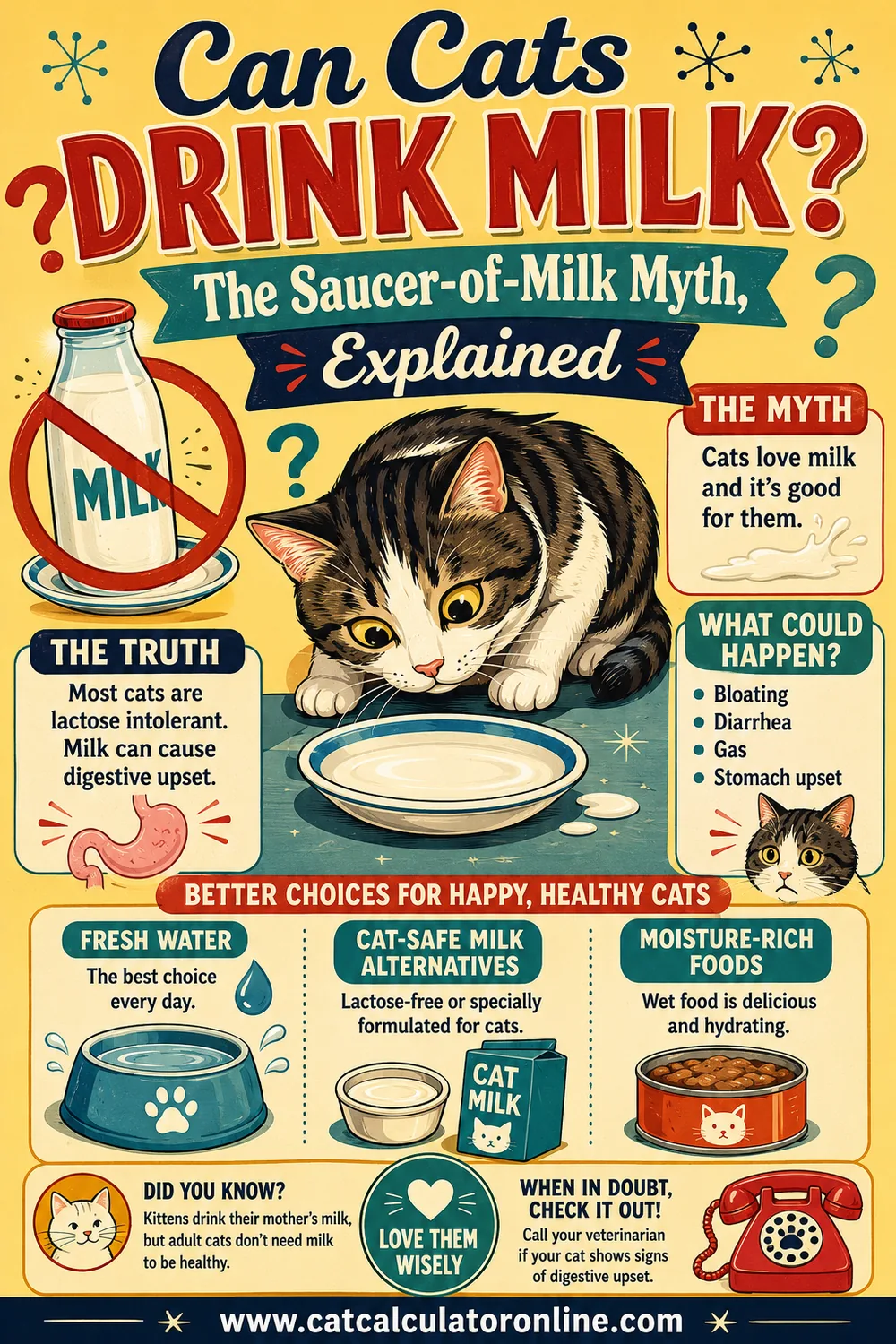
Most adult cats shouldn't drink cow's milk. Cats lose most of their lactase — the enzyme that digests the lactose sugar in milk — after they're weaned, which means a saucer of milk commonly causes gas, bloating, and diarrhea. Milk isn't toxic the way onions or chocolate are, but it's not good for your cat either.
The picture-book image of a kitten lapping cream is one of the most persistent pet myths there is. Here's what's actually going on, what kittens genuinely need, and what to offer instead. If you're rethinking your cat's diet more broadly, our free cat food calculator shows how many calories she should be getting each day — and how quickly a milk treat eats into that budget.
🥛 Can my cat drink this?
Tap a drink to see the verdict:
Tap a drink above to see whether it’s a yes, a no, or an occasional treat.
Why Milk Upsets Most Cats
Kittens are born able to digest milk. They produce plenty of lactase, the enzyme that breaks down lactose, because milk is their entire diet for the first several weeks of life.
Then they get weaned — usually around eight weeks — and their bodies stop making much lactase. There's no reason to keep producing an enzyme for a food they'll never eat again. That's the same reason a large share of adult humans are lactose intolerant.
So when an adult cat drinks milk, the lactose passes through undigested into the large intestine, where gut bacteria ferment it. The result is gas, cramping, and loose stools, usually within about eight to twelve hours.
Not every cat reacts the same way. Some tolerate a spoonful with no visible effect, some get an upset stomach from the smallest taste. But "she doesn't seem bothered" isn't the same as "it's good for her."
Why Cats Love It Anyway
Here's the frustrating part: cats often adore milk, especially full-fat milk and cream.
They're not chasing the lactose. Cats can't even taste sweetness — they lack a working sweet-taste receptor. What they're after is the fat and protein. Whole milk and cream are rich, and richness is exactly what an obligate carnivore's palate is tuned for.
That's why the "but she loves it!" argument doesn't hold up. Cats also love things that make them sick. Enthusiasm isn't a nutrition label.
What Actually Happens: A Quick Reference
| Drink | Lactose | Verdict | Notes |
|---|---|---|---|
| Whole cow's milk | High | Skip it | Common cause of diarrhea; high in calories |
| Skim / low-fat milk | High | Skip it | Same lactose problem, less fat |
| Cream | Lower | Skip it | Very fatty; contributes to weight gain |
| Butter | Very low | Not a treat | Almost pure fat, no benefit |
| Plain yogurt | Reduced | Tiny amounts only | Ask your vet; never sweetened or flavored |
| Hard cheese | Low | Occasional crumb | Salty and calorie-dense |
| Lactose-free "cat milk" | Very low | Occasional treat | A treat, not a dietary need |
| Kitten milk replacer | Formulated | Yes — for kittens | The correct substitute for mother's milk |
| Almond, oat, soy milk | None | Skip it | No nutritional value; check for xylitol |
| Fresh water | None | Yes, always | What your cat actually needs |
Kittens and Milk: What They Really Need
This is where the stakes get higher, because a young kitten drinking the wrong thing can genuinely get sick.
A kitten under about four weeks old needs her mother's milk. If mom isn't available — an orphaned litter, a rejected kitten, a mother who can't nurse — the correct replacement is a commercial kitten milk replacer (often labeled KMR), sold at pet stores and vet clinics.
Never give cow's milk to a kitten. It doesn't have the right balance of protein, fat and nutrients for feline growth, and the lactose causes diarrhea — which is far more dangerous in a tiny kitten than in an adult, because dehydration can set in fast.
Also avoid goat's milk, human infant formula, and homemade recipes you find online unless a veterinarian has specifically told you to use one. Formula for human babies is built for a human baby's needs, not a kitten's.
If you've found an orphaned kitten, call a vet or a local rescue before you feed anything. Bottle-feeding has real technique to it — the wrong position or flow rate can cause milk to go into the lungs. A short conversation with someone experienced makes a big difference.
Around four weeks, kittens start weaning onto solid kitten food, and by roughly eight weeks most are fully weaned. From that point on, they need water and complete kitten food — not milk. See how much to feed a kitten for the transition timeline.
Why the Milk Myth Stuck Around
It's worth knowing where the image came from, because it explains why the advice is so hard to shake.
For most of history, cats lived on farms, and farm cats did drink milk — usually raw, unpasteurized milk skimmed off the top of the pail. It was free, it was there, and it was fatty. Barn cats also ate a steady diet of mice, which supplied the protein and taurine they actually needed. The milk was a bonus, not the meal.
Then storybooks, cartoons and greeting cards did the rest. A kitten and a saucer became visual shorthand for coziness, and generations of people grew up assuming it was a kindness rather than a habit of convenience.
Two things changed. First, cats moved indoors and stopped supplementing themselves with mice, so what's in the bowl became the whole diet. Second, we learned a lot more about feline digestion — specifically that lactase production drops off after weaning in nearly all mammals, cats included.
So the myth isn't a lie exactly. It's an old observation that got detached from its context. Farm cats tolerated milk about as well as house cats do, which is to say variably and with consequences nobody was tracking.
What About "Cat Milk" You Can Buy?
Those little cartons of cat milk in the pet aisle are real products, and they're lactose-reduced, so they don't cause the same digestive trouble as cow's milk.
But be clear about what they are: treats. They contain calories, and cats don't have any nutritional requirement for milk after weaning. If you enjoy giving your cat a small saucer as an occasional ritual, that's fine — just count it toward her daily calories, the same way you'd count a treat.
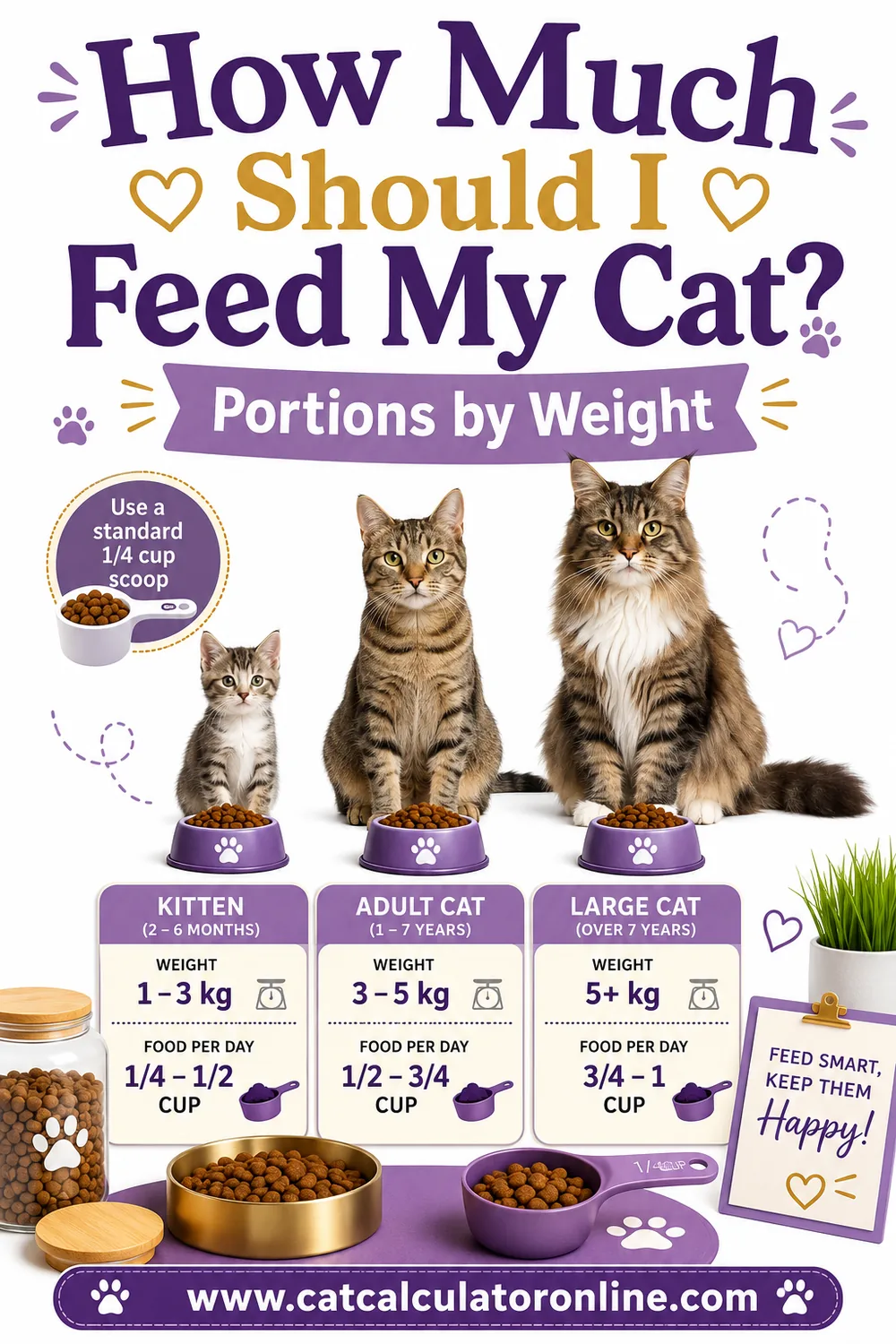
A useful rule of thumb from veterinary nutritionists: treats of all kinds should stay a small share of daily calories, with the bulk coming from complete, balanced food. Our cat food calculator will show you the daily number so you can see how much room a treat actually takes up.
Give This Instead
If the milk saucer was your daily bonding moment with your cat, here are better versions of the same idea:
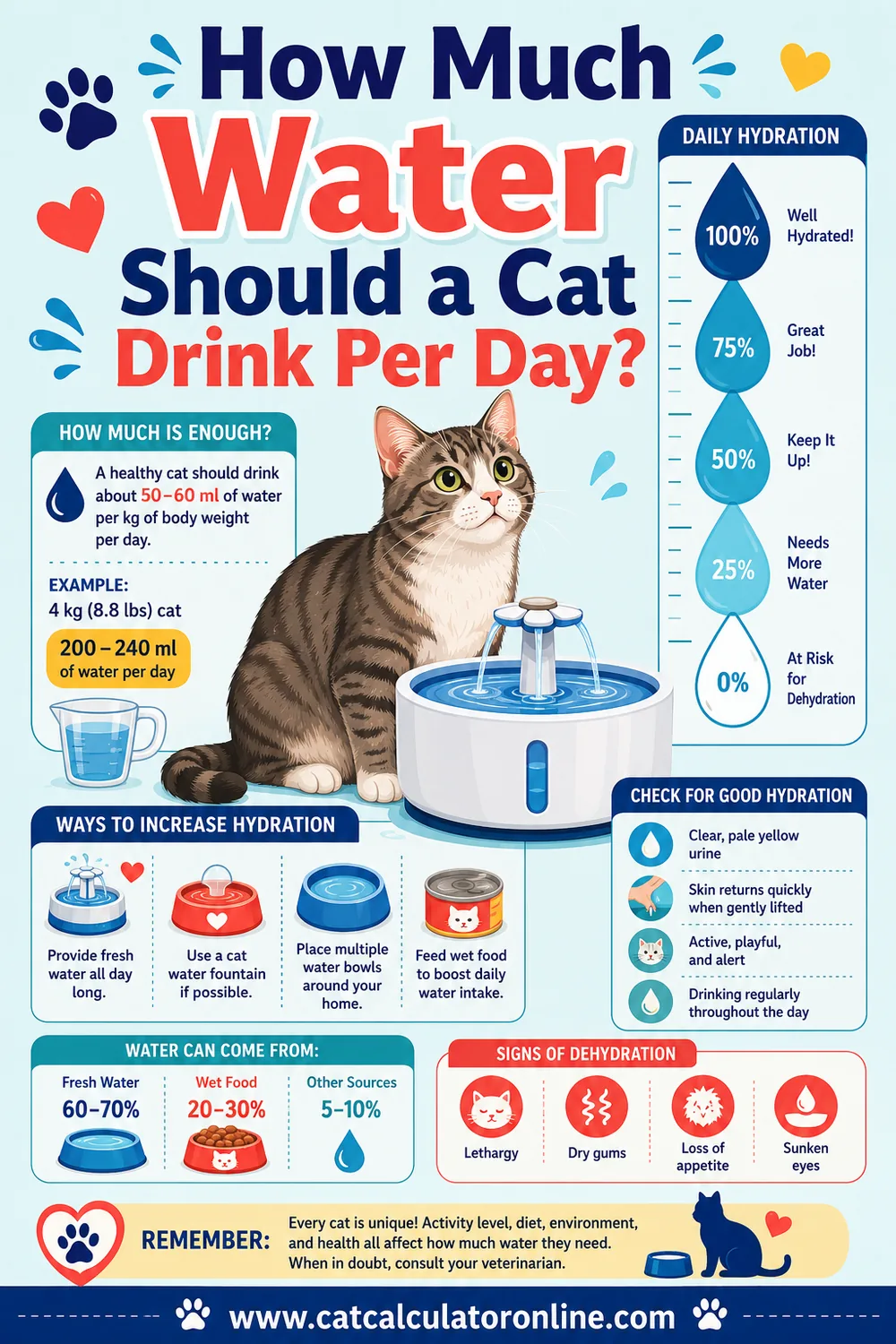
- Fresh water, in more places than one. Cats are famously bad drinkers, and they often prefer water that's away from their food bowl. Multiple bowls around the house genuinely increases how much they drink.
- A pet water fountain. Lots of cats drink noticeably more from moving water. It's one of the easiest wins in cat care.
- Wet food. Canned food is roughly 70–80% water, which is a big contribution to daily hydration — especially useful for cats prone to urinary issues.
- A spoonful of the water from a can of plain tuna (in water, no salt added) mixed into her bowl. Not a nutritional food, but a good flavor nudge.
- Small pieces of plain cooked chicken as the treat instead. No seasoning, no bones, no skin, and definitely no onion or garlic from the pan.
For more on getting fluid into a reluctant drinker, see how much water should a cat drink.
When to Call the Vet
Mild diarrhea after a bit of milk usually clears up on its own within a day or so. Call your vet if you see:
- Diarrhea lasting more than 24 to 48 hours
- Repeated vomiting
- Blood in the stool
- Lethargy, hiding, or refusing food and water
- Any of the above in a kitten — young kittens dehydrate quickly and shouldn't be given a wait-and-see approach
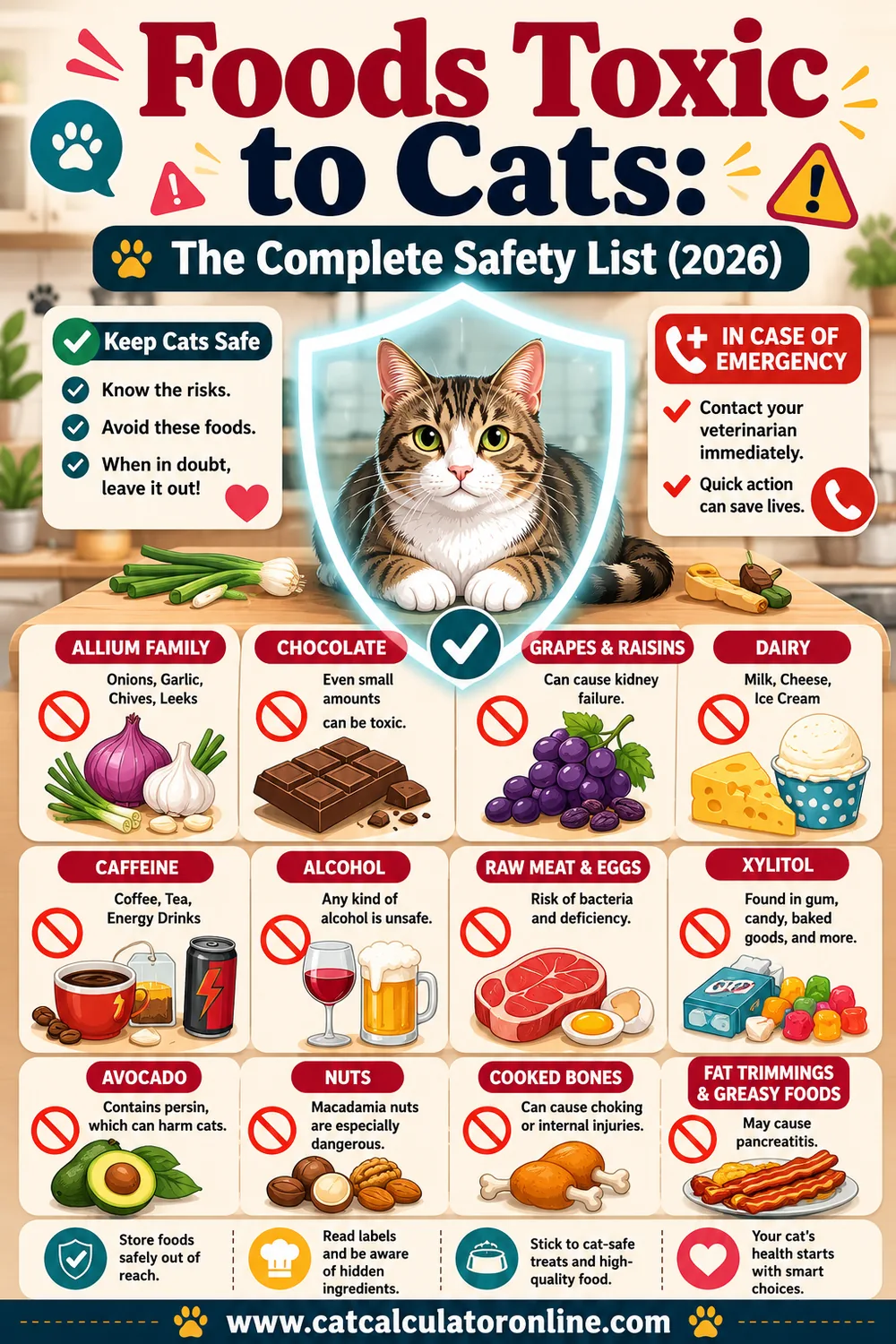
And if your cat drank something that wasn't just milk — a coffee-flavored drink, a milkshake with chocolate, anything with a sugar-free sweetener — call your vet or a pet poison helpline immediately. Our guide to foods toxic to cats covers what's actually dangerous versus what's just unwise.
FAQ
Can cats drink milk at all?
Most adult cats shouldn't. They lose the lactase enzyme after weaning, so cow's milk commonly causes gas, bloating and diarrhea. It isn't toxic, but there's no nutritional reason to give it and plenty of reasons not to.
Why do cats like milk if it makes them sick?
They're drawn to the fat and protein, not the sugar — cats can't taste sweetness at all. Whole milk and cream are rich, which appeals to an obligate carnivore's palate even when the lactose causes trouble afterward.
Can kittens drink cow's milk?
No. Kittens need their mother's milk or a commercial kitten milk replacer. Cow's milk lacks the right nutrient balance for feline growth and causes diarrhea, which is dangerous in a small kitten because dehydration develops quickly.
Is lactose-free milk safe for cats?
Lactose-free and "cat milk" products avoid the digestive problem, so they're safer than cow's milk. They're still treats with calories, not something your cat needs — keep portions small and count them toward her daily total.
What about cheese or yogurt?
Both are lower in lactose than milk, so a small crumb of hard cheese or a lick of plain unsweetened yogurt usually isn't a problem. Both are calorie-dense and cheese is salty, so keep it rare and check with your vet if your cat has any health conditions.
My cat drank milk and now has diarrhea. What should I do?
Make sure fresh water is available and keep an eye on her. Mild diarrhea usually settles within a day. Call your vet if it lasts beyond 24 to 48 hours, if there's vomiting or blood, or if she's a kitten.
The Bottom Line
The saucer of milk is a lovely image and a bad idea. Adult cats are mostly lactose intolerant, kittens need proper milk replacer rather than anything from a cow, and no cat of any age has a nutritional need for milk once she's weaned. Water and complete cat food do the job.
Want to know exactly how much food your cat should be eating — and how much room that leaves for treats? Try our free cat food calculator. You might also find foods toxic to cats and how much should I feed my cat useful next.