How Much Playtime Does a Cat Need Every Day?
Most adult cats do well with two or three interactive play sessions of 10–15 minutes each — roughly 20 to 40 minutes of real play a day. Short bursts beat marathons, because that's how cats hunt: brief, intense sprints with rest in between. Kittens want considerably more; seniors want gentler, shorter games. And when you play matters almost as much as how long — a session before dinner is the single best trick for a full night's sleep.
This guide breaks down the daily numbers by age, the session structure that works with feline instincts instead of against them, and the signs your cat is getting too little play — or too much at once. Since the right amount depends heavily on life stage, it's worth knowing exactly where your cat is: the free cat age calculator tells you in seconds.

🪶 Playtime planner
Tap your cat’s age group — or a behavior you’ve noticed — for a quick play prescription:
Tap an option above for the matching advice.
How Much Playtime Does the Average Cat Need?
For a healthy adult cat, a good baseline is two or three interactive sessions of 10–15 minutes a day — call it 20 to 40 minutes total. "Interactive" is the key word: this means you actively driving a wand toy, not a jingle ball lying under the sofa. Solo toys are a nice extra; they don't count toward the core minutes.
Treat the number as a starting point, not a rule. Cats vary enormously — a lively two-year-old may happily take four sessions, while a mellow ten-year-old is satisfied with two short ones. The honest measure isn't the clock; it's her behavior. A cat getting enough play is relaxed, sleeps well at night, and isn't inventing games with your ankles. A cat getting too little will tell you — more on those signals below.
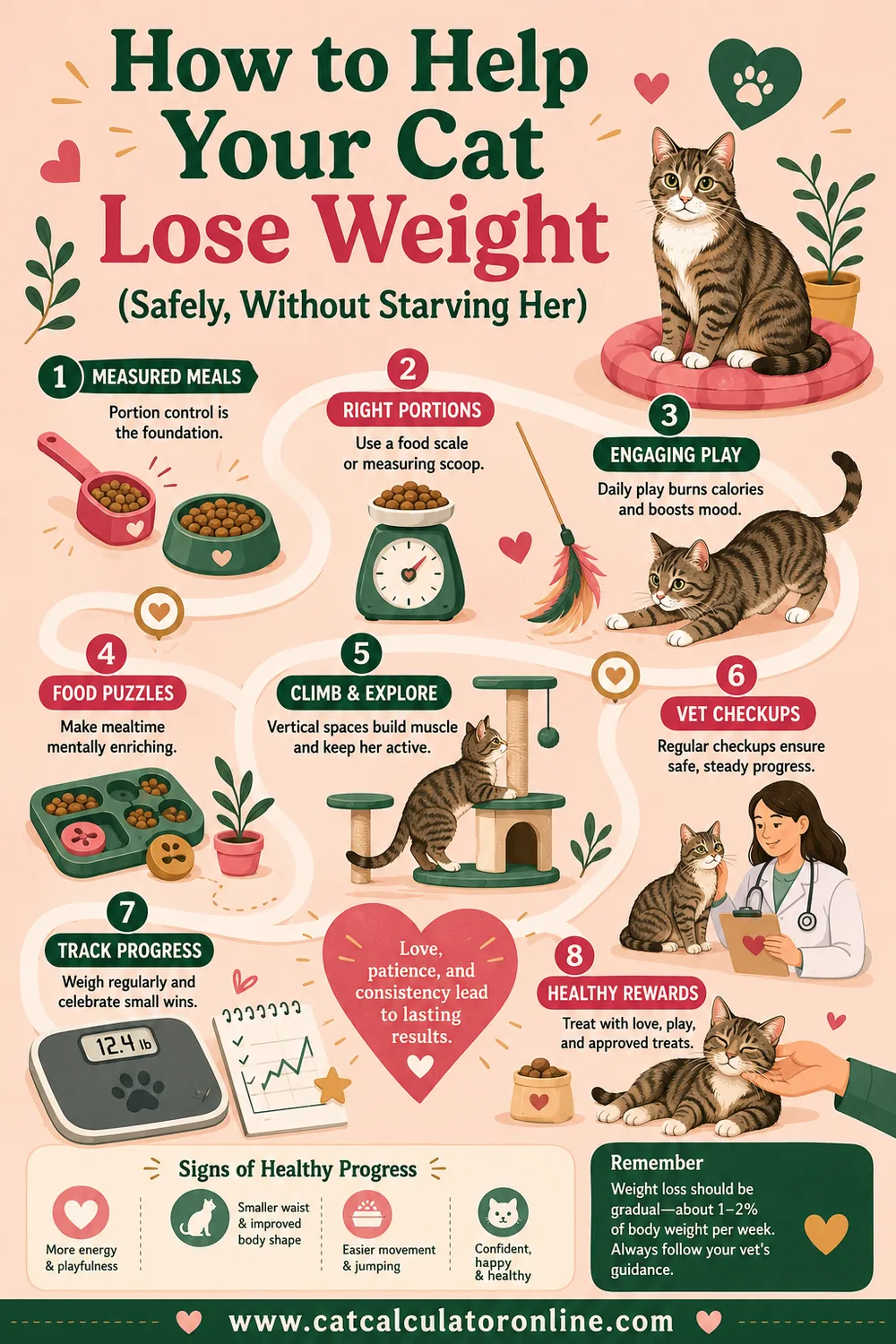
If your cat carries extra weight, play earns a second job: it's one half of any feline weight-loss plan, alongside measured feeding. How to help your cat lose weight covers how the two work together.
Why Do Short Bursts Work Better Than Long Sessions?
Because cats are sprinters, not joggers. A hunting cat in the wild doesn't chase prey for an hour — she stalks patiently, explodes into a few seconds of action, and then rests. Her whole body is built around that rhythm: brief, intense effort followed by recovery.
Play that respects the rhythm works dramatically better:
- 10–15 minutes is the sweet spot. Long enough for several stalk-pounce cycles, short enough that she finishes keen rather than bored.
- Intensity beats duration. Five minutes of a toy genuinely behaving like prey — darting, hiding, freezing — is worth thirty minutes of waving a wand in circles.
- Multiple sessions spread the benefit. Morning and evening sessions bracket the day far better than one long block. Cats are naturally most active around dawn and dusk, so those times land with the grain.
- Rest between bursts is part of the plan. Pauses mid-session — she crouches, stares, regroups — aren't disengagement. That's stalking. Let it happen.
This is also why a cat who "won't play for long" isn't broken. Walking away after twelve good minutes is a cat doing it correctly.
How Does Playtime Change With Age?
More than any other factor, age sets the dose. Here's the honest breakdown:
| Age | Sessions per day | Intensity | Notes |
|---|---|---|---|
| Kitten (under 1 year) | Many short sessions | High — she sets the ceiling | Play teaches hunting skills and burns huge energy; use toys, never hands or fingers |
| Young adult (1–6 years) | 2–3 × 10–15 min | Moderate to high | The 20–40 minute baseline fits best here |
| Mature adult (7–10 years) | 2 × 10–15 min | Moderate | Keep it daily — this is when weight quietly creeps on |
| Senior (10+ years) | 1–2 × 5–10 min | Gentle, low to the ground | Slow wand games; movement protects joints and mind |
Kittens are the easy case — they'll take everything you can give in short bursts, and play is genuinely how they learn to be cats. The one firm rule: never let hands, fingers or toes be the toy, however cute the pouncing is at nine weeks. You're setting the rules an adult cat will play by.
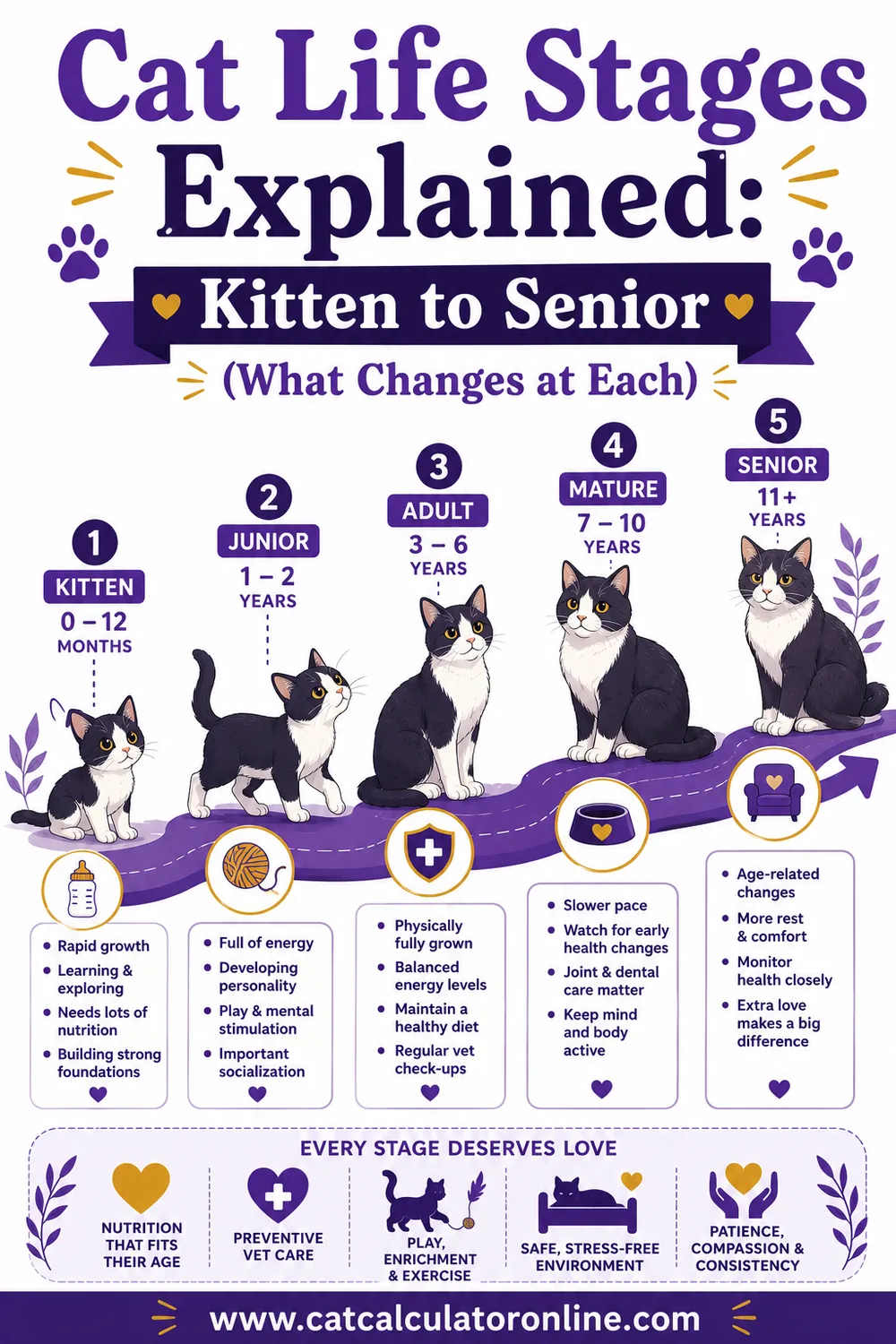
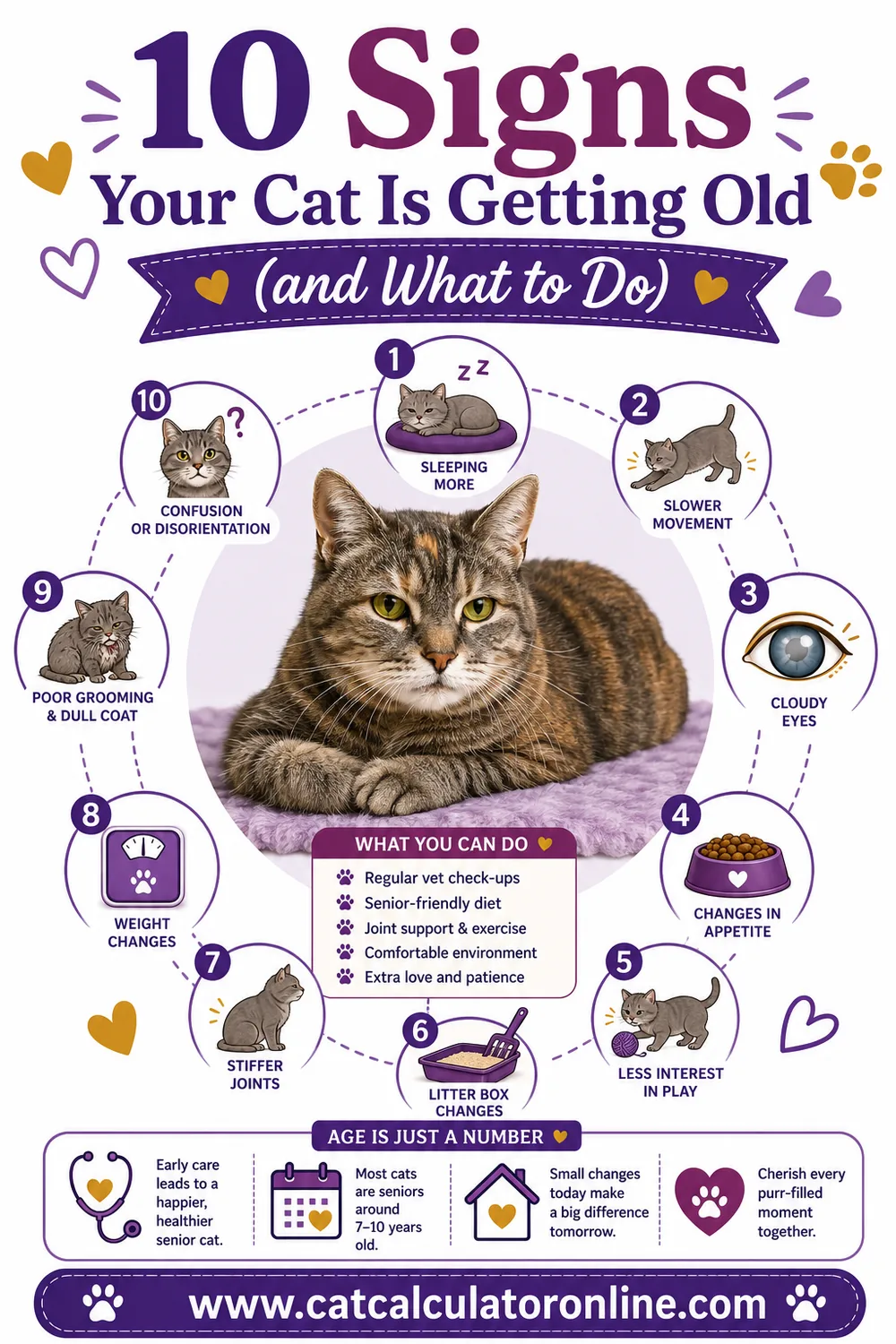
At the other end, senior cats still need daily play, just reshaped: shorter, slower, closer to the ground, on her schedule. If she's stiff, hesitant to jump, or slowing down more than expected, mention it at the next vet visit — signs your cat is getting old explains what's normal aging and what deserves a check. And if you're not sure which row of the table is yours, cat life stages explained and the cat age calculator settle it quickly.
What's the Best Way to Structure a Play Session?
Copy nature. A cat's instinctive daily loop runs hunt → catch → eat → groom → sleep, and a play session that follows the script leaves her more satisfied than one twice as long that ignores it.
The four-step recipe:
- Hunt. Make the wand toy behave like prey: skitter it away from her, dart it behind furniture, freeze it, let it "hide." Prey never flies at a cat's face — movement away triggers the chase.
- Catch. As the session winds down, slow the toy like tiring prey, and let her catch it properly — a real grab, bite and kick. Skipping the catch leaves the hunt unfinished.
- Eat. Follow the catch with a meal or a small treat. Hunt ends, feast begins — the loop closes exactly the way her instincts expect.
- Groom and sleep. She'll take it from here. Wash, curl up, done.
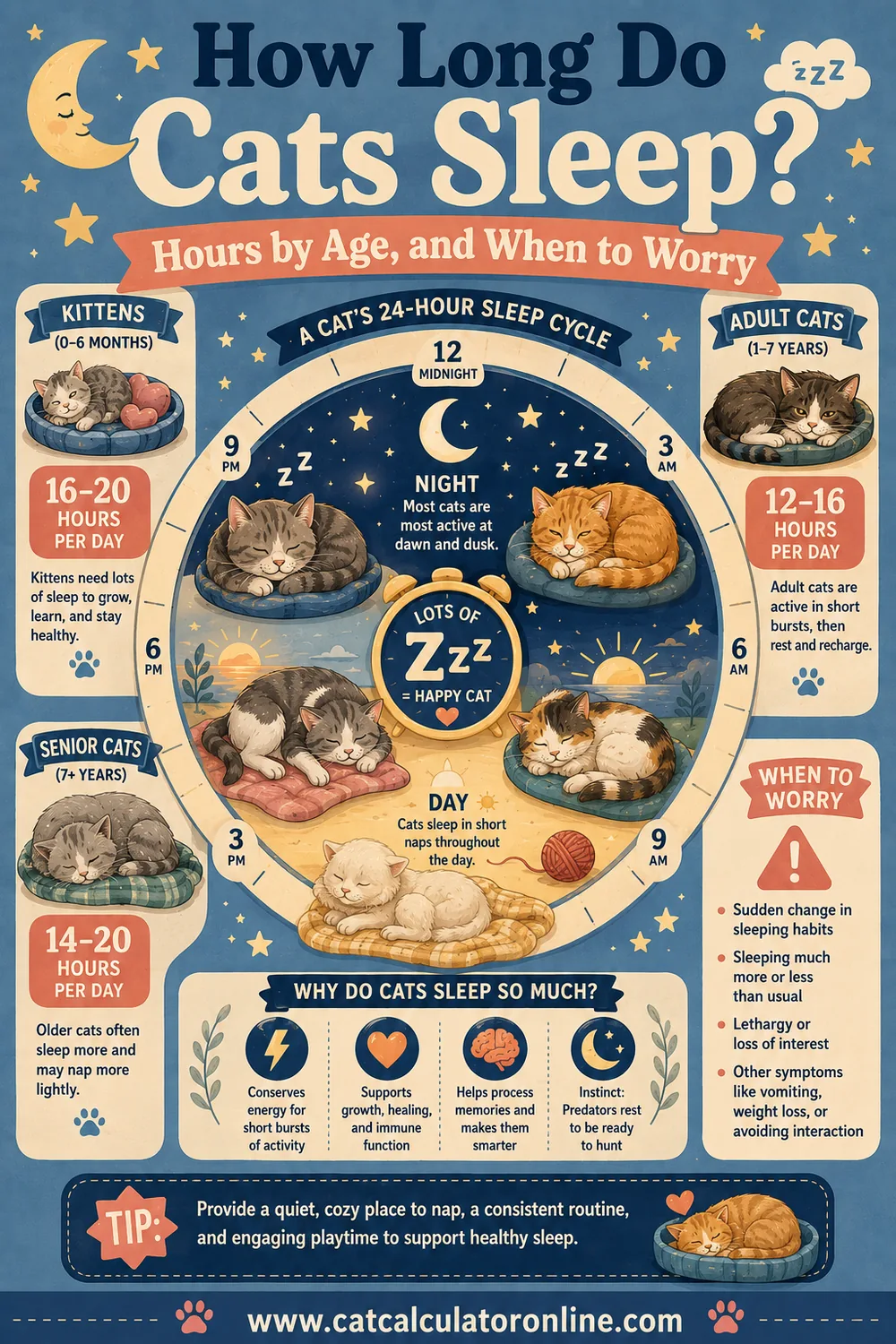
The evening version of this routine is quietly famous among cat owners, and for good reason: a hunt-catch-dinner sequence before your bedtime is the best fix there is for 4am wake-up calls. A cat who's hunted, caught, and eaten has ticked every box and has far less reason to audition as an alarm clock. Cats sleep a huge portion of the day anyway — how long do cats sleep has the numbers — and this routine nudges the deepest stretch of it into your night.
Which Toys Are Worth Your Time?
You don't need many — you need the right few, used well.
- Wand toys are the gold standard. Nothing else lets you make prey behave like prey. Keep wand toys put away between sessions so they stay special (and so nobody chews the string unsupervised).
- Laser pointers: fine as a warm-up, never the whole game. The dot triggers a perfect chase that can never end in a catch — and a hunt with no catch ends in frustration, not satisfaction. If you use one, always finish the session on a physical toy she can actually grab, then feed. Laser for the cardio, toy for the closure.
- Rotate the solo toys. Mice, balls and kickers left out permanently become invisible. Keep three or four out, store the rest, swap weekly — novelty is what makes a toy work.
- Kicker toys (long plush toys she can hug and bunny-kick) give her something satisfying to "defeat" and are a great session-ender.
- Free classics still win. A cardboard box turns any game into an ambush game — why do cats like boxes explains the pull — and a scrunched paper ball has outperformed expensive toys for generations.
One safety note: string, ribbon, elastic and tinsel are for supervised play only. Swallowed string is a genuine surgical emergency in cats, so wand toys live in a drawer between sessions.
How Do I Know My Cat Isn't Getting Enough Play?
Under-played cats broadcast it — just not politely. The classic signals:
- Ankle attacks. Pouncing on your feet as you walk past is hunting energy with no better target.
- Night zoomies and 4am yowling. Energy unspent by day gets spent at night, usually across your bed.
- Relentless attention-seeking. Knocking things off shelves, walking across keyboards, meowing at you for no clear reason — often a cat asking, in the only way she can, for something to do.
- Destructive scratching or over-grooming. Restlessness looking for an outlet. (For over-grooming, rule out medical causes with your vet first.)
- Weight gain. The quietest signal of all: a bored cat eats for entertainment and burns nothing.
The fix is rarely complicated. Add one genuine interactive session a day — evening if you can only manage one — and most of these behaviors shrink within a week or two. If they don't, or if a behavior change is sudden, loop in your vet: behavior shifts can also be the first sign a cat isn't feeling well.
What Are the Signs of Over-Stimulation During Play?
Play has an off switch, and cats flip it clearly if you know the signals:
- Tail lashing or thumping — the clearest one. A swishing, whipping tail mid-game means arousal is tipping past fun.
- Skin rippling along her back, flattened ears, or dilated pupils holding too long.
- Grabbing the toy — or your hand — harder, with real bites instead of play bites.
- Simply walking away. This one isn't over-stimulation at all: it's a cat saying "done for now," and it deserves the same response.
The response to all of them is the same: stop, and respect it. Let her settle, don't chase her with the toy for one more round, and try again later. Pushing past a lashing tail is how play sessions end in scratches — and how cats learn that playtime isn't safe. Short sessions that end while she's still keen build a cat who comes running when the wand drawer opens.
FAQ
How much playtime does a cat need per day?
A good baseline for adult cats is two or three interactive sessions of 10–15 minutes each — about 20–40 minutes total. Kittens need considerably more, in many short bursts; seniors do better with one or two gentler 5–10 minute games. Watch behavior, not just the clock.
Is 15 minutes of play enough for a cat?
One quality 15-minute session is far better than none, and for a mellow or senior cat it may genuinely be enough. Most adults are happier with two sessions. Make the minutes count: prey-like movement, a proper catch at the end, and food afterwards.
What is the best time of day to play with a cat?
Dawn and dusk, when cats are naturally most active. The single most useful session is the evening one: play, let her catch the toy, then serve dinner. That hunt-catch-eat sequence sets her up to sleep through the night instead of waking you at 4am.
Are laser pointers bad for cats?
Not bad, but incomplete. The dot can never be caught, and an endless hunt with no catch leaves cats frustrated. Use a laser as a warm-up if your cat loves it, but always end the session on a physical toy she can grab, followed by a meal or treat.
Why does my cat stop playing after a few minutes?
Because that's how cats are built — short, intense hunting bursts with rest between. Pauses to crouch and stare are stalking, not boredom, and walking away after ten good minutes is normal. Offer another session later rather than stretching one longer.
Do older cats still need playtime?
Yes — daily, but gentler. Short, slow, low-to-the-ground wand games keep senior joints moving, weight controlled and minds sharp. Let her set the pace, and if she seems stiff or reluctant to move, mention it to your vet rather than assuming it's just age.
The Bottom Line
Aim for two or three 10–15 minute interactive sessions a day, scale up for kittens and down (gently) for seniors, and structure every session the way instinct expects: hunt, catch, eat, groom, sleep. Use a wand toy as your main event, keep the laser as a warm-up act only, and read her signals — ankle attacks mean more play, a lashing tail means pause.
The right dose depends on where your cat is in life, so start there: the free cat age calculator gives you her life stage and human-age equivalent in seconds, and cat life stages explained shows how her needs — play included — shift from kittenhood to her senior years.