Cat Gestation Period: How Long Are Cats Pregnant? (Week-by-Week Timeline)
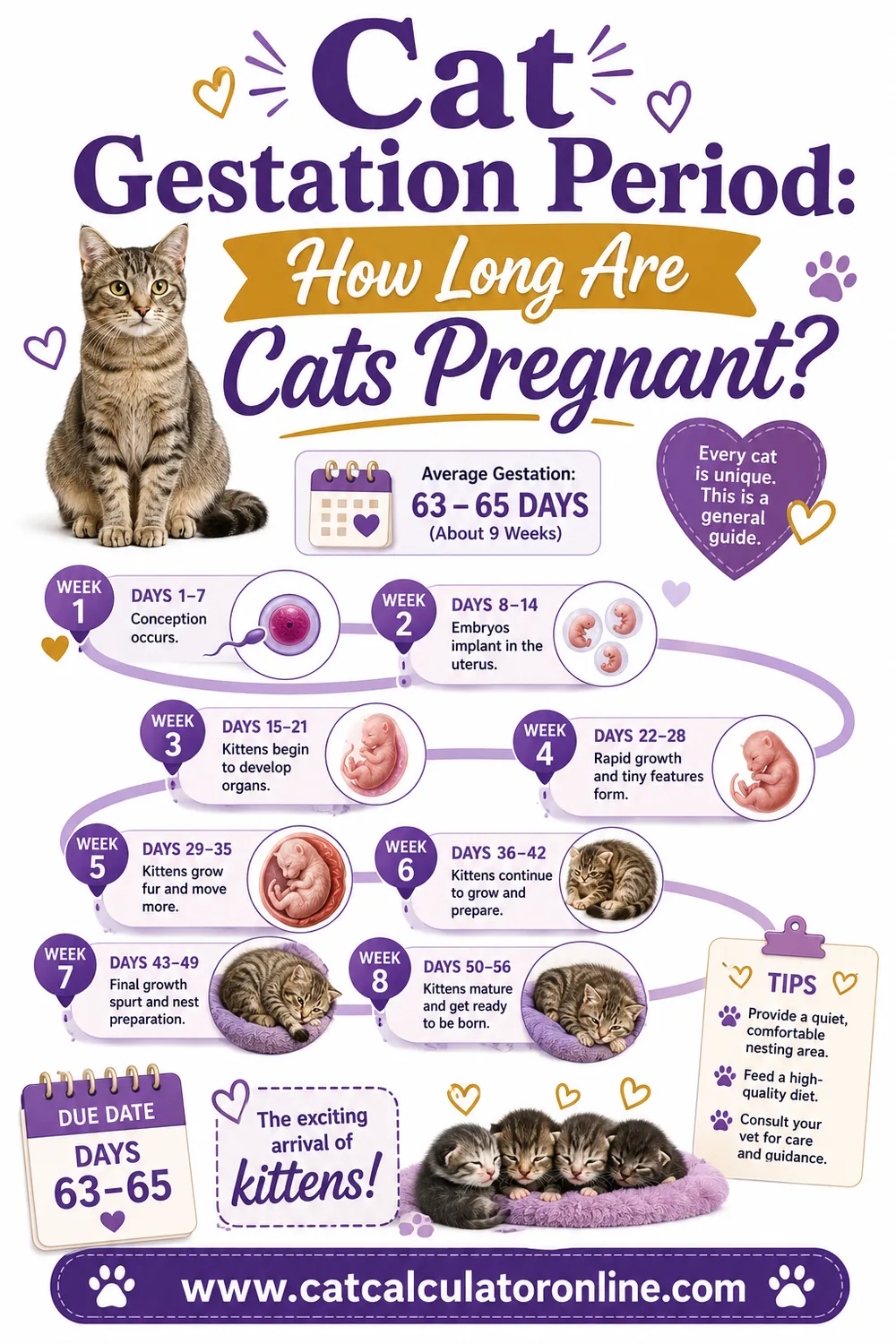
The cat gestation period is about 63 to 67 days — roughly nine weeks, with most litters arriving around day 64 or 65. That's just over two months from mating to kittens. Because the exact day of conception is hard to pin down, anything in that 63–67 day window is normal, and a healthy litter can occasionally show up a day or two on either side.
If you know roughly when your cat mated, you can map the whole pregnancy week by week. Tap a week in the mini-tool below to see the milestone, and use our free cat age calculator once the kittens arrive to track how fast they grow. One important note up front: spaying is the responsible, permanent way to prevent unplanned litters, and it's far kinder than managing repeated pregnancies — more on that at the end.
🤰 Cat pregnancy timeline — tap a week:
Tap a week above to see the milestone.
How Long Is a Cat Pregnant?
Cats are pregnant for about 63 to 67 days, averaging roughly 64 to 65 days — a little over nine weeks. Counted from a single known mating, most kittens arrive within that window.
The range exists for a simple reason: cats are induced ovulators, meaning the act of mating is what triggers a female to release eggs, and she'll often mate multiple times over a few days. That makes the true "day zero" fuzzy from the outside. The kittens develop on a very consistent internal clock; it's the starting line we can't always see clearly.
A few reference points that help with planning:
- Typical length: 63–67 days from mating
- Average: about 64–65 days
- Have supplies ready by: day 58–60, so nothing is missing if she's early
Breed doesn't change gestation length in any meaningful way — a petite Siamese and a big Maine Coon both carry for roughly the same nine weeks. What breed and individual cats change is litter size, not the calendar.
Cat Gestation Period at a Glance: Days, Weeks and Stages
If you just need the numbers, here is the cat gestation period in every format people ask about:
| Measure | Cat pregnancy length |
|---|---|
| In days | About 63–67 days (average about 64–65) |
| In weeks | About 9 weeks |
| In months | A little over 2 months |
| Supplies ready by | Day 58–60 |
| Call the vet if no labor by | Day 67–70 |
It also helps to think of the nine weeks as three rough stages of about three weeks each. These are not official medical "trimesters," just an easy way to remember what to watch for:
| Stage | Days | What you will notice |
|---|---|---|
| Early (weeks 1–3) | 1–21 | Almost nothing at first; nipples "pink up" near the end |
| Middle (weeks 4–6) | 22–42 | Vet can confirm; belly rounds out; appetite rises; movement may be felt |
| Late (weeks 7–9) | 43–65+ | Kitten count by x-ray; nesting; milk comes in; labor |
How to Work Out Your Cat's Due Date
If you know when your cat mated, finding her due window is simple: count forward 63 days for the start of the window and 67 days for the end. If she mated over several days, count from the first day and the last day and use the whole range.
| Mating date | Have supplies ready (day 58) | Due window (days 63–67) |
|---|---|---|
| March 1 | April 28 | May 3 – May 7 |
| June 20 | August 17 | August 22 – August 26 |
| October 14 | December 11 | December 16 – December 20 |
(These examples are for a non-leap year.) To skip the counting, our free cat pregnancy calculator can do the counting for you. If you do not know when she mated, your vet can estimate how far along she is from an ultrasound or x-ray, and the signs in the week-by-week table above give you a rough guide too.
How to Tell If Your Cat Is Pregnant
Early cat pregnancy is easy to miss. For the first couple of weeks, a pregnant cat looks and behaves completely normally. Here are the signs that show up as things progress, roughly in the order you'll notice them:
- "Pinking up" of the nipples (~3 weeks). Around day 15–18, the nipples become noticeably pinker and slightly enlarged. This is often the earliest visible clue, and it's especially clear in a cat that's never had a litter.
- A bigger appetite. As the pregnancy moves along, she'll start eating more to fuel the growing kittens.
- Weight gain and a rounding belly. From about week 4–5 onward, the abdomen fills out. Most cats gain roughly 2 to 4 pounds total across the pregnancy, depending on litter size.
- Calmer, more affectionate behavior. Many pregnant cats become extra cuddly and sleep more.
- Nesting (late). In the final week or so, she'll hunt for a quiet, safe, enclosed spot to give birth.
Home pregnancy tests made for humans don't work on cats. For real confirmation — and to know how many kittens to expect — you'll want your veterinarian:
| Method | When it works | What it tells you |
|---|---|---|
| Abdominal palpation | Day ~17–25 (varies) | An experienced vet may feel fetal "lumps" |
| Ultrasound | Day ~21–25 | Confirms pregnancy and heartbeats |
| Relaxin blood test | Day ~25–30 | Yes/no pregnancy confirmation |
| X-ray | Day ~40–45+ | Counts kittens once skeletons mineralize |
Cat Pregnancy Week by Week
Here's what happens across the roughly nine weeks of the cat gestation period. Use it alongside the quick timeline tool above.
| Week | Days | What's happening |
|---|---|---|
| 1 | 1–7 | Mating triggers ovulation; eggs are fertilized and begin traveling |
| 2 | 8–14 | Fertilized eggs reach and implant in the uterus |
| 3 | 15–21 | Nipples "pink up"; embryos develop rapidly |
| 4 | 22–28 | Belly starts to round; vet can often palpate; ultrasound confirms |
| 5 | 29–35 | Kittens grow quickly; appetite and weight climb |
| 6 | 36–42 | Kittens can be felt moving; belly clearly enlarged |
| 7 | 43–49 | Kittens develop fur; x-ray can count skeletons; set up nesting box |
| 8 | 50–56 | Milk may come in; mom seeks a nesting spot; slows down |
| 9 | 57–65+ | Nesting intensifies, appetite may drop, labor begins |
Weeks 1–2: Fertilization and Implantation
After mating, ovulation is triggered and the eggs are fertilized within a day or two. Over the next week and a half, the fertilized eggs travel down to the uterus and implant in the lining around days 12–14. Your cat looks and acts entirely normal. Don't change her food or routine yet — extra calories now just add fat, not healthier kittens.
Week 3 (Days 15–21): Nipples Pink Up
This is when the first clear sign usually appears: the nipples become pinker and slightly swollen, most obvious on a first-time mom. The embryos are developing fast beneath the surface. Keep her food and activity normal, and if you suspect pregnancy, this is a reasonable time to book that first vet visit.
Week 4 (Days 22–28): Confirmation and a Rounding Belly
Now pregnancy becomes confirmable. An ultrasound around day 21–25 shows tiny heartbeats, and an experienced vet may be able to palpate (gently feel) the developing kittens. Her belly starts to round out. Ask your vet about switching her gradually to a kitten formula or "all life stages" food — the higher calories and protein support the kittens through the rest of the pregnancy and nursing.
Week 5 (Days 29–35): Fast Growth
The kittens are growing quickly now, and mom's appetite and weight climb noticeably. Feed a bit more, and lean toward that higher-calorie kitten food. Keep handling of her belly gentle — the kittens are developing, and rough pressure isn't a good idea.
Week 6 (Days 36–42): Movement You Can Feel
There's no hiding it now. Her belly is clearly enlarged, and if you rest a hand gently on her sides while she's relaxed, you may feel the kittens move. Appetite keeps rising, but her stomach has less room, so smaller, more frequent meals work better than two big ones. An ultrasound or x-ray around this time can help confirm how many kittens to expect.
Week 7 (Days 43–49): Nesting Prep
The kittens are developing their fur and settling toward birth positions. After about day 42–45, an x-ray can count the skeletons — genuinely useful, because during delivery you'll know when she's finished. Set up a nesting box now in a quiet, warm, low-traffic spot, lined with soft washable bedding, so she has time to accept it as her own space.
Week 8 (Days 50–56): Milk Comes In
Milk may begin to develop, and you'll notice mom slowing down and spending more time in or near her chosen nesting spot. She's getting close. Keep the nesting area clean and undisturbed, and keep her food and water nearby so she doesn't have to travel far.
Week 9 (Days 57–65+): Labor Watch
In the final stretch, nesting intensifies — she'll dig at bedding, seek privacy, and become restless. Many cats stop eating in the last day or so before labor. Some breeders take twice-daily temperature checks; a drop can signal that labor is close, though cats are less predictable here than dogs. When active labor starts, most cats manage delivery calmly and privately on their own.
How Many Kittens Are in a Litter?
The average cat litter is about four kittens, but the normal range runs from 1 to 8 or more. First-time mothers tend to have smaller litters, and larger or more experienced cats often have bigger ones. Breed plays a role too — some breeds average larger litters than others.
The only reliable way to know the count before birth is a late-pregnancy x-ray (after about day 42–45), once the kittens' skeletons have hardened enough to show up. Knowing the number is genuinely helpful during delivery, so you can tell when she's finished.
Caring for a Pregnant Cat
Keep it simple and steady:
- Nutrition: normal food for the first few weeks, then a gradual switch to kitten or all-life-stages food from about week 5 through nursing. By late pregnancy she may eat noticeably more, split into small meals.
- Rest and calm: provide a quiet, safe space and minimize household stress and travel.
- Gentle handling: don't press on her belly; let her come to you.
- Vet care: confirm the pregnancy around week 3–4, ask about a late-term x-ray for the kitten count, and check before giving any medication, supplement, or flea/deworming product — several common ones aren't safe during pregnancy.
- Prepare the nesting box by week 7 so she has time to claim it.
Signs Labor Is Near
Watch for this cluster of signals in the final days:
- Nesting — digging at bedding, seeking a private, enclosed spot
- Restlessness and pacing, sometimes with vocalizing
- Refusing food in the last 24 hours or so
- A drop in body temperature (for owners tracking it)
- Licking of the genital area and a small amount of discharge as things begin
Once active labor starts, kittens usually arrive 30 to 60 minutes apart, though a rest between kittens can be normal. Most cats handle the whole process on their own and prefer to be left in peace.
Cat Labor Timeline: Stages and How Long It Takes
The end of the cat gestation period is labor, and it happens in three stages. Knowing them helps you tell normal from "call the vet."
| Stage | Typical length | What happens |
|---|---|---|
| Stage 1: Early labor | Often 12–24 hours, sometimes longer | Restlessness, nesting, panting or purring, hiding, refusing food. Contractions start but are not yet visible. |
| Stage 2: Delivery | Each kitten usually 30–60 minutes apart | Visible straining and pushing; kittens are born one at a time. Mom licks each one clean. |
| Stage 3: Afterbirth | Shortly after each kitten | The placenta passes after each kitten. Mom often eats it; this is normal. |
For a typical litter, the delivery stage often takes a few hours from first kitten to last, and a large litter can take longer. Some cats take a long rest partway through and then carry on, which can be normal if she is calm, comfortable, and nursing the kittens already born. If she is straining hard with no kitten, or seems distressed, use the checklist below and call your vet.
For more detail, see our guides on how long cat labor lasts, cat labor signs, and what to do when your cat gives birth.
When to Call the Vet
Have your vet's number and the nearest emergency clinic saved before the due window opens. Call right away if:
- She's clearly past day 67–70 with no signs of labor
- She has strong contractions for 30–60 minutes without producing a kitten
- More than 2–3 hours pass between kittens and you know more are coming
- There's heavy bleeding, or green/foul discharge before the first kitten arrives
- She seems weak, feverish, in pain, or distressed at any point
Trust your instincts — a "probably nothing" phone call during a birth is always the right call.
Spaying: The Responsible Choice
Here's the honest part. Cats are extraordinarily efficient breeders: a female can go back into heat within weeks of giving birth, kittens can reach sexual maturity as young as 4 months, and one unspayed female and her offspring can produce an overwhelming number of cats in just a few years. Shelters are already full.
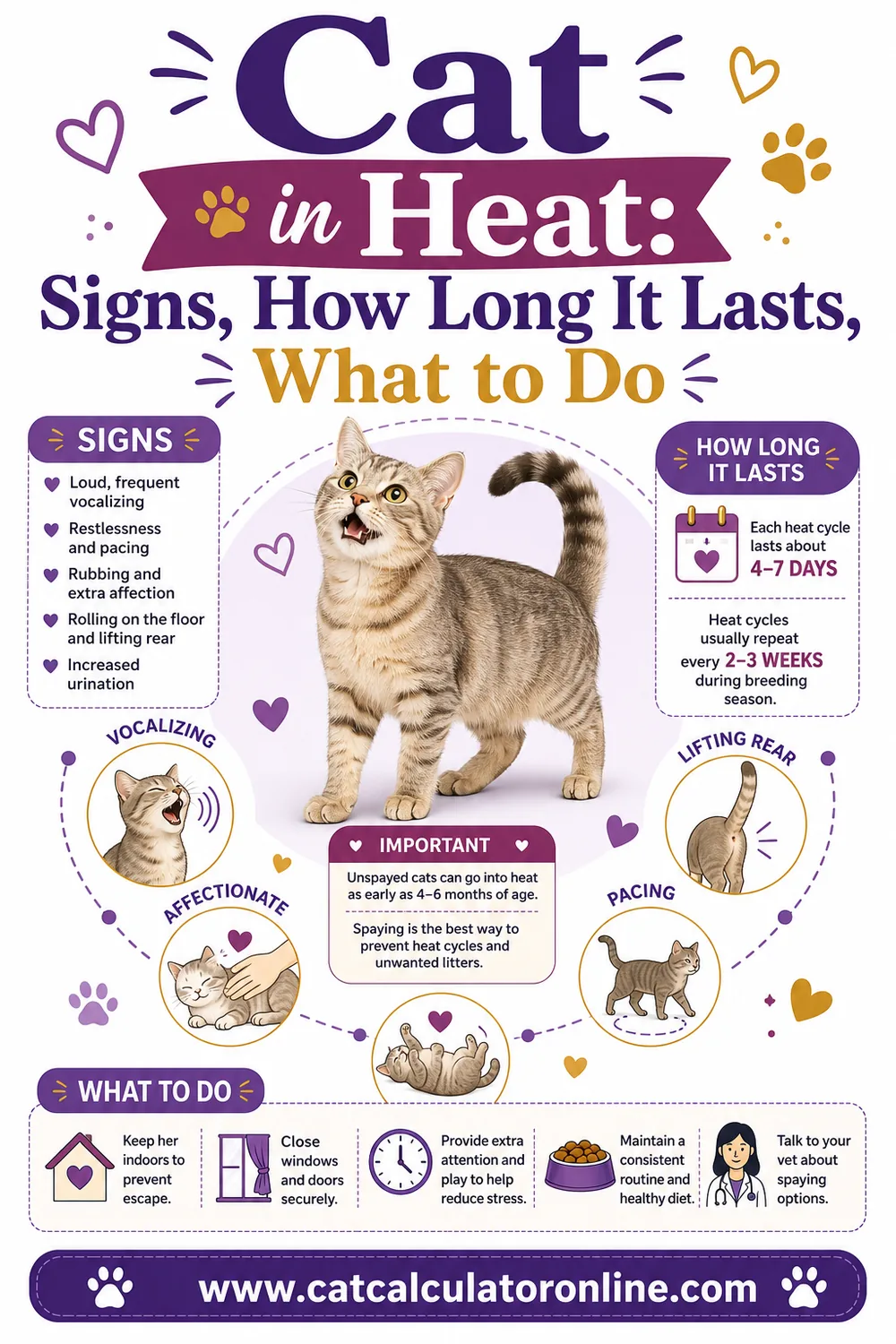
Unless you're a knowledgeable, intentional breeder, spaying your cat is the kind, responsible choice. Beyond preventing unplanned litters, spaying eliminates the stress of repeated heat cycles and greatly reduces the risk of certain cancers and a dangerous uterine infection called pyometra. If your cat is showing the restless, vocal, attention-seeking behavior of a cat in heat, talk to your vet about spaying — it's a routine procedure and a lasting kindness.
FAQ
How long are cats pregnant in months?
About two months. The cat gestation period is roughly 63 to 67 days, or nine weeks, averaging around 64–65 days — dramatically shorter than a human pregnancy.
What are the earliest signs a cat is pregnant?
The classic early sign is "pinking up" of the nipples around week three (day 15–18), when they become pinker and slightly enlarged. A bigger appetite, weight gain, a rounding belly, and calmer, more affectionate behavior follow over the next few weeks. A vet visit confirms it.
How many kittens do cats usually have?
The average litter is about four kittens, with a normal range of one to eight or more. First litters tend to be smaller. A late-pregnancy x-ray (after about day 42–45) is the only reliable way to count them.
Can I feel the kittens move?
Often yes, from around week six, if you rest a hand gently on your cat's sides while she's relaxed. Don't press firmly — let the movement come to you. If you're unsure, an ultrasound is the safe way to check.
How soon can a cat get pregnant after giving birth?
Surprisingly fast — a cat can return to heat and become pregnant again within just a few weeks of delivering a litter, even while still nursing. This is a major reason vets recommend spaying rather than allowing back-to-back pregnancies.
When can I spay my cat if she's pregnant?
Talk to your vet. A cat can be spayed while pregnant, and many vets recommend it to prevent unplanned litters when a home isn't lined up for the kittens. Your vet will weigh the stage of pregnancy and your cat's health and advise the best timing.
How long are cats pregnant in days?
About 63 to 67 days, with most cats giving birth around day 64 or 65. Counting from the first mating date, start getting ready around day 58 and call your vet if there are no signs of labor by about day 67 to 70.
Is the cat gestation period different for first litters?
The length of pregnancy is about the same for a first-time mother, roughly nine weeks. What tends to differ is the litter: first litters are often smaller. A first-time mom may also be more nervous, so a quiet, private nesting spot matters even more.
How long is a cat in labor?
Early labor (restlessness and nesting) often lasts 12 to 24 hours. Once delivery starts, kittens usually arrive 30 to 60 minutes apart, and a whole litter often takes a few hours. Call your vet if she strains hard for 30 to 60 minutes without a kitten or goes more than 2 to 3 hours between kittens when more are expected.
Can a cat get pregnant while nursing?
Yes. A cat can come back into heat and get pregnant again within a few weeks of giving birth, even while nursing her kittens. Read more in can cats get pregnant while nursing, and talk to your vet about spaying.
Count Down to Kitten Day
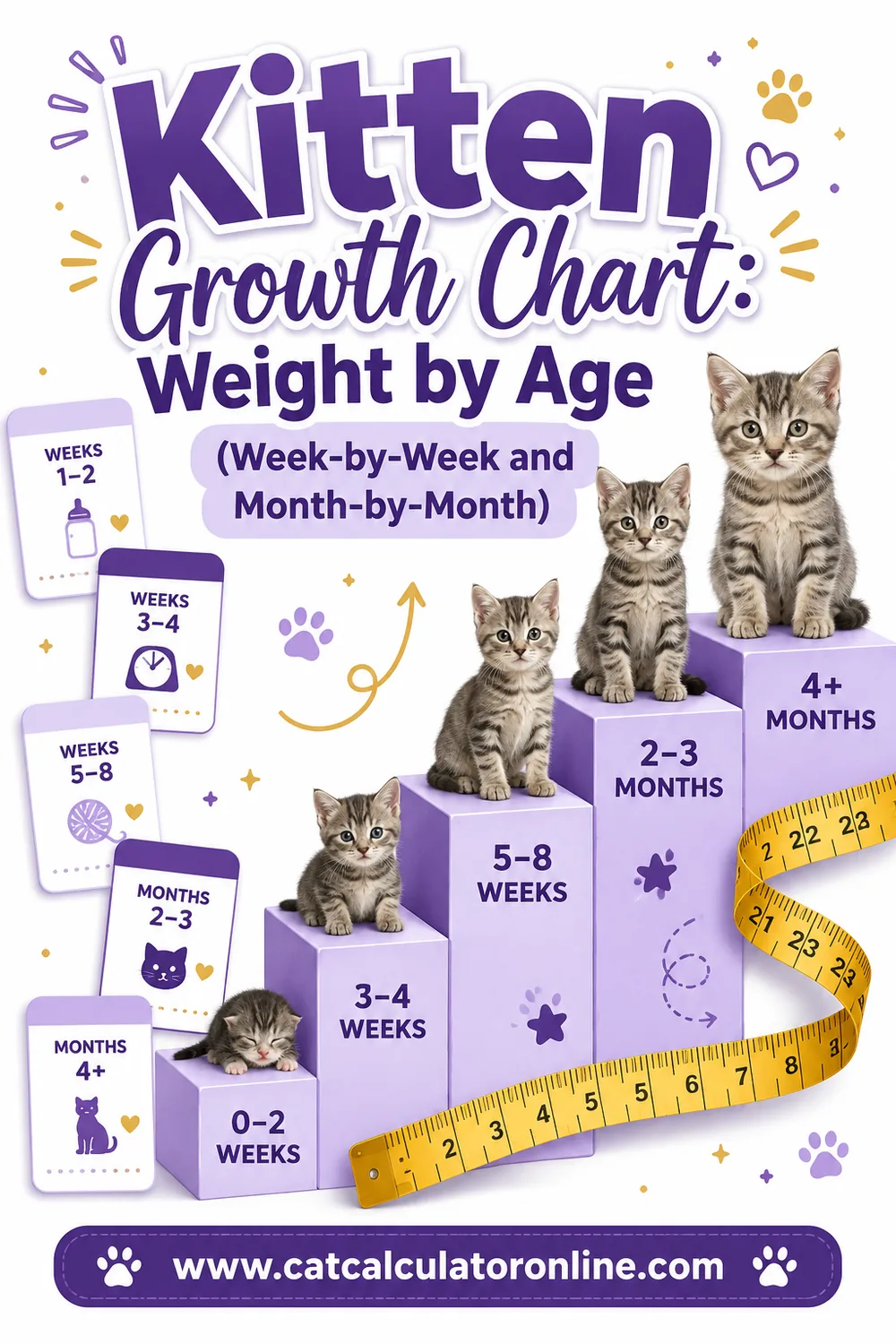
Nine weeks goes fast. If you know the mating date, mark it, prepare the nesting box by week seven, and have your vet's number ready by week eight — that covers most of good pregnancy management. Once the kittens arrive, our free cat age calculator and kitten growth chart help you track their weight and development week by week, and the new kitten checklist gets you ready for everything they'll need. And if pregnancy wasn't the plan, our guide to a cat in heat explains why spaying is the smart, humane next step.