Cat Vaccination Schedule by Age
The thing most owners get wrong about adult cats is assuming everything is annual. It is not — core vaccine components are commonly given every one to three years, and different parts of the same injection are due at different intervals. Panleukopenia protection is long-lasting and is typically boosted every three years in a low-risk adult, while the cat-flu components are often repeated annually in cats that mix with others. That is why your cat may see the vet every year but not receive every vaccine every year. Vaccination is also only one line in the yearly bill — the free cat cost calculator puts it in context.
What Happens After the Kitten Course
The first year sets the pattern, and then the schedule loosens.
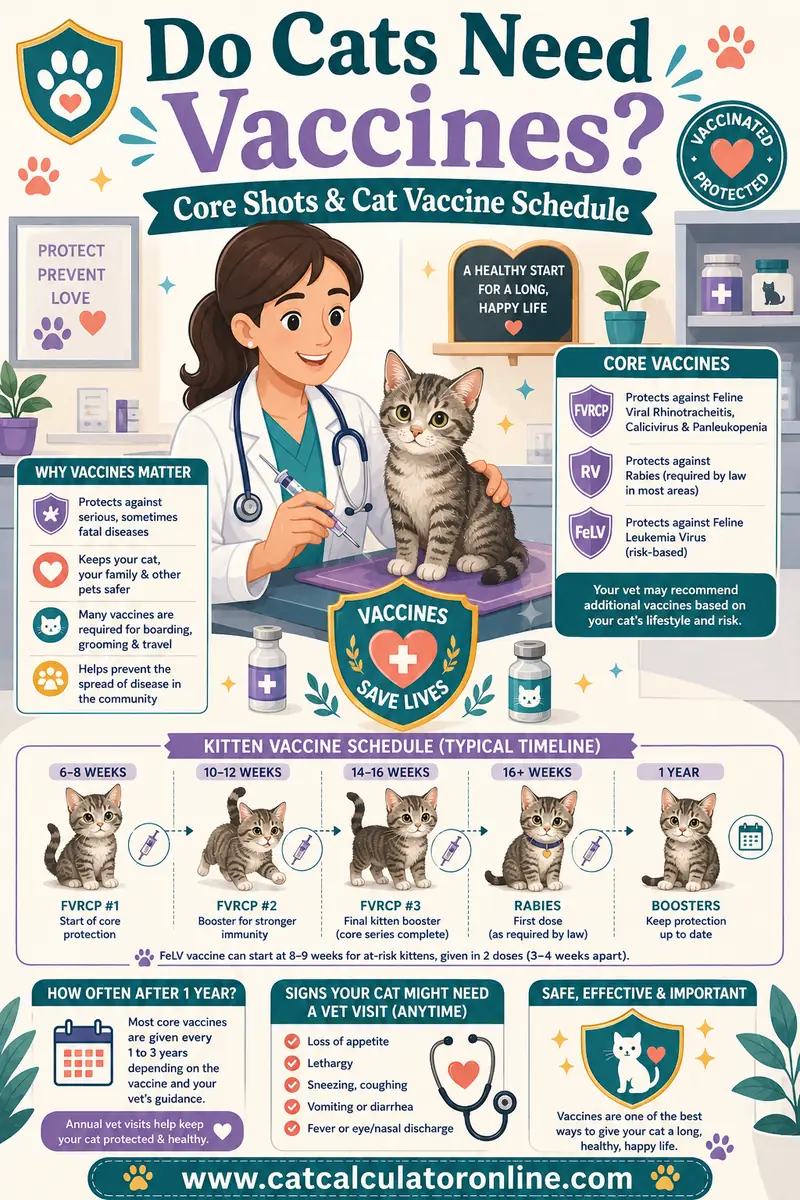
The primary course finishes at sixteen weeks or later. Kittens receive repeated doses every three to four weeks precisely because inherited maternal antibody can block a vaccine — the reasoning is set out in the kitten vaccination schedule.
The twelve-month booster is the important one. Given roughly a year after the primary course, it is what converts a kitten course into durable adult immunity. Skipping it undermines everything that came before, and it is the appointment most commonly missed because the cat seems perfectly well.
After that, intervals stretch. From the twelve-month booster onwards, core components are given every one to three years depending on the component, the product license and the cat's exposure.
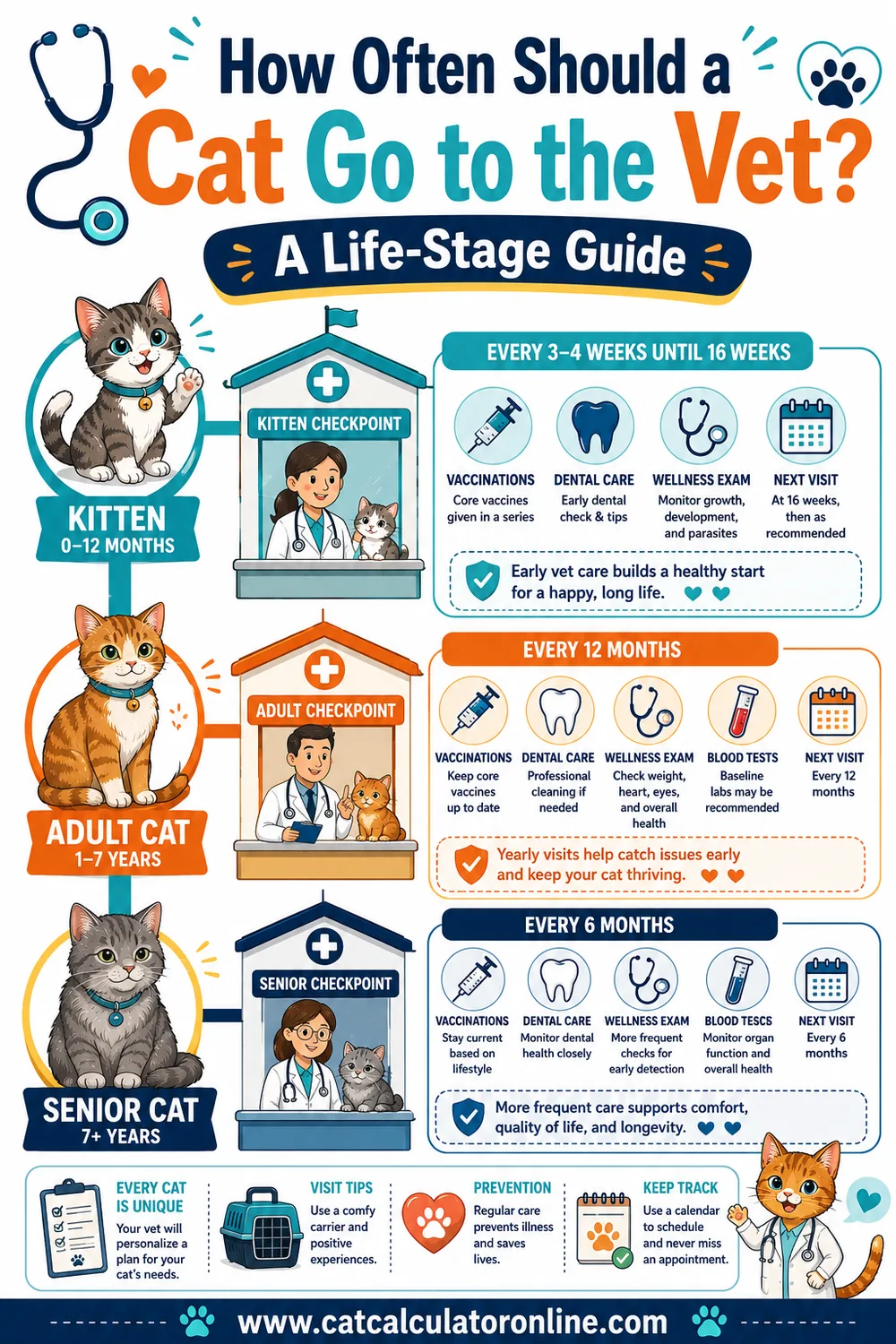
Annual health checks continue regardless. A cat that only needs a vaccine every three years still needs weighing, examining and having its teeth looked at yearly — more often once it is older. That is the point of the visit; the injection is incidental.
The specific product matters. Vaccine licenses differ between manufacturers and between countries. A three-year interval for one product may be a one-year license for another, and your vet works to the license in front of them.
Why Booster Intervals Differ Between Components
A single injection can contain components with genuinely different durations of immunity.
Panleukopenia protection is long-lasting. The vaccine produces strong, durable immunity — often measured in years, and in many cats considerably longer than three. Guidelines therefore put it on a three-yearly cycle for adult cats after the twelve-month booster.
The cat-flu components are weaker. Herpesvirus and calicivirus vaccines reduce the severity of disease rather than preventing infection outright, and the protection they give wanes faster. For cats with real exposure — outdoor access, multi-cat homes, cattery stays, shows — these are frequently given annually.
So the injection you get may vary year to year. Some products are formulated so the flu components can be given on their own, with the full combination given less often. Others are combined and therefore given together on whichever schedule the practice uses.
FeLV follows exposure. Boosted every one to three years in cats with outdoor access or contact with unknown cats; often discontinued in a genuinely indoor-only adult after discussion with the vet, since susceptibility falls with age.
Rabies follows the law, not the biology. Where it is legally required, the interval is set by legislation and the product license — commonly one or three years — and legal requirements override any general recommendation.
Ask what your cat is actually being given. "The annual booster" is a shorthand, and the honest answer varies. The vaccination card records each component.
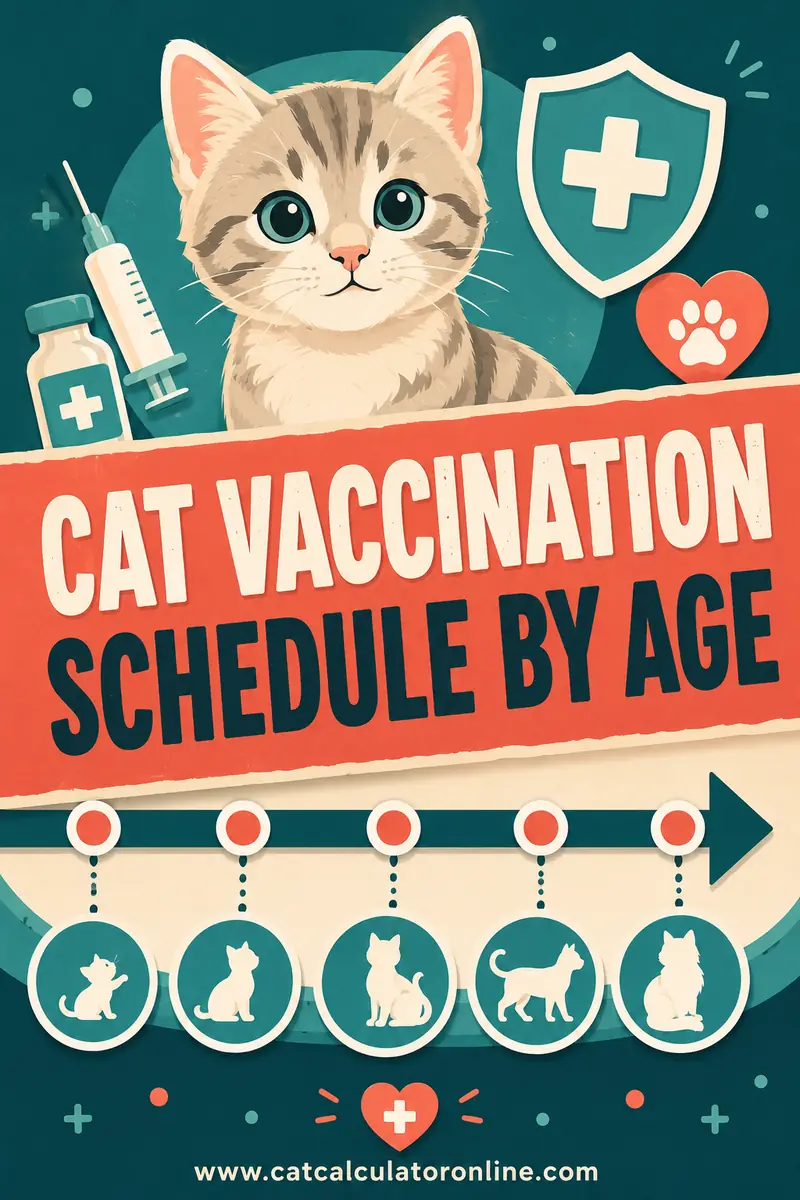
The Cat Vaccination Schedule by Age
Typical timings for a healthy cat. Your vet adjusts these to the product, your cat's lifestyle and local guidance.
| Age | Core vaccination | Non-core / notes |
|---|---|---|
| 6–16 weeks | Primary kitten course, doses every 3–4 weeks, final dose at 16 weeks or later | FeLV two doses; rabies where required by law |
| 12 months | First booster — the one that consolidates the course | FeLV booster; rabies booster where required |
| 1–6 years | Core components every 1–3 years depending on component and exposure | FeLV every 1–3 years if outdoor access continues |
| 7–10 years | Same intervals; annual health check becomes more valuable than the injection | Weight, kidney and thyroid screening usually added |
| 11+ years | Vaccination continues — older cats respond less well, so lapses matter more | Six-monthly health checks commonly advised |
| Any age, lapsed 1 year+ | Often restarted as two doses 3–4 weeks apart | Confirm with the practice; policies differ |
Note what is not in this table: an automatic annual injection of everything. That model has been steadily replaced by risk-based intervals over the past two decades.
Costs vary widely by what is included — a single booster is a very different price to a full kitten course, and how much do cat vaccinations cost sets out realistic ranges.
Do Indoor-Only Cats Need Boosters?
Yes, and the reason is one specific virus.
Panleukopenia does not need a cat to travel. It is a parvovirus: extremely stable in the environment, resistant to many household disinfectants, and capable of surviving for months. It comes indoors on shoes, on clothing, on a visitor who owns cats, on a delivery driver's soles.
It is also severe. In an unvaccinated cat it causes profuse vomiting and diarrhea, immune collapse and frequently death. This is not a theoretical risk — outbreaks recur, particularly where vaccination rates have dipped.
Plans change more often than owners expect. Cats escape through open windows. Households move. A cat needs a cattery at short notice for a family emergency, and catteries require proof of vaccination. A cat that is up to date is not a problem in any of those situations.
Flu components can often stretch further indoors. A single indoor cat with no contact with other cats has a genuine case for a longer interval on herpesvirus and calicivirus. That is a conversation to have, not something to decide unilaterally.
FeLV is the one that can often be dropped in a strictly indoor adult, once the kitten doses are done, because transmission requires prolonged close contact with an infected cat.
The indoor-versus-outdoor decision affects more than vaccination — lifespan, parasites, injuries and insurance all move with it, as indoor vs outdoor cat sets out. Whether cats need any vaccination is covered directly in do cats need vaccines.
Higher-Exposure Cats: Outdoors, Multi-Cat and Catteries
Some cats sit at the frequent end of every interval, and it is worth knowing whether yours is one.
Outdoor cats meet unknown cats. Fights, shared territory and mutual grooming are how FeLV and cat flu move. Annual flu components and maintained FeLV cover are the norm here.
Multi-cat households amplify everything. More cats means more circulating virus, more stress, and more herpesvirus flare-ups. Households over about five cats are functionally a small colony.
Rescue, fostering and breeding raise the bar further. Anyone taking in cats of unknown status should expect a stricter protocol, including additional non-core vaccines such as chlamydia in colonies with a known problem.
Catteries have their own rules. Most require full core vaccination with the last dose given at least seven to fourteen days before arrival, and many now ask for it within the last twelve months regardless of a three-year license. Check the specific cattery's policy well in advance — this is the single most common reason a booster becomes urgent.
Shows and competitions typically require documented vaccination too, sometimes including components a pet cat would not receive.
Traveling abroad changes everything. Rabies vaccination, timings and paperwork are governed by law and by the destination country, and the lead times are long. Start months ahead, not weeks.
A new cat joining the household resets the calculation. An existing indoor cat on stretched intervals is suddenly sharing air, bowls and grooming with an animal of unknown status, so review both cats' cover before the introduction rather than after it.
Tell your vet honestly what your cat does. Owners routinely describe a cat as indoor-only when it has unsupervised garden access, or as a non-hunter when it brings home a mouse a month. The interval chosen is only as good as the description it is based on.
Senior Cats: Does Vaccination Ever Stop?
There is a widespread assumption that old cats can be left alone. It is mostly wrong.
Immune function declines with age. Older cats mount weaker responses to both infection and vaccination, which is an argument for keeping cover current rather than for abandoning it.
Infections hit seniors harder. A bout of cat flu in a fourteen-year-old with kidney disease is a considerably more serious event than the same infection in a three-year-old.
Intervals are more often adjusted than stopped. A vet may lengthen intervals for a strictly indoor senior, or prioritize particular components, based on that individual cat.
Genuinely unwell cats may have vaccination deferred. A cat that is immunosuppressed, receiving certain treatments, or acutely ill is usually not vaccinated that day — a clinical decision, not a permanent exemption.
The health check becomes the main event. From about eleven years, six-monthly examinations with weight tracking and blood pressure, kidney and thyroid screening catch far more than any injection prevents. How to care for a senior cat covers what those visits should include, and how often a cat should go to the vet covers the frequency at every stage.
Do not quietly stop attending. Cats hide illness, and an owner who stops booking because "she is old and never goes out" removes the only routine check she gets.
Lapsed Vaccinations and Titre Testing
Two questions that come up constantly, with fairly clear answers.
A short overrun is usually absorbed. A booster a few weeks late is generally given as a single dose and the schedule resumes.
Over about a year late, many practices restart. That commonly means two doses three to four weeks apart rather than one, on the basis that protection can no longer be assumed. Policies differ between practices and products, so ring and ask.
Restarting is not a punishment or an upsell. It is the same logic as an adult cat with no history: two doses is the standard adult primary course because there is no maternal antibody to work around.
Titre testing measures antibody, not immunity. A blood test can show whether a cat has antibodies to panleukopenia, and a good titre is reasonably reliable evidence of protection for that virus.
It works far less well for the flu components. Antibody levels correlate poorly with protection against herpesvirus and calicivirus, so a titre result there tells you much less.
It is usually not cheaper. Titre testing typically costs as much as or more than the booster it might avoid, so the case for it is philosophical rather than financial for most owners.
Parasite control runs on a completely separate clock, far more frequently than vaccination — the cat worming schedule sets out how that timetable works.
Reactions and Injection Site Advice
Brief, because the risks are small but worth recognizing.
Mild reactions are common and self-limiting. Lethargy, reduced appetite and a slightly sore spot for a day or two need nothing done.
A lump at the injection site should resolve. Report any lump still present after three to four weeks, any lump larger than about three-quarters of an inch (2 cm), and any lump that is growing. That is the standard guidance and it is specific for a reason.
Injection-site sarcoma is rare but real. It is why vets now vaccinate in a limb or the flank rather than between the shoulder blades — a tumour in a limb is far more treatable. If your practice injects in an unusual spot, that is why.
Anaphylaxis is very uncommon. Facial swelling, hives, vomiting, breathing difficulty or collapse within minutes to a couple of hours needs immediate veterinary attention.
Tell the practice about any previous reaction. It can be recorded, and future vaccinations planned around it — sometimes with pre-medication, sometimes by splitting components across visits.
Do not skip food. A cat that is subdued after a vaccination should still be offered its normal meal; cats should never be fasted, and a cat refusing food for more than a day warrants a call.
Frequently Asked Questions
How often do adult cats need vaccinations?
After the twelve-month booster, core components are generally given every one to three years. Panleukopenia is usually three-yearly in low-risk adults, while the cat-flu components are often annual in cats with outdoor access or contact with other cats. Your vet works to the product license.
Do cats need vaccinations every year?
Not necessarily every vaccine every year, but an annual health check is still recommended, and some components are given annually in higher-exposure cats. The blanket annual model has largely been replaced by risk-based intervals, so ask which components your cat is actually receiving.
Do indoor cats need vaccinations?
Yes. Panleukopenia is a hardy virus that can be carried indoors on shoes and clothing, and it is severe. Indoor cats may be able to take longer intervals on the cat-flu components, and FeLV can often be dropped in adulthood, but core cover should be maintained.
What happens if my cat's booster is overdue?
A few weeks late is usually given as a single dose. More than about a year overdue, many practices restart the course with two doses three to four weeks apart, because protection can no longer be assumed. Ring your practice, as policies vary by product.
At what age do cats stop needing vaccinations?
There is no age at which vaccination routinely stops. Older cats mount weaker immune responses and suffer more from infection, so intervals are more often adjusted than abandoned. Vaccination is deferred only when a cat is acutely unwell or immunosuppressed.
Can I get a titre test instead of a booster?
For panleukopenia, a titre test gives reasonably reliable evidence of existing protection. It works much less well for herpesvirus and calicivirus, where antibody levels correlate poorly with immunity. It also usually costs at least as much as the booster it would replace.
The adult cat vaccination schedule is less regimented than most owners assume: the twelve-month booster is the one fixed point, and after that core components run on one to three-year intervals depending on the vaccine, the product and how much your cat mixes with other cats. Indoor-only cats still need core cover because panleukopenia travels on shoes, seniors need it more rather than less, and a booster more than a year overdue often means restarting with two doses. Keep the annual health check whatever the injection interval says, and see where vaccination sits in the yearly budget with the free cat cost calculator.